Turkmenistan might be rich in oil and gas, but the country’s true wealth is its people. Human capital represents the combined health, knowledge, and skills of a country’s people. According to the World Bank, human capital explains two-thirds of the difference in wealth between countries. For example, the countries in Europe and Central Asia (ECA) could experience a 30% increase in wages if they were able to catch up to the human capital levels of the region’s more developed economies.
The HCI+ index calculates how much productive potential a child born today will acquire by the time they reach adulthood. For Turkmenistan, the data reveals a clear path forward: while the foundations are in place, there are significant gaps to bridge to ensure a prosperous future.
Source: The World Bank.
Turkmenistan’s Performance: The Three Pillars
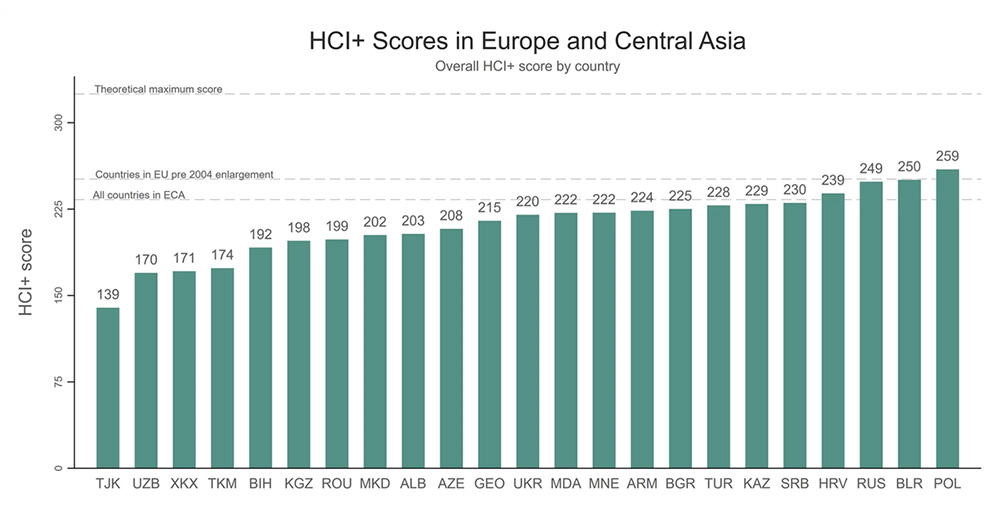
Turkmenistan currently holds an HCI+ score of 174 out of a theoretical maximum of 325. This leaves a gap of 151 points. Here is how the country performs across the three vital pillars:
- Health (44/50): This is Turkmenistan’s strongest area. The probability of surviving to age 60 is 84.7%, and the “No Stunting” rate (a measure of early childhood nutrition and growth) stands at 92%.
- Education (112/188): Children can expect 11.6 years of schooling. However, the Tertiary Completion Rate is low at only 13.4%, and school quality scores (445/625) suggest that time in the classroom isn’t always translating into high-level skills.
- Employment (18/87): This is the most significant area of concern. Only 48.2% of adults and 43.1% of youth are currently working. While those who do work are often in wage-paying jobs, more than half of the potential workforce remains on the sidelines.
The Comparison: Where Turkmenistan Stands
Turkmenistan trails behind its peers. Its score of 174 is lower than the Upper-Middle Income average (204) and significantly lower than the Europe & Central Asia regional average (240).
Donate to support Turkmen analysts, researchers and writers to produce factual, constructive and progressive content in their efforts to educate the public of Turkmenistan.
SUPPORT OUR WORKThe biggest “gaps” holding the country back compared to its neighbors are:
- Adult Employment: Accounts for 18 – 21 points of the gap with peer countries.
- Higher Education: The low university completion rate accounts for 14 to 22 points of the gap.
There is a notable difference between the potential of men (HCI+: 177) and women (HCI+: 171). While they have similar health and basic education scores, women fall significantly behind in tertiary completion rate: men 17.2% compared to women 9.5%, as well as in adults share at work men: 52.5% compared to women: 44.1%. This results in a 6-point gap in human capital for women which means that women in Turkmenistan currently have an earning potential 6% lower than men. Closing this gender gap alone would raise the entire nation’s future earnings by 3%.
The Path to Prosperity: How to Fix the Gaps
Turkmenistan has an opportunity for further improvement of 151 points (174/325). Each 10-point increase, which is achievable through targeted policy reforms, translates to roughly 10% higher future earnings.
- Improve School Quality: Raising the quality of learning in schools could lift expected earnings by a staggering 30.2%.
- Expand Higher Education: Increasing the number of students who finish university to regional standards could increase future earnings by 22.4%.
- Boost Employment: If Turkmenistan raised its adult work participation from 48.2% to the peer average of 72.8%, future earnings would jump by 17.7%.
- Target Health: While already strong, eliminating childhood stunting entirely would further strengthen the workforce and lift earnings by another 1.2%.
By focusing on keeping youth in school longer, improving the quality of that education, and creating more job opportunities, especially for women, Turkmenistan can close the 66-point gap with the rest of Europe and Central Asia, ensuring a wealthier and more resilient future for its citizens.