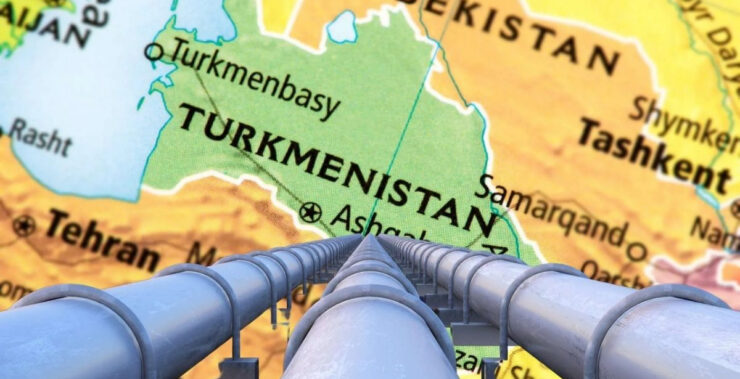
Turkmenistan sits atop one of the world’s largest natural gas reserves. The nation treats it as an infinite resource, providing heavily subsidized gas to its citizens. However, recent data from OurWorldInData aggregator reveals a startling anomaly: gas consumption – the total volume of gas used domestically for power generation, industry, and residential heating – fell by 25% between 2022 to 2024.
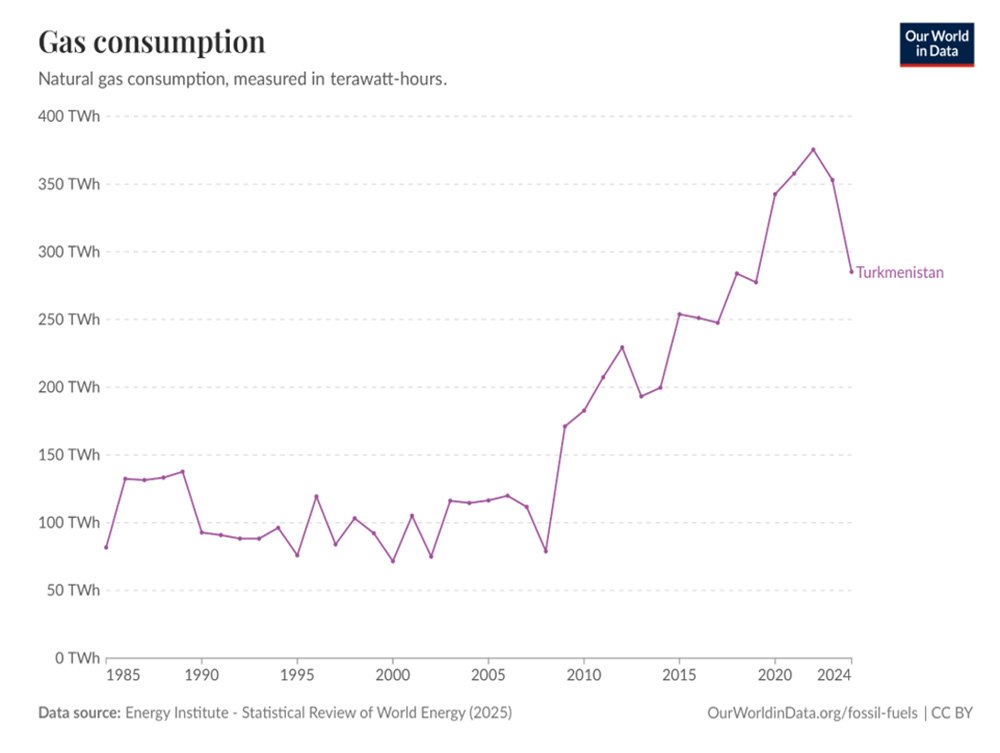
Source: OurWorldInData
In a country where renewable energy is non-existent and energy efficiency is not a policy priority, a double-digit contraction in energy use is not a sign of “going green.” While the government of Turkmenistan does not publish the detailed data necessary to isolate the exact drivers of this decline, the Progres Team has developed several educated hypotheses: mass emigration, industrial stagnation, the mitigation of methane leaks, or a fundamental decline in production.
Mass Emigration and Demographic Shift
One compelling explanation for this decline is a massive contraction in the consumer base. Turkmenistan’s borders remained notoriously closed for an extended period due to COVID-19, but the government began reopening them in 2023. This has likely triggered a “pent-up” wave of emigration. Faced with increased inflation and a lack of local jobs, many citizens are moving abroad to Turkey, Russia, Belarus, Uzbekistan, Kazakhstan, and the EU.
The scale of this exodus is significant:
- Turkey: In 2024, there were 205,369 Turkmen citizens officially residing in Turkey, though unofficial figures are likely higher.
- Russia: Turkmen tourists entered Russia 57,400 times in 2024, a 16-fold increase since 2022, possibly many are using tourist visas to seek work.
- Belarus: This destination saw 16,300 Turkmen labor migrants in 2024, an eightfold increase compared to 2023.
- Central Asia: Uzbekistan attracted roughly 89,000 Turkmens in 2024, with a significant number settling for work.
- EU: The number of residence permits issued to citizens of Turkmenistan in the EU increased dramatically since 2021 reaching almost 3,500 by 2024.
Since domestic heating, cooking, and electricity account for a large portion of primary gas use, thousands of suddenly empty households would cause domestic consumption to mirror this demographic decline.
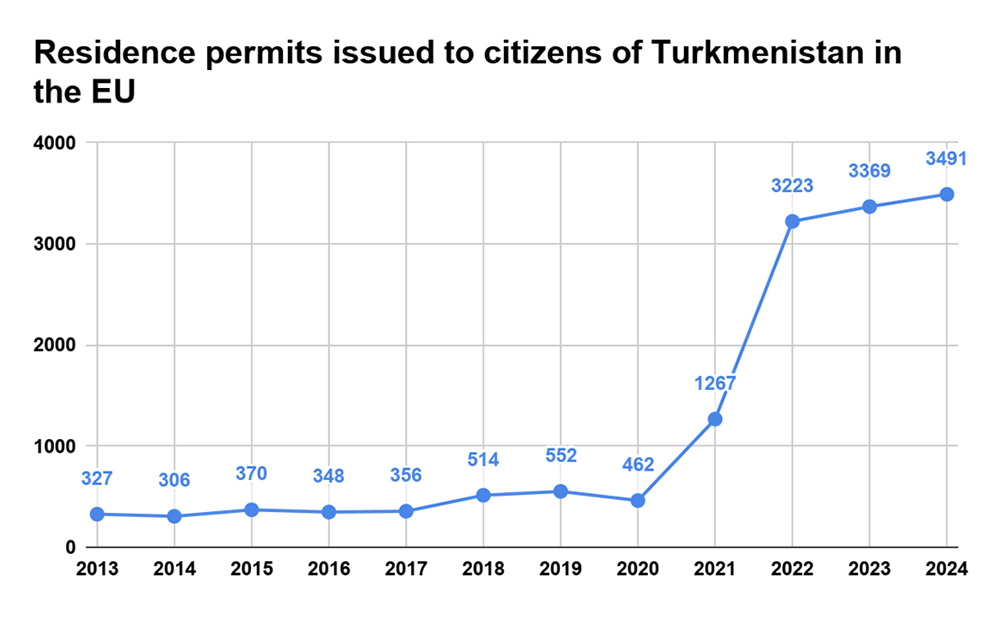
Source: Eurostat
Industrial Stagnation
Turkmenistan’s energy-intensive industry is centered on gas-to-chemicals and gas-to-liquids production, for example fertilizer production or petrol production via Fischer-Tropsch technology. If industrial output stalls, energy consumption declines. A failure in a major fertilizer plant or a gas-to-liquids facility would remove a massive chunk of “consumption” from the national statistics. A few reports of such failures were found in the news, but the extent of their impact is unknown.
Reduced Electricity Exports
Turkmenistan converts gas into electricity for export to neighbors like Afghanistan and Uzbekistan. If these neighbors import less electricity from Turkmenistan, the gas “consumed” to generate that electricity declines. There are some signs that Uzbekistan may be reducing its imports of electricity as they ramp up their renewable energy installations, but not sufficient to explain a 90 TWh decline in Turkmenistan’s gas consumption.
Mitigation of Methane Leaks
Turkmenistan has historically been one of the world’s leading “super-emitters” of methane. Massive leaks from poorly maintained pipelines were often folded into “consumption” statistics as fugitive emissions. In 2023 and 2024, international pressure led to technical partnerships aimed at plugging these leaks. If successful, the reported gas consumption would drop. In this scenario, the gas isn’t “missing” from the economy; it’s simply no longer being wasted into the atmosphere. However, it is currently impossible to confirm how much of the decline is associated with leak mitigation, as new reports suggest the mega-leaks persist in Turkmenistan.
Donate to support Turkmen analysts, researchers and writers to produce factual, constructive and progressive content in their efforts to educate the public of Turkmenistan.
SUPPORT OUR WORKDeclining Natural Gas Production
Data suggests that the problem may start at the source. Between 2022 and 2024, Turkmenistan’s gas exports fell by 23.4% (10.4 bcm). Simultaneously, reports indicate a decline in production: from 78.34 bcm in 2022 to 77.6 bcm in 2024. This trend was exacerbated by massive technical failures at the Galkynysh field during the winters of 2023 and 2024. While a production drop of roughly 1%-2% does not fully account for a 25% drop in consumption, it highlights a tightening of the total energy supply.
Modernizing Energy Infrastructure
Another factor is the gradual modernization of the power grid. Turkmenistan has been replacing inefficient Soviet-era turbines with Combined-Cycle Gas Turbines (CCGT). These modern plants can generate over 60% more electricity from the same amount of fuel by “recycling” waste heat. While a major new plant in the Mary region has been operational since 2018 and another is planned for 2027, the ongoing efficiency gains from existing upgrades may be reducing the amount of gas required to keep the lights on, even if the total power output remains steady.
Legacy of the Price Reform
Finally, the 2019 removal of state subsidies for gas, electricity, and water is likely still yielding results. The behavioral shifts, such as installing meters and repairing leaky home infrastructure, often take years to manifest in national statistics. The 25% drop may represent the “delayed” impact of citizens finally economizing their usage as free resources became a thing of the past.
Conclusion
A 25% drop in energy consumption in two years is typically only seen in nations at war or in the midst of a total industrial collapse. In the context of Turkmenistan, the falling energy consumption numbers tell a story the government won’t. The answer likely lies in a combination of all these factors, yet the exact contribution of each remains uncertain.
Note on the Source
Our World in Data is a highly respected scientific online publication produced in collaboration with researchers at the University of Oxford. It is widely considered one of the most trustworthy sources for global statistics because:
- Data Transparency: They do not “invent” data; they aggregate it from credible sources such as the Energy Institute’s Statistical Review of World Energy (formerly the BP Statistical Review).
- Open Access: All their datasets and methodologies are openly accessible.
- Global Credibility: Their charts and research are frequently used by the World Health Organization (WHO), the United Nations, and major academic journals to track global trends.
Due to limited transparency, data for Turkmenistan is often reconstructed through cross-referencing external sources and extrapolations. This process includes verifying activity via satellite imagery and trade partner records (like China or Russia) to ensure accuracy where official domestic reporting may be unavailable.