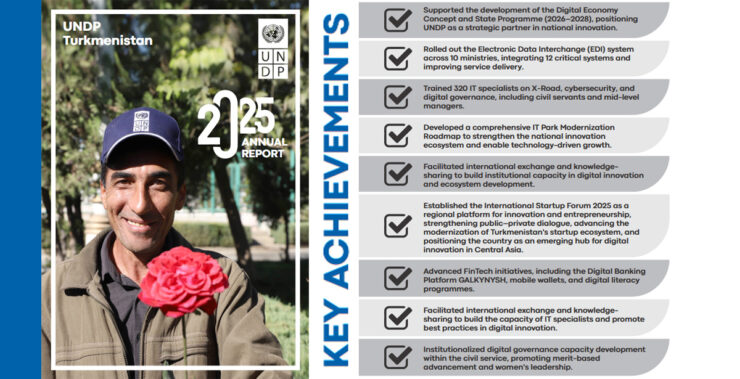
The 2025 UNDP Turkmenistan Annual Report serves as a comprehensive review of development initiatives and outcomes resulting from the collective work of UNDP staff, national authorities, civil society organizations, and various funding partners like the Global Environment Facility (GEF) and the Global Fund. By leveraging a USD 1.4 billion annual investment strategy across 32 Landlocked Developing Countries (LLDCs), the UNDP has helped Turkmenistan address geographic isolation through digital innovation, climate resilience, and enhanced human capital. Below is the brief summary of key areas of engagement and outcomes reached in 2025.
1. Digital Governance and Economic Modernization
In an effort toward “citizen-centered digital government” several initiatives were implemented to build the administrative and financial infrastructure:
- Infrastructure: The Electronic Data Interchange (EDI) system was rolled out across 10 ministries, integrating 12 critical systems.
- Electoral Integrity: The Central Election Commission adopted a Single Voter Registry and Voter Authentication Devices to ensure nationwide transparency.
- Capacity Building: 320 IT specialists were trained on X-Road interoperability and cybersecurity, while 80 senior digital officers and university faculty participated in specialized AI training in late 2025.
- Financial Inclusion: UNDP advanced the GALKYNYSH digital banking platform and mobile wallets.
- SDG Integration: The government adopted the Rapid Integrated Assessment (RIA) methodology for SDG budget tagging, directly linking national spending to global development goals.
2. Climate Action and Environmental Leadership
The “Sustainable Cities” project concluded delivering 32 regulatory instruments and achieving a total reduction of 1.02 million tCO₂-eq:
- Energy Savings: Replacing 300,000+ streetlights with LEDs saved 2.27 billion kWh. Grid modernization included upgrading 957 transformers and over 382,000 meters of power lines.
- Renewable Energy: A 35 kW solar plant in Avaza now reduces emissions by 104 tCO₂-eq annually.
- Waste Management: Ashgabat saw a 10% increase in recycling, processing 2,800 tonnes of waste.
- Land Conservation: Over 1.25 million hectares of land, including new protected areas and buffer zones, were placed under strengthened management.
3. Healthcare Strengthening and TB Control
Donate to support Turkmen analysts, researchers and writers to produce factual, constructive and progressive content in their efforts to educate the public of Turkmenistan.
SUPPORT OUR WORKHealth initiatives focused on diagnostic precision and patient-centric care:
- Tuberculosis (TB) Control: TB incidence rate dropped to 26.9 per 100,000, 661 TB patients received legal literacy sessions and 66 families received psychosocial support.
- Diagnostic Network: Supported 121 laboratories nationwide (86 primary, 22 secondary, and 13 tertiary) and deployed 6 AI-assisted ultraportable X-ray systems.
- Patient Care: 729 patients with multidrug-resistant (MDR-TB) and extensively drug-resistant (XDR-TB) were enrolled in treatment, including 88 patients co-infected with viral hepatitis C.
- Adherence Tools: 120 patients used video-supported treatment and 75 used smart pillboxes to ensure treatment completion.
- Outreach: Conducted 7,880 home visits and held 144 education sessions reaching 1,164 family members.
4. Youth Empowerment and Social Inclusion
Efforts to build a “creative economy” focused on providing market-oriented skills to the next generation:
- Employability: Initiatives led to 467+ job placements. 177 vulnerable youth received specialized TVET training in fields such as welding and IT literacy.
- Education: 732 youth completed professional courses via Coursera, while outreach reached 800+ government and community members to promote mentorship and critical thinking.
- Gender-Based Violence (GBV) Awareness: 92 healthcare specialists and 60 TB specialists were trained in GBV awareness. Notably, 44% of TB patients receiving psychosocial support were women. UNDP and UNFPA launched the “16 Days of Activism Against GBV” campaign, with sessions on preventing violence and addressing digital safety and online challenges.
Despite these gains, the report identifies ongoing hurdles facing Turkmenistan, including:
- Being Landlocked: Geographic isolation leads to significantly higher trade costs and lack of access to global markets.
- Climate and Environmental Hazards: The country faces urgent impacts from climate change, including droughts, dust storms, and land degradation in the Aral Sea Basin.
- Health Risks: The presence of MDR-TB and XDR-TB continues to require intensive enrollment and treatment.
- Social Issues: Addressing gender-based violence (GBV) and online safety challenges remains a priority for social cohesion.