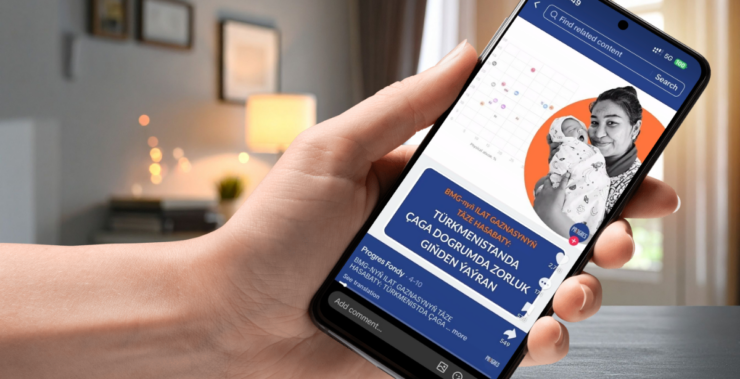
Progres Foundation is grateful to its readers for bravely breaking through a culture of silence to share their personal stories of obstetric violence and voice their desire for institutional reform. This overwhelming response is a powerful sign that Turkmen women are not as fearful as many assume; they are ready to speak out about their challenges and demand justice. This vital community dialogue erupted after the Progres team posted a summary of a UNFPA report, which revealed that two-thirds of surveyed women across 16 countries, including Turkmenistan, experienced abuse or non-consensual medical interventions during childbirth.
While only 11 women from Turkmenistan were included in the original study, the public response on our TikTok channel tells a vastly different story. Discussing the report’s findings erupted into a vital public forum, garnering over 173,200 views – making it the second most viewed post on our channel. It generated 174 raw, unfiltered comments from Turkmen citizens, primarily women sharing firsthand accounts of childbirth.
The data from our followers is clear. Nearly half of all commenters (47.1%) explicitly validated the report’s findings or shared personal stories of abuse, while only 21.3% reported positive experiences. The remaining 31.6% of the engagement consisted of emojis, emotional reactions, and fierce debates. For instance, when one user thanked doctors for good care and healthy deliveries, another retorted: “You must have a lot of money”. When another praised doctors for “treating her well and calling her dear, dear,” a peer responded, “You must have paid”.
Through these personal stories, women have broken cultural taboo to describe severe verbal and physical abuse:
- “They pulled my black hair, yelled, and cursed at me. I left empty-handed [without my baby]. I commend that doctor to God”. [“hakyky dogry mende boldy şu ýagdaý gara saçymy çekip gygyryp söwinip çagajygymdan boş çykdym bir Allaga tawşyrýan şol doktory.”]
- “An intern twisted my leg so badly that I can still feel the pain 5 years after delivery”. [“men bir ayagymy talyp cisik gyz dogtar gaty erbet bir ganyryp goýberdi şol ayagymy şu wagtam agyrýa çaga dogyranyma 5 ýyl gecdi”]
- “They beat me up so badly in 2012. It was my first delivery, I knew nothing, and I had no family around me. I’ll never forget it”. [“Dogry aytyañyz 2012 meni urup gaty kosediler birinji dogum hiç zat başym cykanok yanymda hiç hili hosarym yok hiç yadymdan cykmaz”]
- “I spent one month in the intensive care unit. It caused a lot of damage to my personal life, and I lost the opportunity to become a mother a second time”. [“menä nä yrza meni dogurdan dogtarlardan 1 aý renimasada ýatdym şahsy durmuşyma uly zeper ýetirdi. Ikinji gezek eje bolmakdan mahrum boldym”]
The feedback also underscores a dangerous dual-track system where dignity is bought. Commenters described being forced into unnecessary hospitalizations just so doctors could extract bribes, or being hit with unexpected bills of 2,000–5,000 manats ($102–$256) even after providing their own medical supplies. Nevertheless, as one mother shared, even after having paid extra for doctor’s services, she did not get an appropriate and respectful treatment.
Donate to support Turkmen analysts, researchers and writers to produce factual, constructive and progressive content in their efforts to educate the public of Turkmenistan.
SUPPORT OUR WORKFurthermore, the comments confirmed the report’s findings that younger and economically vulnerable women face the highest risk of abuse. One viewer shared: “I had this experience when I had my first baby. I was naive, I should have reported them or complained about it”. Another viewer noted the stark discrimination: “They humiliate poor women. I had a neighbor next to me from a poor family. She was discriminated against and made to feel ashamed. I felt uncomfortable witnessing this”.
While several comments noted, “I was lucky and got a good doctor,” humane delivery care should never be a matter of luck, a physician’s temperament, or the size of a wallet. Respectful maternity care is a fundamental human right. Followers thanked the Progres team for exposing this issue, expressing deep anger over what they described as the “degrading and humiliating treatment of mothers”. Many vented their frustration that abusive healthcare staff face zero consequences, with several demanding official action against them. As one mother reflected, “This happened to me during my first pregnancy. I was too naive and regret not complaining about it [birinji cagamda sul yagday boldy SADA bolupdyryn ustunden yazsam bolardy etmandyryn]”.
These stories demonstrate that childbirth in Turkmenistan is defined by institutionalized corruption and structural violence impacting families across generations. The government and healthcare professionals in Turkmenistan must transform these citizen insights into structural solutions, ensuring that systemic violations are thoroughly investigated and that quality maternal healthcare becomes a standard guarantee for every family.