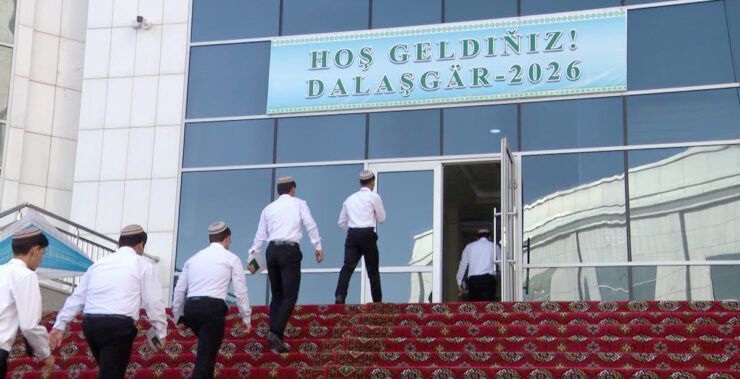
Turkmenistan has launched a specialized online platform, dalasgar.bilim.tm, designed to track higher education admission campaigns across 22 universities spanning the country’s five regions, Ashgabat, and Arkadag. The platform provides an administrative overview of application volumes, enrollment quotas, and distribution trends.
Platform Features and Capabilities
The portal offers several practical monitoring tools for applicants, parents, and observers:
- Centralized Statistics Dashboard: Displays real-time data on active applicant counts, admission quotas, and total submissions.
- Institutional Breakdown: Compares available placement slots against received applications across all 22 monitored universities.
- Regional and Field Segmentation: Categorizes data by geographic zones (the five velayats, Ashgabat, and Arkadag) as well as specific fields of study.
System Limitations and Considerations
While the platform offers useful visibility, it has a few structural limitations:
- Informational Nature: The portal functions strictly as an information and statistics dashboard rather than an interactive application gateway. Candidates cannot submit or modify documents through the platform.
- Dynamic Fluctuations: Because application windows span multiple weeks, figures update dynamically as submissions are processed daily, meaning any snapshot reflects a specific point in time.
- Limited Predictive Insight: While it highlights competition ratios, it lacks predictive analytics or individual rankings, meaning applicants cannot view their precise admission standing.
Key Data Snapshot and Analysis
Overview of Quotas vs. Applicants
Across Turkmenistan’s 22 universities, 175 distinct fields of study and 16,875 spots are available for the 2026 academic cycle. With the admissions window running from July 13 through August 24, live data from the new state portal (dalasgar.bilim.tm) shows that 24,627 applicants have submitted documents as of July 25, 2026. Meanwhile, official news outlets report an expanded intake capacity of over 18,021 university spots, an increase of 1,239 seats from the previous year.
Donate to support Turkmen analysts, researchers and writers to produce factual, constructive and progressive content in their efforts to educate the public of Turkmenistan.
SUPPORT OUR WORKRegardless of slight statistical discrepancies across official channels, access to higher education remains severely constrained. For the 2025–2026 academic year, 108,603 youth graduated from secondary schools nationwide. Based on available university capacities, ranging from 16,875 to 18,021 spots, only about 15.5% to 16.6% of high school graduates can secure a university seat. In practical terms, this means fewer than 2 out of every 10 graduates make it into higher education, aligning closely with UNICEF findings noting that roughly 83% of students do not transition to universities.
While alternative pathways exist, such as secondary vocational schools (which offered 10,879 spots in 2025) or studying abroad, a vast majority of young Turkmen face limited prospects for pursuing higher education and building competitive career paths.
Table 1. Top 5 Universities by Application Volume (as of July 2026)
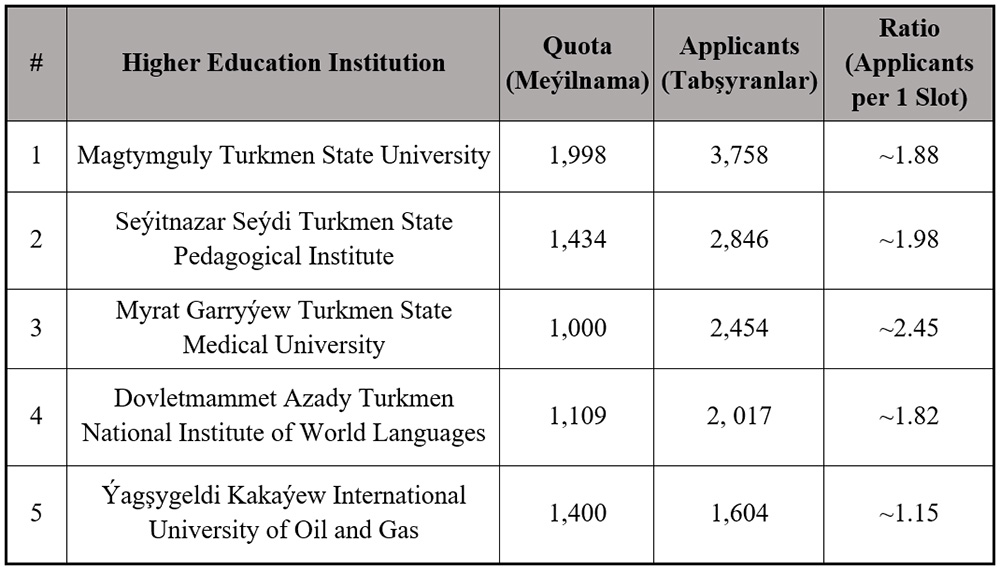
Note: Medical and pedagogical fields are experiencing the highest level of
competition relative to how many physical seats (quotas) are available.
- Regional Patterns: Geographic distribution data shows that candidates frequently lean toward local or proximate institutions. For example, 55% of applicants to the Seýitnazar Seýdi Turkmen State Pedagogical Institute in Lebap originate from Lebap velayat, and 65% of applicants to the Turkmen State Agricultural Institute in Dashoguz come from Dashoguz velayat. Conversely, specialized and multidisciplinary institutions centered in Ashgabat attract broad, nationwide representation alongside local urban volume.
- Top Areas of Study: Traditional high-demand sectors, such as medicine, foreign languages, law, international relations, and core sciences, consistently draw applicant volumes well above baseline quotas. Meanwhile, specialized cultural, artistic, or regional agricultural institutes experience application totals that track closer to or slightly below their designated enrollment plans.