The Turkmen government submitted its official state response addressing questions raised by the United Nations regarding its third periodic report under the International Covenant on Economic, Social and Cultural Rights (ICESCR).
Below is a brief summary of the statistics and claims shared in the report. This overview is provided for informational purposes only and does not constitute an analysis, confirmation, or validation of the data. Because certain assertions in the report (such as claims regarding universal high-speed internet coverage or citizens being able to renew their passports abroad) conflict with known realities on the ground, readers are advised to exercise their own critical judgment when reviewing these claims and statements by the government of Turkmenistan.
1. Macroeconomic Overview & Public Spending
- Social Services Spending: Expenditure on public and social services accounted for 10.6% of GDP in both 2023 and 2024, totaling 22,457.0 million manats and 25,521.6 million manats, respectively.
2. Employment Trends & Workforce Demographics
- Unemployment Rate: Job seekers comprised 4.7% of the economically active population in both 2022 and 2023.
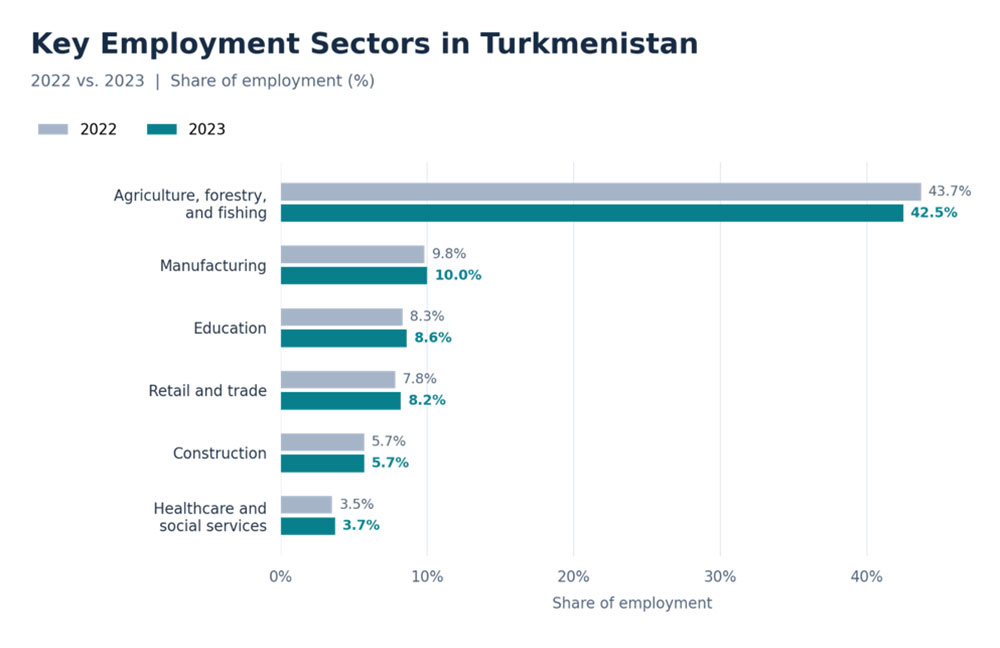
- Key Employment Sectors: The top six sectors accounted for 78.7% of total employment. A breakdown of workforce distribution across these sectors includes:
- Gender Disparities in Employment (2024):
- Women made up 45.0% of agricultural workers (vs. 17.4% of men) and 35.1% of service sector workers (vs. 28.7% of men).
- Men dominated construction (28.2% vs. 1.3% of women) and industrial production (14.0% vs. 8.9% of women).
- Labor Protections & Minors: Between 2020 and 2024, zero complaints regarding forced labor were registered with labor institutions or courts. Additionally, cotton picker and grower roles were added to the list of hazardous jobs prohibited for minors under 18.
3. Environment & Agriculture
Donate to support Turkmen analysts, researchers and writers to produce factual, constructive and progressive content in their efforts to educate the public of Turkmenistan.
SUPPORT OUR WORK- Climate Trends: Over the past 55 years, average atmospheric air temperatures have risen by 1.4°C. Projected increases by 2100 range from 2–3°C (optimistic) to 6–7°C (pessimistic) relative to the 1990 baseline.
- Emissions & Water Management: Agricultural activities account for approximately 12% of total greenhouse gas emissions. Farming relies 95% on artificial irrigation, consuming about 90% of national water resources. Transitioning to advanced drip and sprinkler irrigation can save 30% – 40% of water.
4. Education & Gender Parity in Academics
- Secondary Vocational Education (2024/2025): Female student enrollment is highest in education (94.2%), healthcare (86.0%), economics (73.2%), agriculture (68.9%), culture and art (60.8%), industry (56.5%), and construction (49.8%).
- Higher Professional Education (2024/2025): Women comprise 64.2% of humanities and pedagogical students, 63.2% in mathematical and natural sciences, and 58.3% in medical sciences. Conversely, male enrollment remains higher in engineering and technical sciences (69.9%) and agricultural sciences (64.6%).
5. Health, Infrastructure & Social Indicators
- Child Nutrition: Moderate-to-severe stunting among children under 5 rose from 7.1% in 2019 (MICS-6) to 9.2% in 2024 (MICS-7), while severe stunting increased from 2.4% to 3.2% over the same period.
- Reproductive Healthcare: A network of 95 specialized clinics offers family planning, providing 10 modern contraceptive methods free of charge to high-risk groups (chronically ill women, mothers with 8+ children, and adolescent girls aged 15–19).
- Telecommunications: Funded by Islamic Development Bank (IDB) investments, high-speed internet reaches nearly 100% of populated areas via GPON, 4G+/5G networks, and satellites. External bandwidth expanded more than threefold over 3 years, driving a 154% surge in internet subscribers.
6. Gender Rights, Institutional Reforms & Grievances
- Domestic Violence & Policy: UNFPA-collaborative surveys assessed health and status of women in families aged 18–59, prompting a new Domestic Violence Prevention Roadmap.
- Institutional Changes: The Ombudsman’s Office created dedicated departments for human rights in the private sector and women’s and children’s rights. The Law “On Courts” (April 12, 2025) introduced specialized family court judges.
- Ombudsman Appeals Breakdown (2024):
- Housing: 59 received, 1 satisfied.
- Labor: 40 received, 4 satisfied.
- Health: 10 received, 1 satisfied.
7. Migration & Citizens Abroad
- Internal Migration: Under the Law “On Migration,” the absence of local residency registration (propiska) cannot restrict a citizen’s fundamental rights, freedoms, or employment opportunities anywhere in the country.
- Citizens Living Abroad: Permanent residents abroad apply for passports via foreign diplomatic and consular posts. These documents are processed by the central apparatus of the State Migration Service and returned through the same diplomatic channels.