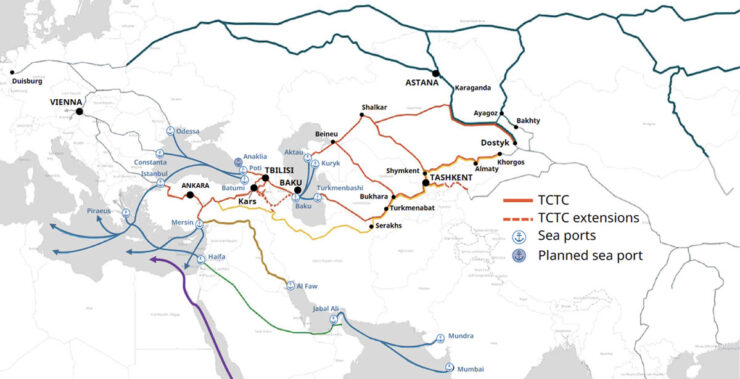
The World Bank published a new report titled: Integration: World-Class Trade Logistics Along the Trans-Caspian Transport Corridor (TCTC). Also known as the Middle Corridor, the TCTC is an emerging multimodal trade network linking Central Asia, the South Caucasus, Türkiye, and Europe. This corridor promises significant economic gains including increase in GDP and employment across its host nations. However, achieving this potential requires significant investments in infrastructure and comprehensive institutional reforms, enhanced digitalization, and streamlined cross-border collaboration. Below is the summary of key points raised and data shared on Turkmenistan – one of the nine countries located along this trade route.
Macroeconomic Context & Corridor Impact
- Growth Performance: Long-run development of the TCTC is projected to increase Turkmenistan’s GDP by 1.25%, generating an absolute gain of $791 million and representing a compounded annual growth rate equivalent to 0.12% over 10 years. Investments in this corridor are also estimated to increase employment by 1.52%.
- Business Environment: According to the World Bank B-READY 2025 assessment, Turkmenistan underperforms relative to regional peers across business environment metrics, scoring roughly 50 out of 100 on the Regulatory Framework pillar, less than 29 on the Public Services pillar, and 60 on the Operational Efficiency pillar due to weak competition frameworks, low digital adoption, and limited financial access.
Trade Structure & Commodity Dynamics
- Export Concentration: Turkmenistan’s export profile is overwhelmingly dominated by hydrocarbons, with the top three exports making up over 90% of total export value in 2023: gas – 75%, oil products – 13% and crude oil – 3%.
- Import Profile (2023): The top three import products of Turkmenistan are electronics (20%), machinery (15%), and cars and automotive parts (10%).
- Trans-Caspian Volume Footprint: Turkmenistan ships 2.2 million tons of freight via trans-Caspian routes, which accounts for more than one-third of its total non-gas exports. It acts as a vital trade lifeline, with the TCTC providing regional market connectivity.
- Baseline Trade Forecast (2023-2040): export value is projected to expand by 4% (an absolute increase of +$4 billion) while import value is projected to expand by 16% (an absolute increase of +$16 billion).
- Trade Shifts Under TCTC Development: Investing in TCTC infrastructure is expected to increase Turkmenistan’s total imports by 1.83% (+$150 million). Overall exports decrease by 0.38% (-$63 million) due to a $91 million (-0.65%) decline in exports to the rest of the world, though intraregional trade within the TCTC block increases.
- Untapped Potential: Because Turkmenistan suffers from high baseline trade frictions, reducing logistics costs along the TCTC by 50% would boost its agrifood exports by 85.6%.
Figure 1. Logistics cost-reduction effect on agrifood exports, millions of tons
Donate to support Turkmen analysts, researchers and writers to produce factual, constructive and progressive content in their efforts to educate the public of Turkmenistan.
SUPPORT OUR WORK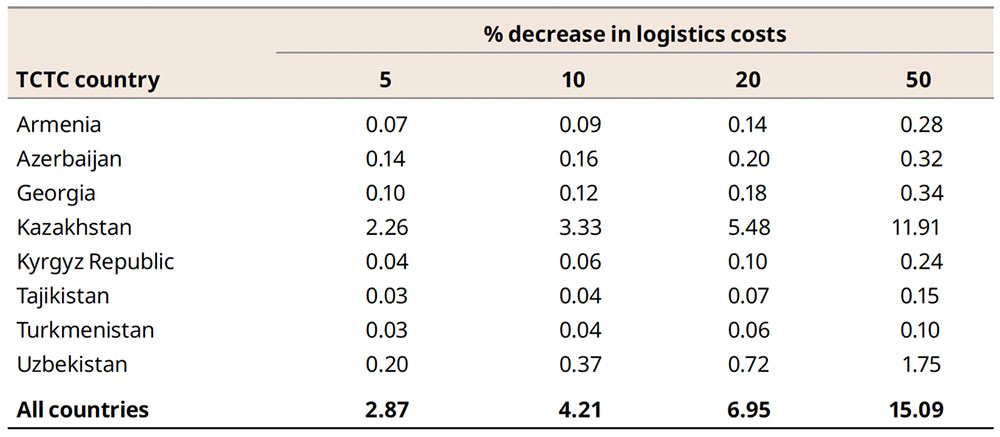
Transport Infrastructure & Operational Constraints
- Railway Infrastructure and Bottlenecks: Turkmenistan Railways (Demirýollary, TDY) manages a national network spanning 4,900 to 5,100 kilometers. However, its systemic transit capacity is heavily restricted by:
- Single-track systems – limit traffic flow by forcing trains to wait for oncoming traffic on side tracks.
- Diesel-traction systems – lack the power and speed of electrified networks, ultimately restricting overall corridor capacity and efficiency.
- Gauge breaks with Iran – incompatible track widths between countries require cargo to be physically transferred to new trains at the border, causing major delays and inefficiencies.
- Acute rolling stock obsolescence – the widespread aging and wearing out of locomotives and freight cars leads to frequent breakdowns and severely reduced transit reliability. Approximately 50% of locomotives require replacement or heavy overhaul, and the freight wagon fleet of 12,000-14,000 units features roughly 70% of assets that are over 30 years old.
- Weather conditions – Turkmenistan is also exposed to fluvial and pluvial flooding risks (overflowing rivers and heavy rainfall pooling over tracks) affecting rail alignments.
- Port Facilities, Utilization & Physical Bottlenecks: Turkmenbashi port is operated as a public service port. It is the largest Caspian port by nominal installed capacity (17 million tons and 400,000 TEUs). However, capacity utilization was only 19% in 2023, rising to 43% by late 2025. Operational capacity is severely undermined by Caspian Sea water level drops and siltation:
- The 21-kilometer access channel depth drops as low as 4.2 meters at high spots against an 8-meter operational requirement.
- The channel width is restricted to 90 meters, preventing two-way vessel traffic (which requires 140 meters).
- These physical shortcomings reduce the port’s effective container-handling capacity by approximately 50%. Also, like other eastern Caspian facilities, Turkmenbashi experiences routine weather-related downtime due to strong winds, dust storms, and fog.
Investment Portfolio & Strategic Capital Projects
- The World Bank estimated the total investment required for Turkmenistan around $4.7 billion for a combination of core infrastructure upgrades and complementary economic-activity-enabling projects. While core infrastructure (like laying tracks or dredging ports) fixes physical bottlenecks, enabling investments help convert that physical connectivity into actual economic activity and local value addition.
- Economic activity-enabling investment program: The total investments through 2040 is estimated at $3.8 billion. This is part of the broader regional framework. It ranks Turkmenistan third in total potential investment scale among the host countries. Enabling investments are structured around linear infrastructure (75% / $2.825 billion), logistics equipment (23% / $850 million), and nodal infrastructure (3% / $100 million). These projects are predominantly public-sector led, reflecting limited private sector participation potential compared to other regional markets.
- Priority capital projects: In addition to these enabling investments, specific core infrastructure projects identified for the short-term include the Tashkent-Turkmenbashi railway line rehabilitation ($625 million) and Port of Turkmenbashi improvements ($285 million).
Ultimately, Turkmenistan must transition from a basic transit route into a true economic corridor by coupling core investments with digital integration, logistics upgrades and private sector participation. Integrating into the TCTC helps landlocked Turkmenistan mitigate high structural trade costs compared to global benchmarks like the EU, facilitating better market access for agricultural and non-gas goods. By executing a targeted $4.7 billion investment strategy, the country can transform its transport network into a catalyst for long-term economic diversification and regional connectivity.