As of 2026, the relationship between the European Union (EU) and Turkmenistan has shifted toward a “strategic pragmatism,” moving beyond traditional energy security to establish Turkmenistan as a vital node in Eurasian trade via the Middle Corridor. While the EU’s Global Gateway initiative mobilizes billions globally in infrastructure and green energy, its investment potential in Turkmenistan faces a critical institutional challenge.
This paper argues that for EU investments to be sustainable, they must move past purely technical deliverables. The EU must leverage Turkmenistan’s current enthusiasm for international integration to demand the “soft infrastructure” of democratic reforms, human capital development, and digital freedom, ensuring that economic growth benefits the Turkmen people and future generations rather than entrenching autocratic isolation. The EU investments in Turkmenistan should serve as an instrument of principled engagement. Otherwise, the business as usual approach will risk being a losing game, particularly for the Turkmen people.
Turkmenistan remains the only Central Asian country without a ratified Partnership and Cooperation Agreement (PCA) with the EU, which limits the scope for bilateral engagement. The PCA with Turkmenistan was signed in 1998 but the European Parliament still has not ratified the agreement due to Turkmenistan’s limited progress on human rights. In 2024 the EU parliament passed a resolution spotlighting the dire situation with fundamental freedoms in Turkmenistan. To unlock trade and energy benefits, the European Parliament has mandated specific human rights benchmarks, requiring the Turkmen government to:
- ensure unhindered access to alternative sources of information;
- end the persecution of independent journalists, civil society activists and human rights activists based in- and outside the country;
- guarantee freedom of assembly and remove restrictions on NGOs; and end arbitrary travel bans.
The New Economic Frontier: Infrastructure and Connectivity
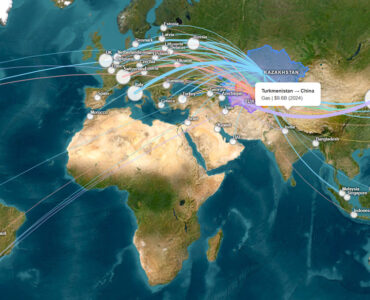
The EU’s current agenda in Turkmenistan is defined by geopolitical developments and national interests. Due to instability in the Middle East and the EU’s planned phase-out of Russian gas, the Trans-Caspian Pipeline is being discussed as a “Project of Common Interest”, potentially qualifying it for EU public funding. For over two decades, Russia stalled the TCP by citing the Caspian Sea’s undefined legal status; more recently, Moscow has pivoted to highlighting environmental risks – a concern that carries weight given Turkmenistan’s leak-prone energy infrastructure. However, the war in Ukraine has motivated a more pragmatic approach, with the EU now exploring smaller, phased-in interconnectors rather than a single massive pipeline. For Turkmenistan, this partnership offers a vital opportunity to diversify its economic ties and reduce its strategic over-reliance on Russia and China. Following the landmark EU-Central Asia Summit in 2025, this cooperation has consolidated around three high-priority sectors:
Transport and Logistics
As part of the Global Gateway initiative, the EU is prioritizing sustainable connectivity, energy, digital infrastructure and trade in Turkmenistan. It is backed by an €18 million allocation for 2021–2027. As part of this initiative, the EU is working on the Trans-Caspian International Transport Route, also known as the Middle Corridor, which is a multimodal logistics network linking Asia to Europe through Central Asia and South Caucasus. The southern branch of the corridor passes through Turkmenistan via railway connection and Turkmenbashi International Seaport.
A new partnership strategy for 2026-2030 between Turkmenistan and the European Bank for Reconstruction and Development (EBRD) focuses on modernizing railways and highways to integrate with the Global Gateway. Similarly, the European Investment Bank (EIB) plans to support Turkmenistan through lending to modernize its ports, railways, and roads to stimulate regional trade and economic growth by reducing transit times and costs. These projects aim to reduce transit times from China to Europe to just 12–15 days. However, EIB’s lending is conditional upon signing a Framework Agreement, a legally binding treaty that provides essential protections like tax exemptions, currency convertibility, and international procurement standards.
The Green Transition
The EU allocated an additional €2 million in March 2026 to the “EU for a Green Turkmenistan” project. This funds technical missions by the German agency GIZ to help the state concern Turkmengas detect and fix methane leaks – a prerequisite for Turkmenistan’s gas to be “EU-compliant”. Turkmenistan was among the top eight global emitters of methane in 2024. Although Turkmengas reported reductions in daily emissions in 2025, the same year it was reported as the host of the world’s worst mega-leaks of methane.
Donate to support Turkmen analysts, researchers and writers to produce factual, constructive and progressive content in their efforts to educate the public of Turkmenistan.
SUPPORT OUR WORKGlobal Trade Integration
The EU remains a primary supporter of Turkmenistan’s WTO accession, which is viewed as a vehicle to modernize domestic trade laws and support the growth of local SMEs. During the “Turkmenistan–European Union” Business Forum in Ashgabat held in March 2026 Turkmenistan explicitly recognized that economic isolation is no longer viable in a transforming global market. A primary objective highlighted during the forum was supporting Turkmenistan’s integration into the global trading system, specifically through its ongoing WTO accession process. The event facilitated over 40 direct bilateral meetings (B2B and B2G), allowing more than 90 European and Turkmen companies to explore specific investment initiatives in sectors like logistics, energy, and IT. Furthermore, the forum showcased the export potential of Turkmen agribusiness and textile sectors, emphasizing the role of international partnerships in building trade resilience.
Efforts to Promote Human Rights and Development
In addition to its economic relations, the EU also tries to constructively engage with Turkmenistan on issues such as human rights, gender equality, labour rights, the rule of law and education. To this end, there is the annual EU–Turkmenistan Human Rights Dialogue. The 18th dialogue took place in March 2026, but no outcomes are shared publicly yet. However, during the 2025 dialogue the EU emphasized that fundamental freedoms remain the essential guiding principle for all future bilateral relations. The EU reiterated the vital importance of freedom of opinion, expression, movement, and association, stressing the urgent need for independent media and the right to information. The EU urged Turkmenistan to ensure affordable, unrestricted internet access for all citizens and to foster a safe, enabling environment for civil society. Furthermore, the EU recommended the criminalization of domestic violence and called for unhindered Red Cross access to detention facilities to address serious concerns over torture and enforced disappearances. It is yet unclear if and how Turkmenistan will commit and implement these recommendations.
The Rule-of-Law Vacuum: Why Infrastructure Alone is Not Enough
Purely economic engagement in Turkmenistan is inherently risky due to the “systemic and institutionalized” corruption identified in the 2025 OECD Report. Building “hard” infrastructure without addressing democratic institutions creates several points of failure:
- Economic Inefficiency: The dual exchange rate system acts as a “hidden tax,” where EU investment risks losing the majority of its purchasing power and European firms may lose up to 80% of their profit value during repatriation. Moreover, the vast gap between the dual rates creates an irresistible incentive for bribery and currency arbitrage.
- Environmental Transparency Gaps: While the EU aims to fix methane leaks, success depends on data integrity. Turkmenistan significantly underreports its footprint; satellite observations in 2025 revealed that actual emissions were double the levels reported by authorities. Without accurate reporting, the “Green Transition” remains a moving target.
- The Digital Paradox: The EU’s goal of a “digital autobahn” is physically impossible under the current state-directed internet blockade. Blocked cloud services, high tariffs ($4,500+/month for business lines), and systemic VPN crackdowns make modern logistics and transparent customs management impossible.
- Human Capital and Gender Gaps: With tertiary education reaching fewer than 20% of graduates, 31.6% of firms identify an “inadequately educated workforce” as their primary obstacle. Furthermore, the exclusion of women from leadership – only 6.1% of firms have female top managers compared to a 17.3% regional average – stifles economic diversity and innovation.
- Governance and Corruption Risks: Systemic corruption remains a major deterrent; the World Bank Enterprise Survey reports a 10.6% bribery incidence. Businesses are frequently pressured for informal payments to secure construction permits (13.4%) or navigate tax assessments (9.6%), undermining fair competition.
- Reputational Risk: As highlighted by Human Rights Watch, deepening ties with a state that jails critics and utilizes forced labor in cotton harvesting, directly contradicts the “essential elements” of the EU’s democratic mandate and risks tainting European supply chains.
Recommendations for Leveraging Investment for Change
The EU should not view its values and its investments as separate; rather, investment is the lever to secure those fundamental values. The following recommendations are based on conditions, where the EU ties the release of each new phase of funding, trade benefits, and technical support to specific, verifiable benchmarks in human rights, transparency, and the rule of law:
- Phased PCA Ratification: The European Parliament should maintain its firm position on the Partnership and Cooperation Agreement (PCA) until specific human rights benchmarks are met, such as the release of political prisoners and the end of arbitrary travel bans.
- Digital Reciprocity: For every Euro spent on “hard” transport infrastructure, the EU must demand a commitment to liberalizing internet access. This includes making internet access affordable, removing the blocks and introducing competition to the telecommunications sector.
- Independent Oversight: As a condition for EIB Framework Agreement lending, the EU should insist on the creation of an independent Business Ombudsman to settle disputes and monitor labor rights in EU-funded projects.
- Monetary Unification: To prevent the catastrophic loss of investment value, the EU and EIB should tie large-scale infrastructure investments to a verifiable roadmap for exchange rate unification. Following the IMF’s 2025 recommendations, a realistic merger of the rates would follow a “Shock + Shield” approach where phased currency unification is accompanied by social safety nets, particularly to protect the most vulnerable people.
- Investing in Humans: The EU should pivot more funding toward vocational training and youth skills to reduce reliance on foreign experts and empower a new generation of Turkmen professionals. Ending arbitrary travel bans and enabling freedom of movement goes hand in hand with attracting highly educated Turkmen nationals living abroad back to Turkmenistan and helping minimize brain drain.
- Mandate Civil Society Oversight: The EU should formalize the role of independent civil society organizations as project watchdogs, ensuring they have secure channels to conduct social audits and file grievances with accountability mechanisms to prevent environmental or social harm.
The EU stands at a crossroads in Turkmenistan. While the “Middle Corridor” offers immense economic promise, it cannot reach its full potential in a country defined by information blockades and institutionalized corruption. The EU must use its financial weight, as a leading global investor and a trade partner, to insist that progress is not measured in infrastructure alone, but in the freedom of Turkmenistan’s citizens and the transparency of its market. Only by tying economic engagement to human rights and the rule of law can the EU ensure its investments lead to a stable, prosperous, and truly connected Turkmenistan.