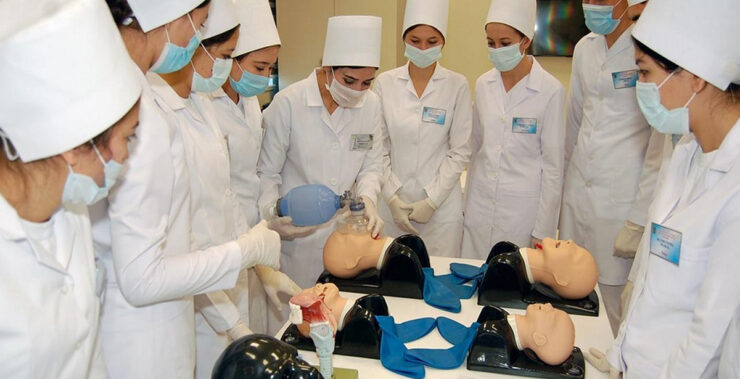
In any developed society, nurses make up the largest portion of healthcare workers and they are the ones most patients see and interact with when receiving care. A well-functioning healthcare system relies on the consistent collection, revision, and public dissemination of critical information about nurse demographics, educational pipelines, and workforce challenges. In Turkmenistan, the Ministry of Health and other state institutions do not publish reports or data related to nursing or midwifery, leaving the public entirely in the dark. Despite this local information vacuum, international data reveals a deeply troubling trend: over the last three decades, as the population nearly doubled, the state’s nursing pool shrank by 26% and annual graduates plummeted by 75%. Predominantly women, this workforce lacks educational and professional development opportunities, making Turkmenistan’s nursing capacity far behind the rest of Central Asia.
Insights from International Research
In 2025, the Asian Development Bank (ADB) approved a $75 million loan for its first-ever healthcare project in Turkmenistan with the goal to strengthen the nursing profession and education. The single most detailed public picture of the country’s nursing workforce comes from project documents released by ADB. According to those documents:
- Turkmenistan’s healthcare capacity has failed to keep pace with its demographics. While the population grew by 96% from 1990 to 2023, the total number of nurses and midwives during this period actually plummeted by 26%, from 34,420 down to 25,600.
- The annual number of nursing graduates fell from 2,366 in 1990 to roughly 600 in 2023, a decline of 75%.
- The density of nurses and midwives stood at about 3.9 per 1,000 people in 2021, against a Europe and Central Asia regional average of 8 per 1,000.
- The nurse-to-doctor ratio is 1.8:1 (1.8 nurses per doctor), well below the OECD benchmark of 2.6:1 (2.6 nurses per doctor).
- Nursing remains a highly gendered occupation with 85% females comprising the nursing workforce.
- There are six nursing schools in the country – one in each region and one in the capital city.
- Nursing is taught almost entirely by doctors rather than nurses, and no nurses sit on the governance bodies of either the medical or the educational systems.
Lagging Behind Central Asian Neighbors
International organizations either lack nursing workforce data from Turkmenistan or publish it with significant gaps and outdated reference years. Even in the most recent regional analysis, the 2024 WHO-led case study on nursing and midwifery in five Central Asian countries, the governments of all Central Asian countries contributed except Turkmenistan.
The analysis further confirms the declining state of nursing in Turkmenistan. The data reveals that the country’s nurse density fell from 41.6 to 37.9 per 10,000 population between 2010 and 2020 while the number of midwives remained unchanged, at 2.0 per 10,000, which is less than half of the WHO European Region average of 4.1. According to the 2020 data that the research refers to, Turkmenistan stands behind other Central Asian countries in its nursing capacity, with Kazakhstan leading the region with 65.1 per 10,000 population (Uzbekistan: 53.5, Tajikistan: 47.5 and Kyrgyzstan: 40.7). Unlike its neighbors, Turkmenistan also does not offer bachelor’s, master’s, or PhD programs in nursing.
Although Turkmenistan is the second-richest country in Central Asia per capita, it falls behind every one of its neighbors in investing in its nurses. Kazakhstan and Uzbekistan now offer nursing degrees up to the PhD level, with Bologna-aligned curricula and published health labor market analyses. Uzbekistan rolled out digital health information systems that track the nursing workforce, while Kazakhstan has restructured nursing management and integrated nurses into primary-care teams with clear statutory job descriptions. Even Tajikistan, the poorest country in the region, increased its nursing density from 34 nurses in 2010 to 44 per 10 000 population in 2023, while Turkmenistan’s density quietly declined.
The Paradox of Care and Patient Rights
A 2022 UNFPA report “State of Midwifery Workforce in Eastern Europe and Central Asia” highlights severe structural shortages, projecting that Turkmenistan will face a deficit of 1,000 midwives by 2030. It is the only country in Central Asia that offers an integrated (rather than separate) nursing-midwifery program. Only 25% of midwifery educators are actually midwives themselves, and there are zero midwives in leadership or regulatory roles.
Most strikingly, despite reporting near-universal antenatal care (98%), 100% skilled birth attendance, and the highest postnatal check rate in the Eastern Europe and Central Asia (EECA) region (99.8%), Turkmenistan recorded the smallest reduction in neonatal mortality in Central Asia between 1990 and 2020 (just 12%, against 75–79% in Kazakhstan and Uzbekistan). This apparent paradox may reflect workforce composition problems or data quality issues that better public statistics could clarify.
Donate to support Turkmen analysts, researchers and writers to produce factual, constructive and progressive content in their efforts to educate the public of Turkmenistan.
SUPPORT OUR WORKThis disconnect strongly suggests data manipulation or major underlying issues in the quality of care. Indeed a UNFPA report on respectful maternity care in Central Asia revealed that 55% of surveyed patients in Turkmenistan reported poor interactions with healthcare staff, and 46% admitted to undergoing obstetric procedures without their informed consent. Though only indicative, these numbers suggest that near-universal attendance statistics can coexist with significant gaps in the quality and dignity of care, reinforcing the case for better local data.
Regional initiatives might be an effective way to engage Turkmenistan and encourage positive change. In December 2025, WHO Europe together with the Health Ministries of Turkmenistan and its four regional neighbors (Kazakhstan, Kyrgyzstan, Tajikistan, Uzbekistan) launched the “Central Asian Strategic Directions for Nursing and Midwifery 2025-2030”. This framework responds to the fact that nurses and midwives make up 74% of practicing health professionals in Central Asia, most of whom are under the age of 44. It will focus on four priority areas:
- Modernizing education;
- Optimizing service delivery;
- Expanding representation in leadership;
- Improving regulations, protections and working conditions.
The Driving Forces of Nurse Emigration
Over the past decade, Turkmenistan has faced growing emigration, including healthcare workers. Although the government has not published any data, independent sources identify a large outflow of migrant workers mainly to Turkey and the Russian Federation. Economic crisis, chronic unemployment and limited opportunities are among the main drivers of outward migration that has increasingly affected the country’s healthcare workers in recent years. While there is no published salary data for healthcare professionals, the official state minimum wage was 1,410 Manats (approximately $70 USD) in 2025, pointing to constrained living standards for ordinary workers. Without basic social protections, fair compensation, or a supportive working environment, highly trained nurses are regularly abandoning the local health system to work as domestic caregivers or cleaners in higher-paying countries abroad.
The Way Forward
Turkmenistan’s nursing sector faces a critical decline driven by a shrinking workforce, rising emigration, poor pay, lack of further training and career progression. Addressing this crisis requires immediate, practical reforms.
- The current combined nursing-midwifery curriculum should be split into separate, specialized educational tracks taught by experienced senior peers rather than doctors, ensuring graduates receive targeted training.
- The government must leverage the active $75 million Asian Development Bank loan to formally expand the role of nurses in primary care, giving them more independence and legally protected duties to improve their professional status and slow down emigration.
Ultimately, nurses are the backbone of primary healthcare in Turkmenistan, keeping society healthy by delivering babies in difficult conditions, managing chronic illnesses in remote villages, and supporting patients through their hardest nights. Yet, they continue to do this vital work without proper appreciation, support, or structural backing. While upgrading infrastructure and modernizing textbooks through projects like the ADB’s above are helpful steps, true progress remains impossible until the state breaks its silence, embraces transparent research, and openly collaborates with international organizations to value its healthcare workforce.