
A growing number of people in Turkmenistan are experiencing food insecurity.
The 7th edition of the UNEP Global Environmental Outlook covers a number of interlinked threats – climate change, biodiversity loss, land degradation, desertification, and pollution. While the report mostly focuses on global trends, the data specific to Turkmenistan and Central Asia shows that a region is facing a worsening environmental crisis.
Land use and degradation
While global forests are under increased pressure, Central Asia has seen forest conservation and restoration efforts: forests grew at a rate of 3.68 MHa/year in 1990-2000, accelerating to 4.62 MHa/year in 2000-2010. However, the expansion has since slowed to 2.78 MHa/year.
At the same time, cropland expansion has been surging in Central Asia, driven by population growth and large-scale agribusiness. In Turkmenistan, the report expects a shift from bareland to cropland, which intensifies the pressure on soil health.
- Land degradation: In 2019, 20.3% of land in Central Asia was classified as degraded – the third-highest share globally.
- Soil erosion: Turkmenistan faces significant erosion levels, estimated at 1-3 Mg/ha/year in some areas and as high as 3-5 Mg/ha/yr in others.
- Raw material extraction: in Central Asia, Eastern Europe, and the Caucasus the resource extraction (mostly fossil fuels) is the 2nd highest globally, estimated at 19 tons per person.
Climate, water stress, and extreme events
The region is exceptionally vulnerable to intensifying droughts and changes in water cycles. A third of the population (75 million people) is estimated to lack access to reliable water sources.
Donate to support Turkmen analysts, researchers and writers to produce factual, constructive and progressive content in their efforts to educate the public of Turkmenistan.
SUPPORT OUR WORK- Reduced snow cover duration is changing the seasonality and magnitude of flow in snow-fed rivers. Glaciers melt faster globally, but Central Asia is one of the rare cases where melt rate is reduced due to debris cover.
- Rising temperatures and reduced rainfall are expected to trigger more intense droughts, leading to severe sand and dust storms.
- Heatwaves have increased in frequency and intensity globally, and especially in Central Asia, where three heatwaves were observed in spring-summer 2023.
Pollution and public health
Air, water, and soil pollution are worsening and taking a toll on public health and environment.
- Air quality: Over 94% of the population in Central Asia and Europe is exposed to unsafe PM2.5 levels. The mortality rate linked to NO2 emissions is 51.3 per 100,000 people – the highest regional rate globally. In some cities in Central Asia the mortality rate has been growing despite an overall global decline.
- Water contamination: major Central Asian rivers such as Amu Darya, Syr Darya, and Chu Talas are heavily polluted by industrial waste and agricultural run-off.
- Respiratory health: higher CO2 concentrations are projected to prolong pollen seasons, increasing exposure to allergens and worsening respiratory diseases.
Ecosystem collapse
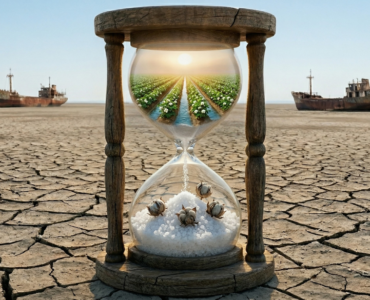
The Aral Sea remains the primary example of an ecologically collapsed system and the report warns that future collapses may occur even faster. These environmental stressors have an impact on human settlements as well:
- Food insecurity: between 1% and 10% of the population in Turkmenistan, Uzbekistan, and Kyrgyzstan are experiencing food insecurity (2024 data).
- Migration: water shortages and land degradation are expected to drive human displacement. Turkmenistan is predicted to have a very high rate of migration from the country – the highest in Central Asia and one of the worst globally.
Regional success stories
Despite these challenges, there are notable successes in the region. For example, Azerbaijan has increased its protected areas by 100% over the last 20 years. Protected land now covers over 20% of the country’s total land area, providing a potential template for regional conservation.