A recent study by researchers from Germany, the United States, and Uzbekistan, titled “Climate change has increased crop water consumption in Central Asia despite less water-intensive cropping”, has highlighted the growing water crisis in the Amu Darya Basin, one of Central Asia’s most important agricultural regions. The study found that crop water consumption increased by 10% between 1987 and 2019.
Agriculture consumes more water
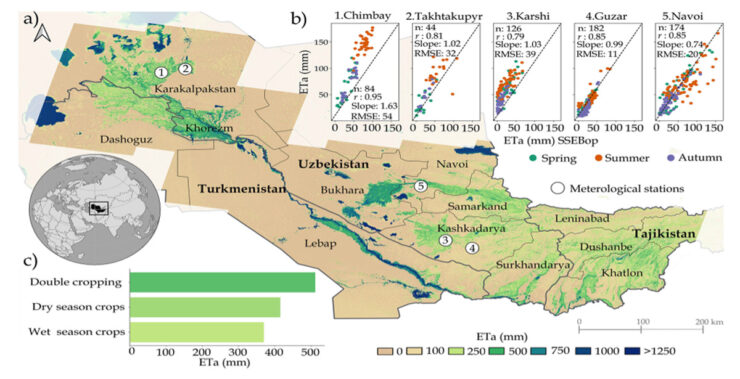
Using satellite imagery, the researchers examined changes in crop water use across the basin. Their findings show that climate change is placing an increasing pressure on irrigated agriculture, especially in downstream regions such as Dashoguz in Turkmenistan.
The study used evapotranspiration, a measure of how much water is lost through evaporation from the soil and release by plants into the atmosphere, as a proxy for total water consumption in irrigated agriculture. Although farmers have partially shifted from cotton to less water-intensive crops such as wheat, total crop water consumption still increased by 10% over 1987-2019. Water consumption per unit area has grown even more, by 18%. According to researchers, climate change has been responsible for the majority of the increase in water consumption (21%), while changes in cropping patterns have reduced it by only 3%.
Higher vulnerability in downstream regions
The effects are more severe in downstream regions, including Dashoguz in Turkmenistan and Khorezm and Karakalpakstan in Uzbekistan. These areas have experienced some of the largest increases in temperatures and atmospheric water demand in the entire basin.
Donate to support Turkmen analysts, researchers and writers to produce factual, constructive and progressive content in their efforts to educate the public of Turkmenistan.
SUPPORT OUR WORKDespite growing water scarcity and land degradation, water-intensive crops such as cotton continue to be cultivated because of existing production mandates. In Dashoguz, the situation is further complicated by high soil salinity, shallow groundwater, and aging irrigation infrastructure.
The study identifies several priorities for adapting agriculture to increasing water stress in the Amu Darya Basin:
- Improving irrigation efficiency and switching to drought-tolerant crop varieties;
- Modernizing aging infrastructure to reduce water distribution losses;
- Strengthening transboundary water cooperation to prevent water-related conflicts in the region.
The authors emphasize that regional measures alone will not be enough. Without global efforts to reduce greenhouse gas emissions and stabilize the climate, rising water stress could make agricultural production in the Amu Darya Basin increasingly difficult.