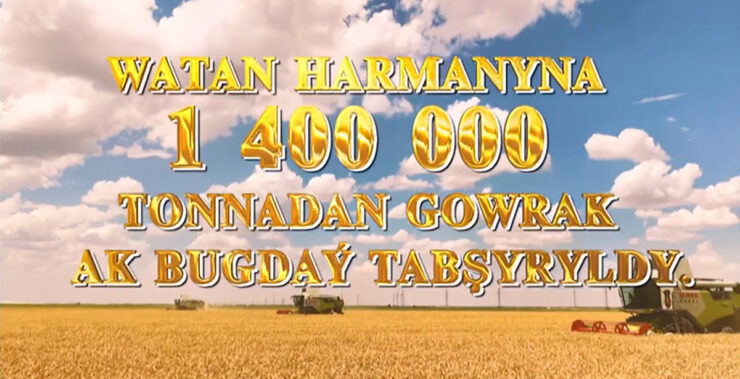
A comparative analysis of agricultural data reveals a massive divergence between Turkmenistan’s state media narratives and international observations. During the 2025 harvesting season, the national state media outlet Turkmenportal declared that domestic farmers delivered over 1.4 million metric tons of wheat to the state. And in 2026 Turkmen farmers delivered more than 1.4 million tons of wheat to state reserves, according to the pro-government media.
However, independent data from the United States Department of Agriculture (USDA) tells a vastly different story. The USDA estimated Turkmenistan’s actual gross wheat harvest for 2025-2026 at just 600,000 metric tons – a dramatic decline of 33% from the previous year.
This 800,000-ton discrepancy highlights a long-term environmental crisis. A report by the European Commission’s Joint Research Centre (JRC) reveals that Turkmenistan is the only Central Asian country where wheat production structurally declined during the 2021-2024 period. The JRC notes that between the 2016-2020 and 2021-2024 blocks, wheat production decreased by 16%, driven by a 10.2% reduction in harvested area and a 6.4% drop in yield (land productivity).
According to the JRC, the diminished yield is deeply tied to climate change and systemic irrigation failures. Between October 2022 and May 2023, the region suffered its lowest total rainfall in 32 years. Likewise, severe soil dryness and heavy reliance on diminishing mountain rivers like the Amu Darya have caused severe soil salinization.
Donate to support Turkmen analysts, researchers and writers to produce factual, constructive and progressive content in their efforts to educate the public of Turkmenistan.
SUPPORT OUR WORKTurkmenistan retains virtually all domestic wheat for internal use. However, its 600,000-ton harvest falls short of the 1.05 million metric tons the USDA estimates the country needs annually for domestic food, seed, and industrial consumption. To plug this 450,000-ton deficit, the state relies heavily on imports from regional agricultural giants. This reliance is driven not just by volume shortages, but by quality: Turkmenistan’s arid, high-salinity soil yields low-gluten “soft” wheat with poor baking characteristics. Consequently, local mills must blend their harvest with premium, high-protein “hard” wheat and flour imported from Kazakhstan and Russia just to produce standard consumable flour and traditional bread (çorek). According to the Observatory of Economic Complexity (OEC), Turkmenistan imported $8.57 million in raw wheat and $14 million in processed flour from Kazakhstan alone. Additionally, Russian miller AgroExport supplies 6,000 tons of flour monthly, with active plans to scale deliveries to 400 tons per day to help meet the shortfall.
Moving into mid-2026, the crisis continues to worsen. In March 2026, the country faced extreme temperature anomalies exceeding 2.5°C above average, alongside forecasts of reduced river flow. While state media continues to project an image of agrarian triumph, international data proves that worsening climate realities are making it impossible to conceal Turkmenistan’s shrinking agricultural capacity.