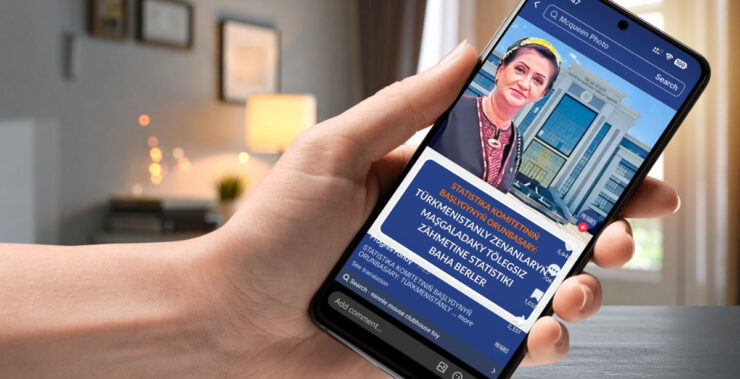
When the Progres Foundation, a think tank promoting independent research in Turkmenistan, posted a TikTok video about Turkmen government’s plan to officially measure unpaid household work, it sparked a massive conversation. The majority of the commentators misunderstood this statistical exercise as the government’s intention to pay women for doing unpaid housework.
The Turkmen state media announced on July 14, 2026 that a new study would measure how much time women spend on chores and caregiving. The goal was to show the hidden economic value of this work and highlight gender inequality. This makes sense given that women in Turkmenistan performed 91.4% of unpaid domestic work in 2019. In 2024, 14.4% of youth aged 15-24 were not in education, employment, or training (NEET) – a burden that disproportionately impacts young women (20.0%) compared to young men (8.0%).
Our TikTok post received nearly 234 thousand views, 693 comments and over 2,3 thousands reshares, garnering much attention and reaction from the public. However, out of 693 total comments, many viewers completely misunderstood the post. Hundreds of women did not interpret the announcement as ‘a statistical survey’ but instead believed that the government was about to start paying salaries to housewives.
Of 693 comments, 431 (62.2%) were written comments in which users shared opinions, experiences or questions and 262 (37.8%) were emoji-only reactions, most of which used positive or celebratory emojis. While it is difficult to determine the exact gender makeup of the users, the content of the comments strongly suggests that the majority were women, particularly homemakers engaged in unpaid labor.
An analysis of 431 written comments reveals that nearly a third of users mistakenly interpreted the government’s statistical tracking of unpaid work as financial assistance. Furthermore, the discussions highlight widespread economic insecurity, exhaustion from invisible household labor, and a significant communication barrier between institutional language and the public.
The table below breaks down the main issues and feelings expressed by women in the comments section, including examples of their relevant comments. Because comments often touched on multiple topics, percentages overlap and do not add up to 100%
Table 1. Summary of TikTok Comment Themes on Unpaid Labor in Turkmenistan
| Main Themes | % of Comments | Summary of What Women Are Saying | Example comments from commentators |
| Desire for Financial Help | 29.9% | Many thought a salary or benefit was coming. They noted how even small financial aid would help buy food, school supplies, or medicine. | “Oh God, even if they pay 1.5 million manat, that would allow mothers to buy school supplies for their kids and their own necessities.” |
| Seeking Recognition | 22.7% | Women felt seen and valued just by having their invisible household labor acknowledged publicly for the first time. | “Right now I really want to cry out loud. Someone has understood us.” “Finally they will understand our worth and care for us.” |
| Exhaustion from Unpaid Chores | 17.4% | Housework is described as a continuous, unpaid, and unappreciated shift involving childcare, cleaning, and caring for in-laws. | “I’ve been doing unpaid housework since I was 18, and now I am 33. Nobody ever said thank you or recognized my work. I have never worked in a paid job. I only served my mother-in-law, father-in-law, my husband, my kids and guests.” “In my opinion, housework is the hardest job that goes unseen.” |
| Religious Hope | 12.8% | With low expectations of government policy, many turned to prayer, hoping a miracle would bring relief. | “Even if it is not true, let it be true please.” “From her lips to God’s ears.” “God bless her.” |
| Job Scarcity & Bribes | 11.4% | Women want jobs, not handouts, but report that unemployment is high and finding work often requires paying bribes. | “I have a diploma in my hands. No one is employing me. Everyone needs a bribe. Who can I turn to and seek help?” “It is okay if they do not pay benefits and rather help us find jobs. I am happy to work and be paid.” “If there were jobs, I would work. I would not sit at home waiting for this financial support.” |
| Confusing Language | 10.2% | Many native Turkmen speakers could not understand the bureaucratic terminology used in the announcement. | “I cannot understand this in my native Turkmen language. It would have been better if you explained it in a simple language that people can understand.” “What does statistics mean? Can you please explain it in a simple language?” |
| Deep Skepticism | 9.3% | Viewers doubted the government would actually follow through, calling the announcement empty promises. | “Even if these are lies, they are pleasant to hear.” “This might be just an advertisement and empty words.” “We will not see this. It might happen in 100 years.” |
| Health Toll | 6.5% | Constant caregiving and childbirth take a heavy physical and mental toll without any medical support or recovery time. | “I took care of someone who was bedridden for 32 years. My entire life was spent on this. It affected my physical and mental health. I could not take proper care of my child or myself.” “Every woman after delivering a baby needs rehabilitation, needs to care for herself, and needs physical and psychological support.” |
| Exclusion from Welfare | 3.5% | Full-time homemakers feel left out when state cash gifts (like for March 8th) only go to officially employed women. | “I am a housewife with three children, and they do not pay me anything (for 8th of March). Aren’t we also women?” “Every time the state provides the 8 March money gift to working women, I feel offended because housewives do not receive anything.” |
| Gender Inequality & Power | 3.5% | Very few comments discussed sharing chores with husbands or mentioned how controlling family members block women from working. | “If one day the wife does the laundry, then the next time the husband should do it. They are asking us to be equal.” “Men do not realize how much housework women have.” “Many women have skills such as sewing, but their mothers-in-law and husbands do not let them work. They spend their youth taking care of children and the household, give up their dreams, lose their health and become emotionally exhausted.” “They should ensure that the money is paid directly to the woman herself. Mothers-in-law should be offered some training or counselling so they understand that the money belongs to the woman and must not be taken from her.” |
Note: Because comments often touch on multiple topics,
percentages overlap and do not add up to 100%
Donate to support Turkmen analysts, researchers and writers to produce factual, constructive and progressive content in their efforts to educate the public of Turkmenistan.
SUPPORT OUR WORKOverall, the flood of comments on this TikTok video highlights a harsh reality: widespread anxiety over unemployment, invisible domestic labor, and severe economic stress. When institutional announcements use heavy, confusing language, desperate citizens project their greatest hopes onto them, in this case, dreaming of financial relief. Beyond the confusion, the comments serve as a powerful megaphone for Turkmen women, giving a rare public voice to those who spend their lives working behind closed doors without pay, recognition, or support.
Methodological note: While TikTok comments do not provide a statistically representative sample of all women in Turkmenistan, they offer valuable qualitative insights into how women perceive and experience the burden of unpaid household work.
The post as it appears on Progres’ TikTok in the Turkmen language:
Statistika komitetiniň başlygynyň orunbasary: Türkmenistanly zenanlaryň maşgaladaky tölegsiz zähmetine statistiki baha berler
Güljemile Annanyýazowa görä, bu görkeziji Türkmenistan üçin möhüm ähmiýete eýedir. Sebäbi ýurtda aýallaryň ep-esli bölegi çagalara, gartaşan maşgala agzalaryna ideg etmek we öý hojalygyny alyp barmak ýaly tölegsiz öý işlerini ýerine ýetirýär.
Annanyýazowa Türkmenistanda öý hojalyklarynyň wagt býujetini öwrenmek boýunça barlag geçirmek meýilleşdirilýändigini aýdýar. Bu barlag öý işleri we ideg bilen bagly tölegsiz zähmetiň möçberine jynsy, ýaş toparlary we ýaşaýan ýeri boýunça baha bermäge mümkinçilik berer.
Aýallaryň ýerine ýetirýän tölegsiz zähmetiniň möçberi gender deňsizliginiň esasy görkezijisidir.
Dünýäde aýallar öý we ideg işlerine erkeklerden has köp wagt sarp edýärler. Bu deňsizlik aýallaryň ykdysady garaşsyzlygyna zarba urýar.