Turkmenistan receives the lowest levels of Official Development Assistance (ODA) in Central Asia, and development bank lending remains limited due to fewer opportunities for deeper financial and institutional engagement than in neighbouring countries.
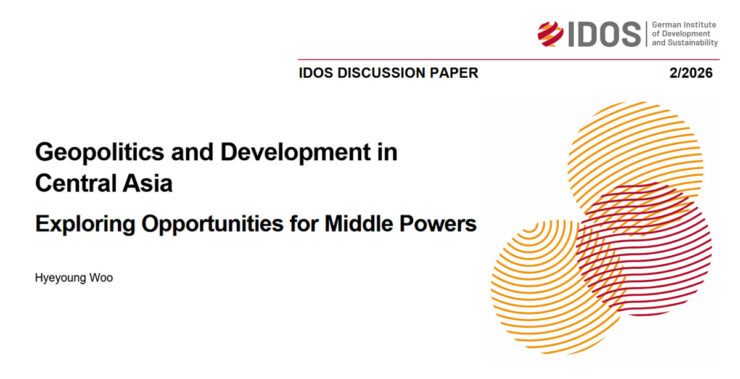
A recent discussion paper by the German Institute of Development and Sustainability (IDOS), “Geopolitics and Development in Central Asia: Exploring Opportunities for Middle Powers” examines how major powers and emerging donors engage with Central Asian countries through aid, investment, and development cooperation. The paper argues that traditional aid, understood as aid flows, is in decline as emerging donors increasingly use development cooperation to pursue foreign policy, geopolitical interests, and energy partnerships in Central Asia.
Official Development Assistance (ODA) is financial support provided in the form of grants or “soft” loans by official providers to aid recipients in areas such as health, sanitation, education, and infrastructure, helping developing countries achieve developmental goals and economic growth.
The study reveals that since 2010, the Central Asian countries have received the most aid from Japan and the US, followed by EU institutions, Germany, and France. The ODA volumes vary across the region, with Uzbekistan at USD 11.9 billion, being the largest recipient, and Kyrgyzstan at USD 8.2 billion; Tajikistan at USD 7.2 billion; Kazakhstan at USD 2 billion; and Turkmenistan at USD 0.5 billion, being the smallest aid recipients in Central Asia.
Turkmenistan’s ODA Profile
Despite Turkmenistan receiving approximately USD 500 millionin ODA between 2010 and 2023, this is a marginal amount of development aid compared with its regional neighbours. According to the research, aid accounted for only 0.1 percent of the country’s Gross National Income (GNI) between 2018 and 2022. The country’s GNI reached approximately USD 58.2 billion in 2022. The report also identified the top five donors to Turkmenistan by ODA volume in USD millions between 2010 and 2023.
- United States: the largest donor, providing approximately USD 104.6 million.
- European Union institutions: USD 61.7 million.
- Germany: USD 22.9 million.
- Türkiye: USD 15.6 million.
- South Korea: USD 12.1 million.
Major Development and Strategic Partners’ Engagement
United States
Donate to support Turkmen analysts, researchers and writers to produce factual, constructive and progressive content in their efforts to educate the public of Turkmenistan.
SUPPORT OUR WORK- The United States has focused on promoting regional stability, democratic governance, and security while incorporating human rights considerations through initiatives such as CASA-1000 (Central Asia–South Asia Electricity Transmission and Trade Project) and the C5+1 platform (Kazakhstan, the Kyrgyz Republic, Tajikistan, Turkmenistan, Uzbekistan, and the United States). However, following the termination of USAID programs under the Trump administration, development assistance declined significantly, reducing support for development initiatives across Central Asia.
European Union and Japan
- The European Union engages broadly across Central Asia through development cooperation, connectivity, governance, and sustainable development initiatives.
- Japan adopts country-specific programs to expand its soft power. In Turkmenistan, Japan’s engagement focuses on improving Japanese firms’ access to natural resources, expanding investment in the country’s energy sector, and strengthening bilateral trade.
China
- China’s engagement with Turkmenistan is primarily driven by energy cooperation and gas infrastructure investment, reflecting Turkmenistan’s strategic role as one of China’s major natural gas suppliers. Between 2008 and 2009, China provided approximately USD 6.01 billion to support the development of the Galkynysh Gas Field.
- At the institutional level, Turkmenistan participates in the China–Central Asia (C+C5) framework and Shanghai Cooperation Organization (SCO) dialogue formats, which promote regional economic cooperation and connectivity.
Türkiye and South Korea
- Türkiye has become an increasingly active development donor in Central Asia, although its ODA engagement in Turkmenistan remains relatively limited.
- South Korea’s presence as a development partner has been prominent in joint development and business initiatives. Turkmenistan participates in South Korea’s Knowledge Sharing Program (KSP), which supports policy consultation, capacity development, and economic cooperation across multiple sectors.
- Between 2019 and 2023, Turkmenistan received approximately 2 percent of South Korea’s USD 340 million ODA allocated to support economic development in Central Asia.
Overall, the paper’s findings suggest that Turkmenistan is less dependent on foreign aid than its neighbouring countries. The country’s future development trajectory appears increasingly tied to its ability to diversify its economy and improving the conditions for greater engagement with international development partners.
Factors Behind Turkmenistan’s Low ODA
While the paper does not discuss reasons for Turkmenistan’s low level of ODA, Turkmenistan’s classification as an upper-middle-income country, a category with GNI per capita within the USD 4,466–13,845 range in 2022, may partly explain its relatively limited ODA, as assistance is often prioritized toward lower-income and least developed countries. In addition to the country’s relatively high national income and hydrocarbon resources, limited openness to international engagement and transparency concerns may constrain opportunities for development cooperation. In this regard, the World Bank Country Engagement Note (CEN) of 2025 identifies several institutional constraints that may limit development partners’ engagement with Turkmenistan, including key risks related to data availability, government commitment to reforms, and limited implementation capacity for Bank-funded operations.
According to the World Bank, key risks in Turkmenistan include:
- High Fiduciary risks: weaknesses in public financial management and procurement processes, limited capacity to manage international procurement, and insufficient financial transparency.
- Substantial Political and Governance risks: challenges in sustaining government commitment and capacity for reforms.
- Substantial Macroeconomic risks: dependence on hydrocarbons, limited diversification, insufficient reform capacity, and unreliable or limited data.
- Substantial Institutional Capacity for Implementation and Sustainability risks: weaknesses in implementation capacity, bureaucratic delays, and limited experience in managing new international projects.
- Substantial Stakeholder risks: limited stakeholder engagement and potential resistance to reforms.