Following our initial 2021 assessment, the Progres Foundation has updated its analysis to evaluate how the Ashgabat housing market has evolved over the past five years. Our findings reveal a diverging trend in housing affordability: while rising minimum wages have made homeownership slightly more accessible for lower-income earners, property price growth has outpaced average salary increases, making it marginally harder for the average Turkmen to save for a home.
The Findings at a Glance
Housing affordability has moved in two different directions since 2021:
- For Minimum-Wage Earners: Housing has become more affordable. A 47% increase in the minimum wage has reduced the total years of work needed to buy a home by roughly 16% to 18%.
- For Average-Salary Earners: Housing has become slightly less affordable. Because property prices have risen faster than the average salary. These earners now need about 3% to 5% more time to save for a home compared to five years ago.
Table 1. Years Required to Purchase an Apartment in Ashgabat city
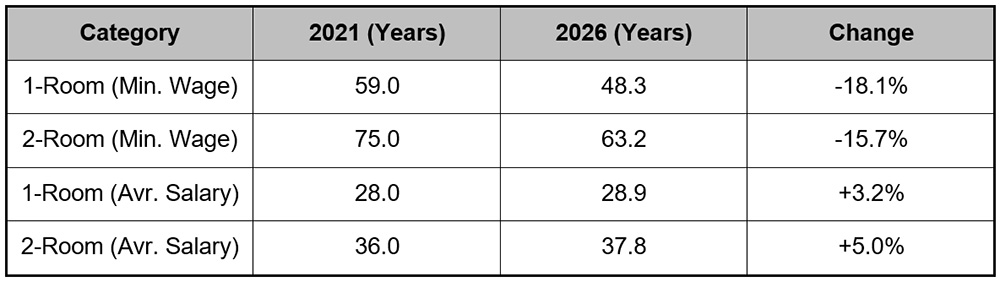
Note: Calculations are based on a statutory minimum wage increase of 47.3% (from 957 TMT to 1,410 TMT) and an estimated average monthly salary increase of 18.0% (from 2,000 TMT to 2,360 TMT). The “Years Required” figures reflect the time needed to purchase an apartment based on these income levels.
Why are housing prices rising?
Since 2021 the average price for a one-room apartment has increased by 70% and a two-room apartment by 74.3%. The increase in property prices is driven by a combination of market pressures:
- Supply Contraction: Large-scale urban re-development often replaces older, affordable apartment blocks with luxury buildings, leaving fewer low-cost options for residents.
- Demand Shifts: Continued migration to Ashgabat for education and jobs increases competition for housing. Similarly, the high profitability of short-term rentals encourages owners to bypass long-term tenants in favor of higher daily yields.
- Rising Construction Costs: Developers face high inflationary pressures, with the IMF projecting 5.4%-6.9% inflation for 2026 driven by higher food and import prices. Additionally, the dual exchange-rate system forces the construction sector to purchase imported materials at the higher black-market rate significantly increasing building costs and apartment prices.
Methodology and Data
This analysis focuses on housing in Ashgabat, where the cost of living is the highest in the country. We collected 30 recent listings for both one- and two-room apartments from TMCARS, covering both standard micro-district blocks and “elite” buildings, to estimate the years of income required to purchase a home. The samples included listings published during the same period to calculate the average and were filtered only to identify the cheapest and most expensive apartments.
Important Data Notes:
- Income Proxies: As there is no official nationwide average wage, we used Numbeo’s estimated net salary (2,360 TMT). As this is based on user-submitted data, it should be viewed as an estimate rather than an official statistic. Meanwhile, the minimum wage was 1,410 TMT in 2025.
- Shared vs. Private: Some “one-room” listings include shared accommodation (renting a single room within a larger apartment). Therefore, these affordability metrics represent a “best-case” lower-bound estimate.
- Currency Sensitivity: Real estate is primarily priced in USD, while wages are in TMT. With the black-market exchange rate at approximately 19.50 TMT per USD, compared to the fixed official rate of 3.5 TMT, any currency volatility significantly impacts how many years of labor are required to afford a home.
Table 2. Rental Market Overview (2026)
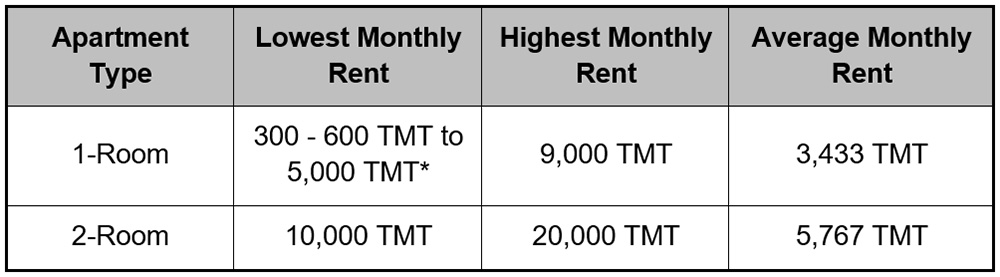
*Includes shared accommodation (300-600 TMT) and private rentals in micro-districts (5,000 TMT).
Donate to support Turkmen analysts, researchers and writers to produce factual, constructive and progressive content in their efforts to educate the public of Turkmenistan.
SUPPORT OUR WORKThere were numerous daily rentals priced between 80 and 300 TMT for one- and two-room apartments, while the lowest daily rate (elite apartment) was 500-650 TMT. These findings are broadly consistent with Numbeo’s estimates for 2026: an average monthly rent of 3,660 TMT for a one-bedroom apartment in the city center, 2,625 TMT outside the city center, and 5,625-5,800 TMT for three-bedroom apartments.
To calculate the affordability index, we used the following average purchase prices collected from recent listings:
- One-Room Apartment: Lowest: $32,000 | Highest: $57,000 | Average: $41,913
- Two-Room Apartment: Lowest: $52,500 | Highest: $97,000 | Average: $54,847
These findings are also consistent with 2026 Numbeo estimates, which place the average price per square meter in Ashgabat at approximately 10,000-12,400 TMT, depending on the location of the property.
To put these prices into perspective, buying a home in Ashgabat requires a lifetime of earnings. A minimum-wage earner today must work for approximately 48 years to afford a one-room apartment, or over 63 years for a two-room unit. Even for those earning the average salary, the cost remains daunting, requiring roughly 29 years of income for a one-room apartment and 38 years for a two-room unit. While affordability has improved slightly since our 2021 study, particularly for minimum-wage earners, the path to homeownership remains exceptionally difficult.
Regional Comparison
Housing in Ashgabat remains significantly less affordable than in other Central Asian countries. Numbeo’s 2026 price-to-income ratio indicates that Kazakhstan is the most affordable among neighboring countries, with 8.9 years of income needed to purchase a 90 m² apartment for a family. Housing affordability is also lower in other countries:
- Kazakhstan: 8.9 years;
- Tajikistan: 11.4 years;
- Uzbekistan: 13.4 years;
- Kyrgyzstan: 15.1 years.
However, different methodologies were used to analyse housing affordability in Turkmenistan vs the regional peers. Our Ashgabat study measures the affordability of smaller, one- and two-room apartments based on individual minimum or average wages. In contrast, regional benchmarks from Numbeo, calculate a ‘Price-to-Income Ratio’ based on a household unit (assuming 1.5 earners) purchasing a standard 90 m² family apartment. This partially explains why the average years needed to purchase an apartment is lower in the neighboring countries. Hence, our figures specifically highlight the affordability challenges faced by individual earners, while regional data provides a broader, family-based benchmark.
Pathways to Homeownership
While several mortgage options exist, they remain difficult to access for the average Turkmen citizen:
- Halkbank: Offers 1% interest loans with up to 30-year repayment terms, but these are strictly limited to purchasing new residential developments in Ashgabat.
- Turkmen-Turkish Joint-Stock Commercial Bank: Also provides 30-year loans, but with a restrictive 30% down payment requirement. This program is also limited to public-sector employees and existing bank customers.
- State Housing: Priority social groups, such as those living in inadequate housing, may be eligible for state-owned units, though this process relies on long-standing, often decade-long waiting lists.
Our analysis of public sentiment on TikTok also revealed that many Turkmen citizens face severe housing insecurity characterized by long waiting lists, extreme overcrowding, and a lack of transparency in state allocation processes. It highlights a significant gap between constitutional housing rights and the reality of limited affordability and inadequate living conditions for the majority of the population.
Ultimately, resolving the housing crisis requires dismantling systemic barriers, most notably the lack of transparent allocation, restrictive mortgage criteria, and the economic instability of a dual-currency market. By replacing state-managed scarcity with an equitable, merit-based system and expanding mortgage eligibility beyond the public sector, Turkmenistan can incentivize sustainable construction and broaden access to homeownership. Shifting toward these reforms is essential to ensuring that housing becomes an attainable reality for the many, rather than an unattainable dream for the few.