Turkmenistan’s 2025 Human Rights Ombudsman report reveals a striking reality – while the number of citizen complaints have increased by 25.7% since 2024, the share of those resolved has not changed, it remains at mere 6%. It is also clear that citizens are increasingly grouping together to demand their rights, demonstrated by a large share of submissions collectively. At the same time, Turkmenistan’s primary human rights office lacks authority and faces constant delays from the very ministries whose compliance and respect for human rights it is legally mandated to ensure.
Statistical Discrepancies: Making the Surge Look Smaller
The report states that total complaints grew by 20.4%. However, the Ombudsperson used an inconsistent mathematical method to arrive at this lower number. When calculating individual increases, the report correctly compares the new growth against the previous year (2024) as a baseline, showing that written complaints surged by 24.4% and oral ones by 28.9%. When calculating the total combined increase, the authors switched tactics. Instead of comparing the growth to 2024, they divided it by the larger 2025 total. If the report had stayed consistent and used the standard 2024 baseline, the total spike in public grievances would actually be 25.7%. By changing the formula, the authors subtly minimized the appearance of growing public discontent.
Statistical Discrepancies: Making the Success Look Larger
A case is considered “satisfied” when the Ombudsman’s intervention directly results in the restoration of a citizen’s violated rights, the correction of an administrative error, or the recovery of funds. The Ombudsman boasts an official 15.7% success rate for resolved cases. While mathematically accurate on paper, this number is based on a highly restrictive administrative filter. The office ignores 73.6% of all total submissions (498 out of 676 cases). They only calculate success from a tiny, hand-picked pool of 178 written complaints that they chose to formally investigate (“take into production”).
However, if you look at the big picture, the true success rate drops drastically:
- 5.9% is the written success rate: Out of all 475 formal written letters sent by citizens, only 28 were actually satisfied.
- 4.1% is the absolute success rate: If you count any citizen who reached out for help, including the 201 people who walked in to give oral complaints, the absolute success rate drops dramatically.
Why Legitimate Grievances are not Considered
The report treats the remaining hundreds of cases as procedural noise rather than real human problems.
- Dismissing Oral Complaints (201 cases): Oral grievances are treated as informal chats. The Ombudsman counts giving “on-the-spot legal advice” as a closed case, but these are never tracked statistically or counted as “satisfied”, meaning no real legal action is taken to resolve the root issue.
- The Bureaucratic Hand-Off (164 cases): Over a third of written complaints (34.5%) were answered with “recommendation letters” telling citizens how to fix the problem themselves or pointing them to another agency. The state logs this as “legal guidance”, but to the citizen, the problem remains entirely unresolved.
- Rigid Rejections (105 cases): Nearly a quarter of written complaints (22.1%) were thrown out entirely. While some lacked signatures, many were rejected due to a “competence gap”. Citizens frequently appeal to the Ombudsman as a last resort regarding unfair court rulings, but the office legally lacks the power to change them and simply dismisses them.
The massive gap between submitted complaints and actual resolutions highlights a major barrier for the public. Turkmen citizens do not have a robust culture and history of filing official legal paperwork. While national literacy is high, navigating rigid, confusing state application guidelines might be incredibly difficult for many.
Collective Cry for Help
In 2025 the total number of citizens sharing their grievances increased by 50% or 993 citizens. This increase was driven by 49 collective petitions signed by 567 people. Lebap region led this trend with 232 citizens joining efforts to achieve change. It might be because individuals feel they have a greater chance of getting the government’s attention due to their sheer number, or because many people lack knowledge and understanding of formal submissions and hence join the petitions initiated by others.
Government Agencies Simply Ignore Deadlines
A striking 32.4% of government agencies completely ignored the legal deadlines to respond to the Ombudsman’s inquiries. The Ombudsman openly blamed this on an “irresponsible approach” by leadership. Notably, not a single agency utilized a new legal provision allowing them to formally ask for an extension, simply letting the deadlines pass.
Legal Mandates Without Enforcement Power
The institutional framework governing the mandate and limitations on an ombudsman is anchored in the Law of Turkmenistan On the Ombudsman. Article 1 of the Law explicitly established the office to ensure state guarantees for human rights by complementing, rather than restricting, the existing competencies of other state institutions. However, the law limits this mandate to a complementary role rather than giving the office overriding authority.
While the law grants the Ombudsman broad powers to inspect facilities and request documents, it denies her direct enforcement mechanisms over non-compliant ministries and local governments (khyakimliks). A clear example of this is Article 17, titled “Liability for obstructing the activities of the Ombudsman”, which states that officials who fail to fulfill their duties or obstruct her work “shall entail liability established by the legislation of Turkmenistan”. On paper, this creates a legal basis for liability; in reality, it functions as a bureaucratic dead end. The Ombudsman’s own law establishes no direct penalties, such as fines or disciplinary actions, for dismissing her timelines. Instead, if an official ignores her queries, her only recourse under Article 18 is to ask another state body or the Prosecutor General to act. Because state agencies face no direct, independent penalties from her office, they can simply let legal deadlines pass with impunity. This leaves the Ombudsman in an institutional paradox: she is legally empowered by Article 1 to oversee human rights compliance, but left entirely dependent on the executive branch to punish its own members when they violate Article 17.
Donate to support Turkmen analysts, researchers and writers to produce factual, constructive and progressive content in their efforts to educate the public of Turkmenistan.
SUPPORT OUR WORKWhat Citizens Are Complaining About: Top Topics
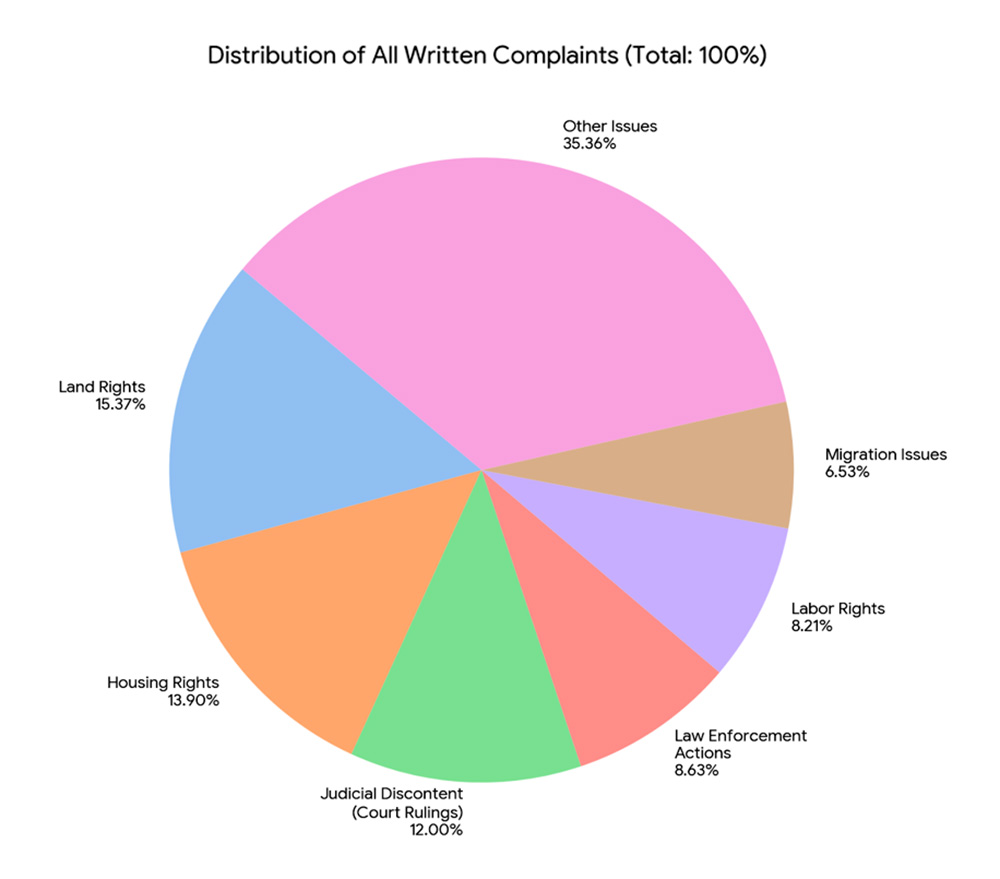
The public’s written grievances primarily focus on basic survival, legal challenges, and economic rights.
Housing Challenges
Housing remains a serious concern in Turkmenistan. While the state boasts about building 645,000 square meters of housing, the report exposes severe underlying issues. A major new trend involves failed “share construction” (cooperative housing). Citizens paid private contractors (such as the firm Mynasyp gerçek) advance life savings, only to receive severely delayed, poor-quality homes that failed basic state safety standards. Furthermore, infrastructure is failing; a collective complaint from 56 people in Geokdepe revealed that a residential complex completed in 2021 still lacked drinking water and electricity in 2025.
Labor Rights and Forced Labour
The Ombudsman recorded 48 labor disputes. Landmark resolutions included forcing a state employer to pay major back-pay (23,769 manats and 10,959 manats) to two citizens who had worked for decades without ever being allowed to take vacation.
The report references cooperation with the International Labour Organization (ILO) to monitor labour rights conditions during cotton harvest. The Ombudsman admits to sending “proposals” regarding the prevention of child labor during the harvest to the Prosecutor General, the Ministry of Internal Affairs, the Ministry of Education, and regional governors. However, the report fails to mention a single specific documented violation or name any penalized officials in relation to forced labour.
Exit Denials and Travel Fraud
Migration accounted for 44 complaints, heavily featuring citizens who were arbitrarily barred from leaving the country by the State Migration Service. It consistently issued only vague, brief legal justifications for travel bans. The report also highlights private sector travel fraud: four citizens were scammed out of over 70,000 manats each by a private firm (Mirasa syýahat) promising work visas that never existed.
Women, Children, and Gender-Based Violence (GBV)
The report highlights the creation of a new Department for the Protection of Women and Children’s Rights (which handled 178 written and 47 oral complaints). However, the report does not explicitly mention a single case of domestic violence, child abuse, or gender-based violence. Its documented activities are generic, such as inspecting a children’s home in Balkanabat and recommending better food.
Interestingly, women made up the majority of oral (in-person) complaints (146 women vs. 98 men), indicating they are actively seeking help, even if their specific domestic grievances might be sanitized out of the final text.
Declining Birth Rates & Rising Disability
While state media continuously projects an image of economic and population growth, the report’s raw data accidentally leaks a much grimmer demographic reality.
- The 10% Drop in First-Graders: The report reveals that the number of children entering the first grade was 131,523 (2025-2026) compared to 146,065 (2024-2025). This is a 10% decline in a single year, exposing an undeniable drop in birth rates or a massive wave of unregistered family emigration.
- Surging Disability Numbers: The number of registered people with disabilities rose significantly from 201,593 in 2025 to 207,151 by January 2026. Combined with the shrinking youth population, these numbers paint a worrying picture of national health and demographic sustainability.
- The “Entrepreneur” Illusion: The state notes that 29,000 people registered as entrepreneurs in 2025 (surpassing the 27,000 looking for jobs at the public employment agency). However, the report mentions that the entire private sector created only 1,100 actual jobs all year. This shows that these “entrepreneurs” are not thriving business owners, but desperate, unemployed citizens forced into informal, precarious self-employment to survive.
The Way Forward: Moving from Paper to Action
The surge in collective petitions shows that citizens are increasingly eager to defend their rights. To meet this demand, the Ombudsman’s office must transition from a passive administrative gatekeeper into an active educator. Under Articles 33 and 34 of the Law, the Ombudsman is already legally obligated to raise public human rights awareness, use mass media to teach citizens how to protect their rights, and train civil servants. Instead of dismissing hundreds of cases over rigid paperwork technicalities, the office must deploy these exact legal powers to run public workshops that teach ordinary people how to successfully navigate the complaint process. Furthermore, the office must establish a strict follow-up system for oral complaints and “recommendation letters” to ensure citizens actually receive help on the ground. Ultimately, Turkmenistan must give the Ombudsman real enforcement authority, transforming the office from a legal observer into an empowered watchdog capable of compelling timely government compliance.