In examining the history of Turkmen tribal society, I encountered the remarkable story of a woman whose leadership is reflected in both historical accounts and Turkmen literature. In the nineteenth century, authority within Turkmen communities was largely exercised by male elders and warriors, and leadership was closely associated with masculinity. Women were generally expected to remain within the domestic sphere, fulfilling roles as caretakers and mothers. Yet, despite these deeply rooted norms, Güljemal Khan emerged as an authentic political figure rather than a later folkloric invention. Remembered across generations as the woman khan of the Merv (Mary) region in the nineteenth and early twentieth centuries, her legacy challenges conventional assumptions about gender and power in Turkmen society.
Historical records indicate that Güljemal Khan, born around 1836 in Tejen, and passing away in 1925 in Mary, was the daughter of Töre-Soky, a member of the noble Beg clan of the Teke tribe. She was also a distant relative of the ruler of Merv, Gowşut Khan, and the second wife of Nurberdi Khan, who ruled over the Ahal and Mary Teke. Güljemal Khan lost her first husband, Anna-Öwez, in 1855 during an attack on the Teke of Saragt by Khivan Khan Muhammad Emin. In 1858, the Teke were resettled in Merv, with Nurberdi Khan playing a key role in assisting the population and receiving a significant grant of land and water in the oasis. In gratitude, the Merv Teke gave the widowed Güljemal Khan to Nurberdi Khan. According to written sources, she had a son with Nurberdi Khan, Yusup Khan, and was also the stepmother of Magtymguly Khan (Атдаев, 2024; Türkmen hanlary we serdarlary, 1992).
Leadership without rebellion
My research on Güljemal Khan reveals a leader who lived within established traditions rather than in open defiance of them. A skilled diplomat and accomplished negotiator, she effectively managed the Merv oasis’s socio-political and economic affairs. Her leadership became particularly significant as she addressed the future of the Turkmen people amid the expanding influence of the Russian Empire. This challenge intensified following the fall of the Gökdepe Fortress in 1881, an event that decisively altered the regional balance of power. In the aftermath of this military defeat, the Merv population faced a critical decision: to continue armed resistance with uncertain prospects and heavy human losses or to pursue strategic accommodation with a rapidly expanding empire.
In this context, Güljemal Khan’s position assumes particular importance. Archival evidence indicates that she was “the first to speak in favor of Merv’s annexation to Russia” and notes her presentation to Alexander III in Baku in 1888, accompanied by her two sons, both officers in Russian service (Soegov, 2020). This episode signifies more than ceremonial recognition; it reflects her active participation in shaping Merv’s political transition. Her reception by Alexander III suggests that she was regarded as politically significant and recognized by Russian authorities as a legitimate representative of Merv’s elite.
The recognition by imperial authorities did not represent a shift away from Turkmen political traditions. Instead, it was grounded in the authority and legitimacy she had already established within her own society. In keeping with the long-standing institution of the Geňeş (Council), she was distinguished for her attentive listening and her active participation in guiding discussions on both routine and strategic issues alongside serdars and community members. She neither rejected nor distanced herself from her cultural environment. Instead, she exercised authority through its established norms and values. Described as a commanding presence in traditional Turkmen dress, wearing a börük adorned with silver and semiprecious stones, she earned broad respect among her contemporaries. As men of her time remarked: “Güljemal Khan is one of the khans who can teach even the devil a lesson. Do not look at her as a woman. She would carry off all your little khans with water and bring them back without it“.
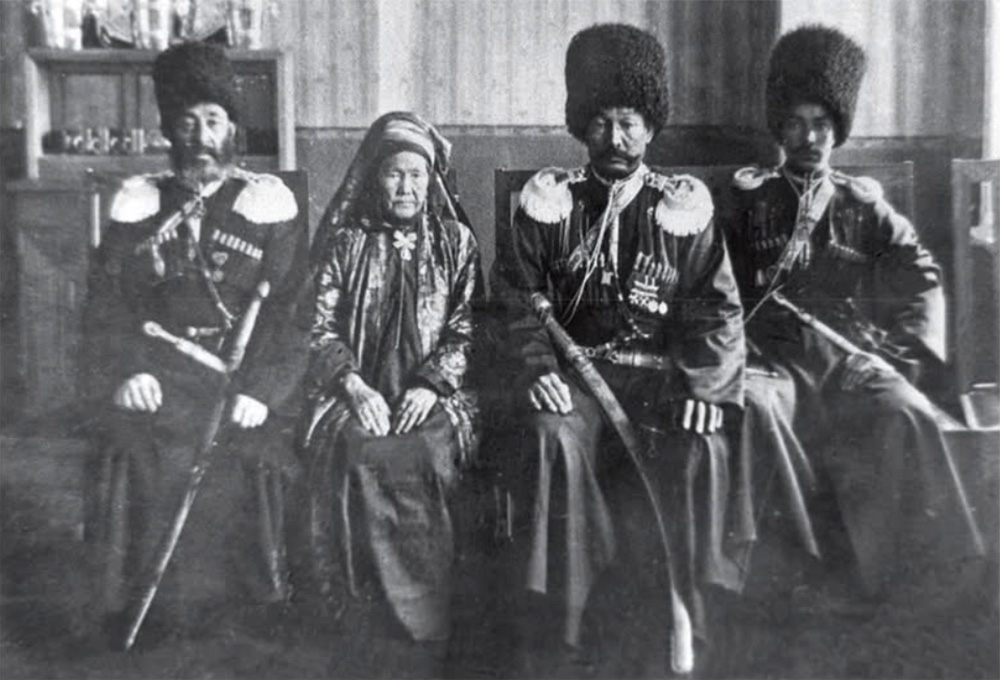
Photo: Güljemal Khan (center) with her stepson Magtymguly Khan (left) and her son Yusup Khan (right) in 1910 in St. Petersburg during the celebrations marking the 25th anniversary of the voluntary incorporation of Merv into the Russian Empire. A cropped section of a photograph taken by K. Bull (Soegov, 2020).
Güljemal Khan gained influence not by imitating men, but by broadening the concept of leadership. In a society where power was seen as masculine, she redefined it through wisdom, negotiation, and moral strength.
Collective memory
Traditional Turkmen storytelling and visual arts play a significant role in maintaining the collective memory across generations. Cultural narratives and stories about Güljemal Khan presented in Turkmen official media channels emphasize her as a significant historical figure who “played a big political role after the death of Nurberdi Khan”, as well asstories on social media. Turkmen storytelling has been instrumental in preserving her legacy, while many others have faded from memory.
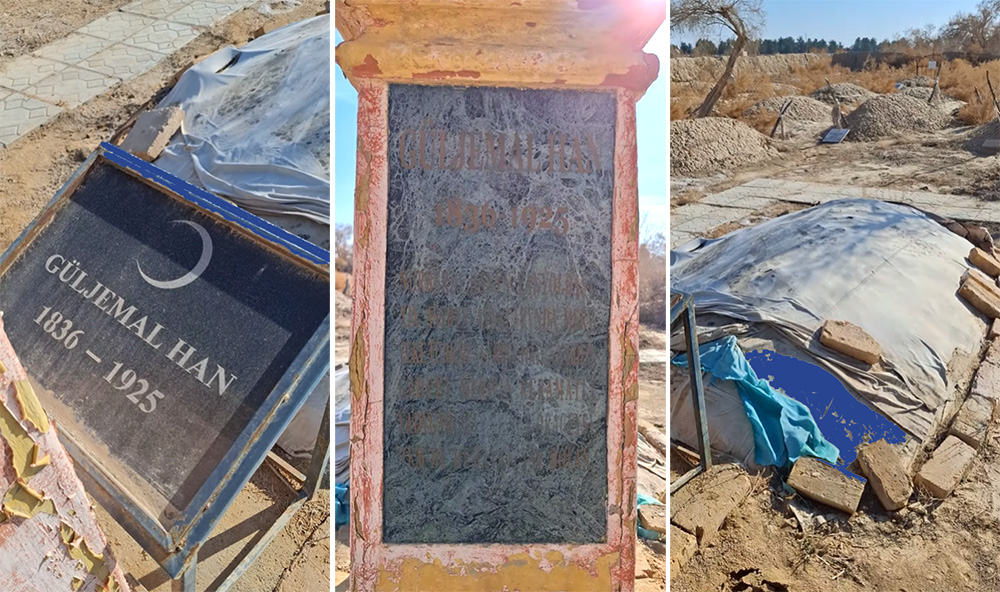
Image of the grave of Güljemal Khan, Edermen, YouTube, accessed March 2026
Societies often remember individuals whose lives embody important values and key moments. It is evident in the memory of Güljemal Khan, as seen in the visual art at the History and Country Study museum in Mary. Paintings of her personality contribute to the visual representation of national memory and identity. Works by the People’s Artist of Turkmenistan, Ata Akyýew, such as The Legend of Merv and Güljemal Khan, commemorate the historical legacy of Merv and the character of our heroic woman. These works also emphasize their symbolic importance in contemporary cultural discussions.
Donate to support Turkmen analysts, researchers and writers to produce factual, constructive and progressive content in their efforts to educate the public of Turkmenistan.
SUPPORT OUR WORKTurkmen history recalls her not only because female leadership was exceptional within a traditionally patriarchal tribal society, but also because her tenure coincided with a critical turning point for the Turkmen people. The expanding authority of the Russian Empire forced a profound choice: whether accommodation within a foreign imperial system, despite differences in culture and religion, would better serve the people, or whether resistance and sacrifice in defense of independence was the rightful path. Faced with this dilemma, Güljemal Khan chose what she believed to be the most prudent course for her people, accepting the Russian Empire’s assurances regarding the preservation of cultural and religious freedoms. In collective memory, she endured as the embodiment of deeply respected cultural values. She became more than a political leader. She became a lasting example.
Güljemal Khan in Turkmen literary narratives
The literary image of Güljemal Khan is powerfully rendered by Gylyç Kulyýew (1913-1990) in his historical novel Güljemal Han. Drawing on oral traditions and the limited archival materials available, Kulyýew reconstructs the life of a woman tribal leader and the political and social world that surrounded her. Through carefully crafted dialogue and narrative detail, he presents a figure who embodies authority exercised within tradition.
In the novel, the author attributes to her the following words, which capture both her political insight and her rootedness in custom: “Our community follows a longstanding tradition: in times of external threat, significant hardship, or major disputes over land or water, a council is convened. The khans and elders gather to consult and reach a decision. The majority opinion determines the outcome”.
Such literary representation deepens our understanding of her character, her voice, demeanor, and leadership style. Narratives of this kind enable modern readers to engage more fully with her historical presence. With each retelling, new generations reaffirm the image of a traditional woman who played a singular role in her time, ensuring that the memory of this remarkable leader remains vivid and accessible.
Quietly Redefining Leadership
As we honor women breaking barriers this month, Güljemal Khan’s legacy reminds us that change is not always dramatic. Sometimes, barriers are moved little by little until what once seemed out of reach becomes possible. Her story shows that even in strict social and political systems, women have always found ways to lead, make decisions, and support their communities with strength and vision.
References
- Атдаев С. Дж. 2024. Гюль-Джемал-Хан (Последние штрихи к портрету). Институт Истории и археологии. Академия наук Туркменистана. Ашгабат. Туркменистан.
- Edermen. 2024. GÜLJEMAL han we ogly ÝUSUP hanyň gubury (Grave of Güljemal Khan and her son Yusup Khan. [Video]. YouTube).
- Kulyýew Gylyç. Güljemal Han. Historical novel.
- Soegov M. 2020. About Graphic Portraits and Verbal Characteristics of Magtymguly Khan, Son of Nurberdi Khan. (To the 140th anniversary of the heroic defense of Dengil Fortress / Dingli-Tepe). In Peoples and Cultures of the Sayan-Altai and Bordering Territories.
- Соегов M. 2017. Британские Участники Событий 1918 года о Членах Первого Туркменского Правительства. Вестник Казахстанско-Американского Свободного Университета. Выпуск 2. Общие Вопросы Филологии.
- Türkmen hanlary we serdarlary. 1992. Turkmenistanistanyň Ylymlar Akademiýasy. “Ensiklopediýa neşirýaty”. P.58.
- Turkmenistan Golden Age. 2016. Woman in a national history and culture: a creative role and an inspiring image in a heritage and traditions of a modern society.
By Oguljamal Yazliyeva,
Ph.D., Charles University
Image:
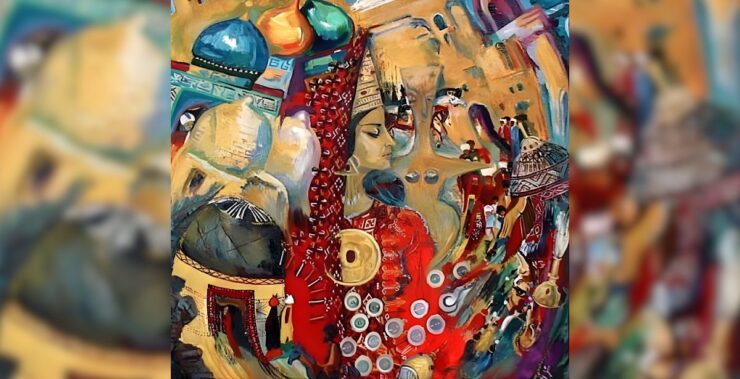
Reproduction of a painting “Merv”
by Turkmen artist Suray Akmyradowa,
from O. Yazliyeva’s personal collection.