
Large families with five or more children were once a cornerstone of Turkmen society, but economic pressures have driven a sharp demographic shift, making families of this size increasingly rare. UNICEF data shows that the fertility rate in Turkmenistan stood at 2.6 births per woman in 2025 and is expected to drop toward the replacement level of fertility of 2.1 by 2050. The decline was particularly noticeable in Lebap and Dashoguz, while in Ahal and Ashgabat, it has remained comparatively stable.With over 50% of the country’s population under 30, demographic indicators and public testimony suggest that reproductive choices are constrained by economic insecurity. Low wages combined with child benefits are insufficient to offset the costs of childbirth, infant necessities, and housing, leading many people of reproductive age to hesitate having children in Turkmenistan.
Perceived Barriers to Having Children: Evidence from TikTok Comments
A TikTok post by Progres Foundation summarizing a recent UNFPA survey about barriers to starting families and having children opened a critical window into readers’ perspectives on decisions around having children. The post garnered thousands of views and likes and received 316 comments. After excluding comments consisting only of emojis and unrelated content, 217 comments were examined to identify the main factors shaping contributors’ stance on having children. The analysis of comments revealed several recurring concerns in which financial pressure, such as low salaries, rising consumer prices, and the cost of raising children, dominated the discussion (42.9%). Housing insecurity was the second most common concern among commenters (21.2%), followed by medical expenses (8.8%), the cost of marriage (7.8%), insufficient state support (7.4%), and unemployment (5.1%).
Figure 1. Self-Reported Barriers to Childbearing: Distribution of Primary Concerns (%)
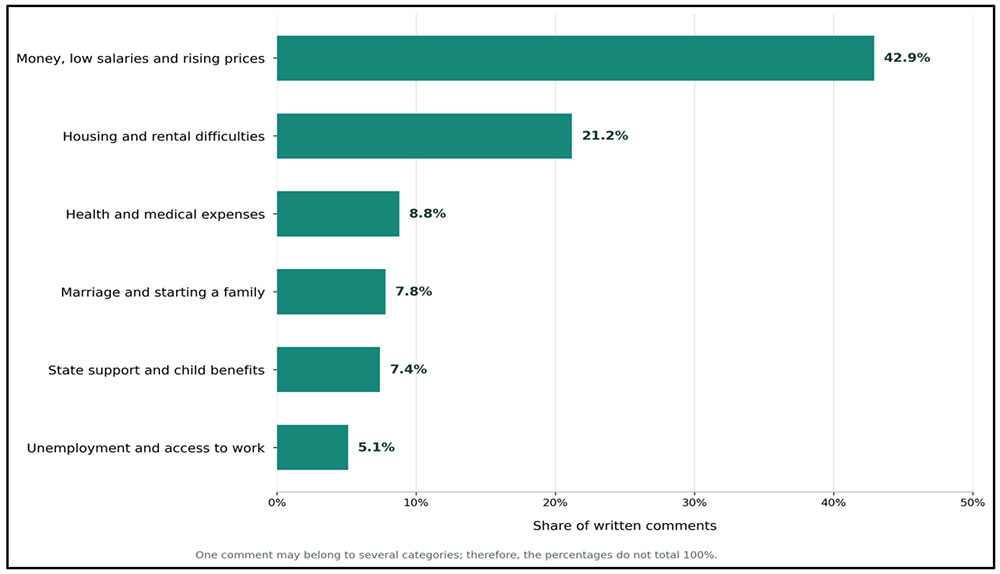
Note: Some comments addressed multiple issues and were therefore included in more than one category. Hence, the percentages do not total 100%.
To illustrate these concerns and capture how people described the issue in their own words, Table 1 presents the comments that received the most likes and engagement.
Table 1. Most-Liked TikTok Comments on Having Children in Turkmenistan
| Likes | English translation | Original comment in Turkmen |
| 277 | “Why have children? There are already so many beggars. How are you supposed to raise them on 2,000 manat?” | Waý, çaga näme gerek, gedaý köpeldip 2 000 manat bilen nädip ulaltjak? |
| 123 | “I have five children, thank God. If one of them gets sick, it costs 4,000 manat. How are people supposed to have children?” | Mende 5 çaga bar, Alla şükür, biri ýaraman galsa, 4 000 manat çykýar, nädip köpelsinler? |
| 114 | “These days, two children are like ten children. Thank God.” | Şu döwürde 2 çaga 10 çaganyň ýerini tutýar, Hudaýa şükür. |
| 95 | “I have eight children… My oldest is 37 years old and still doesn’t have a house or apartment in his name.” | 8 çagam bar… Iň uly çagam 37 ýaşynda, öz adyna jaýy ýok… |
| 72 | “There’s no need to have more than one or two children… Everything is expensive. Who would have more than two children?” | 1–2-den artyk çaga geregi ýok. Hemme zat gymmat, 2-den artyk çagany kim dogursyn? |
| 71 | “People are even hesitant to get married, let alone have children 😁.” | Millet öýlenmäge çekinýär, çaga ýasamak aňyrda dursun 😁. |
| 64 | “Look at the root of the problem… Everywhere you look, people are renting because they don’t have a home; everywhere you look, people are unemployed…” | Meseläniň düýbüne serediň… kimi görseň kwartirant, jaýy ýok; kimi görseň işsiz… |
| 41 | “The doctor’s informal payment is 1,000 manat just for giving birth.” | Lukmanyň el haky 1 000 manat çaga doguranyň üçin. |
| 39 | “I have one child, and one person’s salary is barely enough. Tell me, how are we supposed to have more children?” | 1 çagam bar, şoňa 1 aýlyk zordan ýetýär… nädip köpelişmeli aýdyň maňa… |
The Economics of Parenthood: Household Costs vs. Family Benefits
Can Turkmen families afford to have children?While there is no official nationwide estimate of how much it costs to have and raise a child in Turkmenistan, available data on wages, child benefits, healthcare, housing and food shed light on the financial pressure families may face.
- Household costs
The cost of raising children must be understood within the broader context of household expenditure in Turkmenistan, where families already face considerable costs for basic necessities, including food, housing, utilities and healthcare.
According to Numbeo, the average monthly salary after tax is 2,400 manat while the official minimum monthly wage was 1,410 manat in 2025. To put this salary into perspective, renting a one-bedroom apartment in Ashgabat costs an estimated 2,625–3,433 TMT per month. When housing alone exceeds an individual’s entire monthly earnings, introducing a kid into this structure adds further financial pressure which is likely to be even greater for families living in rented accommodation, particularly given the country’s wider housing insecurity.
Out of Pocket Healthcare and Childbirth: According to the World Health Organisation (WHO), about 77.4% of all healthcare spending in Turkmenistan was out of pocketin 2023, while public health spending covered only 17%. This means, maternal and pediatric care expenses cannot be relied upon as a free public service. As noted in Table 1 above, the informal delivery fee (el haky) is roughly 1,000 manat, which is almost half of an average monthly salary. When added to future childhood medical expenses, this creates a financial burden especially for single-income households.
Child Nutrition and Food affordability: Regardless of income, families tend to spend more on food especially when their children get older. In Turkmenistan, the poorest households spend around 68% of their total expenditure on food, compared with the national average of 59%, leaving only 32% of the income available for all other recurring expenses such as clothing, healthcare, education.
Donate to support Turkmen analysts, researchers and writers to produce factual, constructive and progressive content in their efforts to educate the public of Turkmenistan.
SUPPORT OUR WORKFamilies renting privately must cover these costs alongside all their other essential household expenses. Consequently, the inability to afford a balanced diet is substituted with low-cost, calorie-dense foods. Findings from the UNICEF 2024 National Micronutrient Survey (TNMS) show that: only 56% of children aged 6–23 months receive a Minimum Acceptable Diet, while 70.3% consume junk food and 67.6% consume sugary beverages. Nutritional deprivation in early childhood can have lifetime consequences on children from survival, physical growth and cognitive development.
- Family Benefits
Maternity benefit: Under Article 74 of Turkmenistan’s Code on Social Protection of the Population, an employed woman receives maternity benefit calculated by multiplying her average daily earnings during the 12 months preceding maternity leave by the number of calendar days of leave. Formally employed mothers receive 16 weeks of paid maternity leave, but subsequent childcare leave is unpaid. This means that households in which a parent stops working to provide childcare fulltime will experience a reduction in earned income as child-related expenses rise.
One-time childbirth benefit: Under Article 75, families are entitled to a one-time childbirth benefit calculated as a percentage of the statutory base amount, which was set at 520 manat in 2025. Families receive 676 manat (130%) for the first or second child, 1,300 manat (250%) for the third and higher amounts for each subsequent child. The right to the benefit is non-conditional on employment status and belongs to the mother (or father/adoptive parent/guardian if the mother is absent or deceased) upon the birth of a live child.
Monthly childcare benefit: Under Article 76, families receive a monthly childcare benefit equal to 75% of the 520 manat base amount, (amounting to 390 manat per child per month), paid from birth until the child turns three. It is granted regardless of employment status to all mothers, including housewives and unemployed caregivers.
Despite the family benefits available, the financial contribution provided by the state remains limited in relation to the broader costs of raising children. From housing and food to healthcare and childcare, families bear much of the financial responsibility themselves.
Overall, the above discussed evidence hints to a substantial gap between available financial resources and families’ everyday needs. The TikTok comments support this finding, revealing a widespread perception that having children has become increasingly unaffordable in Turkmenistan. When a single hospital delivery costing almost half the average monthly wage and food expenditures claiming nearly 60% of household income, the 390-manat monthly childcare allowance falls far short of essential needs; under such pressures, it is hardly surprising that families are sizing down.
For young couples already struggling with low incomes, rising unemployment and inadequate housing, establishing a household may already feel unattainable, let alone having and raising one or more children. Decisions to delay and have fewer children may therefore represent a practical response to economic insecurity in Turkmenistan rather than shaped by personal preferences.
Methodological Note: TikTok comments are not statistically representative of the population but provide qualitative evidence of public perceptions and experiences on barriers of having children.
The post as it appears on Progres’ TikTok in the Turkmen language:
Türkmenistanlylaryň çaga edinmek meýilleri gowşaýar
BMG-niň Ilat Gaznasynyň (UNFPA) täze pikir soramasynyň netijeleri sebitde ýaş adamlaryň maşgala gurmagy isleýändigini, ýöne bu maksada ýetmekde uly päsgelçilikler bilen ýüzbe-ýüz bolýandygyny görkezýär. Sebäpler sebit boýunça umumylaşdyrylýar. Türkmenistandaky UNFPA edarasynyň ýolbaşçysy Kemal Goşlyýewiň aýtmagyna görä, çümdürtik edip bellän sebäpleriniň içinde jaý edinmek meselesi, işsizlik we maşgaladaky gatnaşyklar bellenilýär. Bu meseleleriň näderejede türkmenistanly ýaş adamlaryna degişlidigi aýdylanok.
Soňky birnäçe onýyllyklaryň dowamynda Türkmenistanda çaga dogurmagyň derejesi yzygiderli pese gaçdy. 1990-njy ýyllarda çaga dogluş koeffisiýenti 3,6 bolan bolsa, şu wagt bu san 2,6 çenli aşak düşdi. Gurama bu sanyň has hem aşak düşmegini çaklaýar. Koeffisiýent aýalyň ömrüniň dowamynda ortaça näçe çaga dogurjakdygyny ölçeýär.