Turkmenistan is moving against the regional trend: while undernourishment has declined across Central Asia, it has risen in Turkmenistan in recent years. The country also faces nutrition challenges, including child wasting, anemia among women of reproductive age, and rising adult obesity.
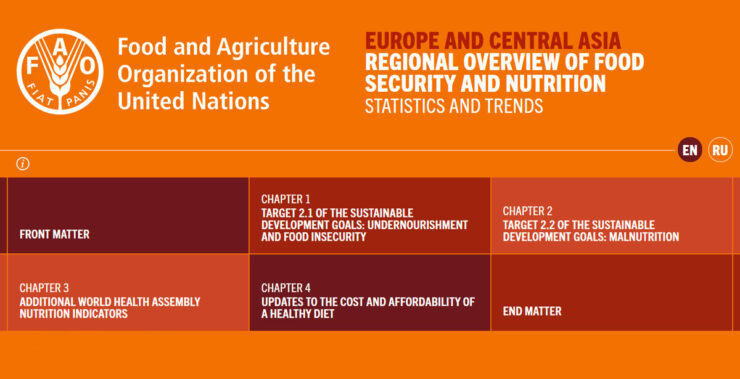
The Food and Agriculture Organization’s (FAO) Europe and Central Asia-Regional Overview of Food Security and Nutrition 2025 assesses progress towards Sustainable Development Goal (SDG) 2, focusing on hunger, food insecurity, malnutrition, and the cost and affordability of healthy diets. The report calls for coordinated action and long-term transformation of agrifood systems towards ending hunger and all forms of malnutrition.
According to the FAO report, moderate or severe food insecurity affected 16.2% of Central Asia’s population in 2024, meaning that people may have run out of food, experienced hunger, or, in extreme cases, gone for entire days without eating.
However, Central Asia has shown progress in reducing the prevalence of undernourishment (PoU), an indicator of chronic energy deprivation, which fell from 14.6% in 2000 to 2.8% in 2024.The number of undernourished people declined from 8.2 million to 2.3 million during the same period.
In contrast to this regional progress in the PoU rate, it increased in Turkmenistan from 3.4% in 2014–2016 to 4.3% in 2022–2024. The increase in the rate means that a growing share of Turkmenistan’s population does not regularly consume enough food energy.
Children Face Multiple Forms of Malnutrition
Beyond undernourishment, Turkmenistan also continues to experience several forms of child malnutrition:
Stunting: In 2024, stunting affected 6.5% of children under five in Turkmenistan, compared with 7.4% across Central Asia.
Stunting results from failure to receive adequate nutrition in early life over an extended period and/or recurrent or chronic illness that can restrict children’s physical growth and development.
Wasting: Based on the latest country data available from 2017 to 2024, Turkmenistan had the second-highest rate of child wasting in Central Asia, at 4.1%,after Tajikistan, at6.4%. Wasting is a form of acute malnutrition, and the prevalence can change quickly in response to shocks or seasonal changes in the availability of food and/or disease prevalence.
Overweight: In 2024, 6.4% of children under five in Central Asia were overweight, exceeding the global estimate of 5.5%. The rate in Turkmenistan was lower, at 4.9%.
Donate to support Turkmen analysts, researchers and writers to produce factual, constructive and progressive content in their efforts to educate the public of Turkmenistan.
SUPPORT OUR WORKNational averages show regional disparities.The 2024 Turkmenistan MICS data reveal that among children under five, Dashoguz recorded the highest prevalence of stunting at 12.4%, followed by Mary at 11.5% and Lebap at 10.4%. Lebap also recorded the highest prevalence of both wasting and underweight, at 5.0% each, while Mary recorded a similarly high prevalence of wasting at 4.9%.
More Than One-Third of Women Have Anemia
The FAO report identifies that anaemia remains a serious public-health concern in Turkmenistan, with more than one-third of women aged 15 to 49 years affected by anemia in Turkmenistan in 2023. This means that the country is above the regional average of 32% and the global average of 30.7%.
On this regard, the survey conducted by the Ministry of Health and Medical Industry of Turkmenistan (MHMI) together with UNICEF in 2025 found out that anemia affects 31.4% of children aged 6-59 months and 36% of women aged 15-49 years: 35.6% non-pregnant and 37% pregnant.
Additional Nutrition Indicators
At the same time, Central Asian countries are experiencing a substantial increase in adult obesity at the other end of the spectrum. The latest data available on adult obesity from 2022 reveals that adult obesity rose from 16.7% in 2000 to 25.1% in Central Asia, considerably higher than the global average of 15.8%. In Turkmenistan, adult obesity increased from 17.2% in 2012 to 21.4% in 2022.
Despite these challenges, Turkmenistan has made notable progress in two nutrition indicators:
- Exclusive breastfeeding: The proportion of infants exclusively breastfed during their first six months, as a core nutrition indicator as recommended by the World Health Organization (WHO), rose from12.1% in 2000 to 56.5% in 2019. This is much higher than the average of Central Asia, 33.3%.
- Low birthweight: The prevalence of low birthweight has decreased in Turkmenistan from 4.9% in 2012 to 4.3% in 2020.
Updates to the Cost and Affordability of Healthy Diets
Finally, the report points out that the average cost of a healthy diet in Central Asia declined marginally from 3.81 purchasing-power-parity (PPP) dollars per person per day in 2023 to 3.78 dollars in 2024. Nevertheless, 11.5 million people are unable to afford a healthy diet in the region, which is 1.1 million fewer than the previous year. However, FAO has no data on cost and affordability for Turkmenistan, and the percentage of people in Central Asia who cannot afford a healthy diet is likely underestimated.
The affordability of a healthy diet refers to the cost of a diet relative to income; therefore, changes over time can result from changes in diet costs, incomes, or both.