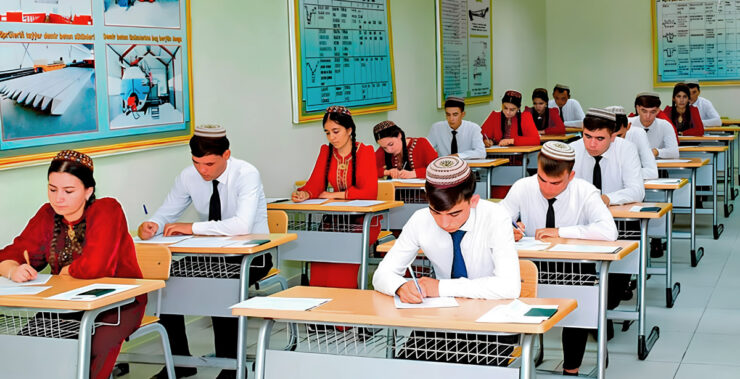
The State Commission for Admission to Studies is the central governmental body tasked with overseeing the annual higher and secondary vocational education admission process in Turkmenistan. Established by presidential decree ahead of each academic cycle, the Commission holds primary authority over institutional quotas and examination standards. It coordinates regional working groups alongside local administrations across the five velayats, Ashgabat, and Arkadag to set up examination hubs, document intake stations, and medical screening centers.
While administrative quotas expand incrementally, with approved higher education intake targets scaling from 16,782 spots in the 2025-2026 academic year to over 18,000 spots for the 2026-2027 cycle, the institutional mechanisms governing these selections remain heavily restricted.
The Risks of Opacity: Accountability and the Absence of Transparency
The Commission operates without a direct public portal or an open roster of its members. Citizens cannot see who sits on the body, how they are selected, or what precise criteria guide their decisions, creating structural vulnerabilities:
- Erosion of Public Trust: Operating behind closed doors makes it impossible to independently verify institutional integrity.
- Susceptibility to Unchecked Bias: Without independent oversight, closed administrative bodies risk influence from informal networks, favoritism, and conflicts of interest.
- Absence of Safeguards: When guidelines and decision-making processes are kept obscure, standard procedures can be applied unevenly across regions without public detection.
The Enforcement Gap: Rhetoric Versus Reality in University Admissions
Ahead of the admissions campaign, President Serdar Berdimuhamedov stated that “The country’s universities should admit talented, most worthy representatives of the younger generation, and conduct entrance examinations in an organized and fair manner, ensuring public oversight.” However, realizing this ideal remains challenging due to systemic design flaws.
Independent civil society and international monitors, including research from the Progres Foundation and Transparency International, indicate that restrictive admission quotas combined with pervasive bribery, nepotism, and favoritism severely undermine educational equity. According to UN Child Rights Committee observations, Turkmenistan faces major gaps in ensuring equal educational access between urban and rural youth. When presidential calls for fairness lack transparent enforcement mechanisms or independent oversight, applicants face a system vulnerable to self-interested evaluators with no structural way to remedy unfair outcomes.
Donate to support Turkmen analysts, researchers and writers to produce factual, constructive and progressive content in their efforts to educate the public of Turkmenistan.
SUPPORT OUR WORKStructural Vulnerability and the Total Lack of Grievance Mechanisms
The absence of a formal, independent complaint mechanism or ombudsman service leaves students and parents uniquely defenseless:
- Power Asymmetry: If a student encounters lost paperwork, scoring errors, or systemic bias, no legal or administrative office is mandated to independently investigate or reverse the decision.
- Forfeiture of Rights: Because grievance procedures designed to protect citizens from unfair treatment do not exist, applicants have zero institutional recourse and must simply accept any outcome.
Impact on Youth and the Risk of Brain Drain
For an average young person in Turkmenistan, this institutional reality translates into tangible risks:
- Merit vs. Informal Advantage: Despite scoring high marks or preparing for years, talented candidates from ordinary backgrounds face headwinds if informal networks dictate final selections.
- Socioeconomic Discouragement: When access to higher education depends on factors outside transparent academic merit, it breeds disillusionment, discourages local study, and accelerates “brain drain” as capable young professionals look abroad for educational and career paths.
In modern administrative governance, transparency regarding who holds authority and how decisions are enforced serves as a fundamental safeguard for fairness. Without a public roster of decision-makers, open scoring frameworks, and functional complaint mechanisms, Turkmenistan’s admissions system will continue to struggle with systemic corruption, leaving capable youth to navigate an opaque and high-stakes process without institutional protection.