
A report by the International Organization for Migration (IOM) titled Central Asian Migration to Europe: Poland and Lithuania as Cases Studies of Regular Pathways reveals that the number of Turkmen citizens residing in the EU has nearly quadrupled in recent years. Driven by powerful economic push factors at home and complex geopolitical shifts in traditional destinations like the Russian Federation, a growing number of Turkmen citizens are redirecting their journeys toward Eastern Europe.
Emerging Corridors: Growth Trends and Key Destinations
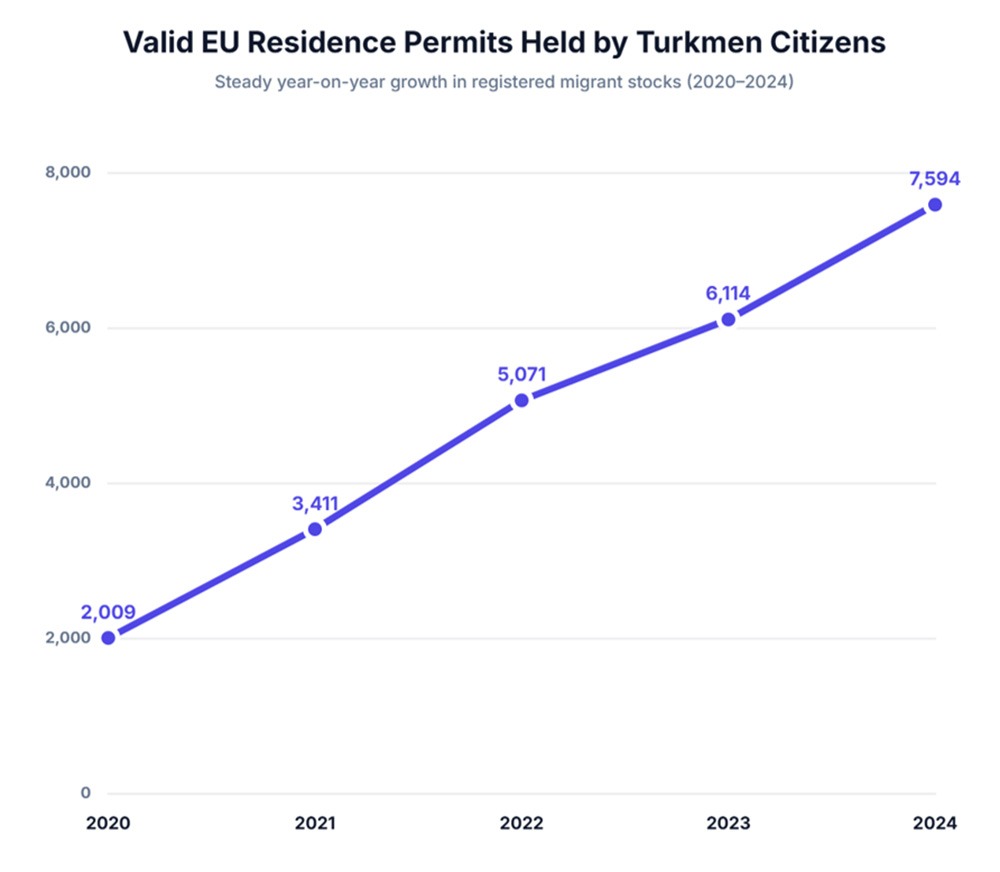
Historically, migration from Turkmenistan to the West was relatively low compared to neighboring Central Asian states. However, Eurostat data reveals a steady, year-on-year climb in valid residence permit holders.
Poland has rapidly emerged as the primary destination for Turkmens. In 2024 alone, Poland issued 3,814 work permits to Turkmen citizens, accounting for an overwhelming 70% of all work-related permits issued to Turkmen nationals across the entire EU. Conversely, neighboring Lithuania remains a niche destination, accounting for just 68 work-related permits (1%) in the same year. This regional pivot is heavily accelerated by severe labor shortages in Poland and Lithuania, where the reduced availability of Ukrainian and Belarusian workers has forced recruitment networks to scout aggressively within Central Asia.
Poland and Lithuania are not only work destinations but also entry points into the EU as some migrants move on to other EU states in search of higher salaries or stronger migrant networks.
Drivers, Pathways, and Networks
Main causes of Central Asian migration are low wages, high youth unemployment, and heavy reliance on remittances, combined with shrinking opportunities and perceived rising risks in Russia. While specific wage and remittance data is lacking for Turkmenistan, the country faces a 14% youth unemployment rate (ages 15-25) compared to a 4% overall unemployment rate. Due to limited opportunities at home, many young nationals pursue employment abroad.
When entering the EU, Turkmen citizens overwhelmingly rely on formal employment-based entry routes:
- In Poland: 95% of first-time residence permits granted to Turkmen nationals are for work, followed by 2% for education and 1% for family reunification.
- In Lithuania: While overall numbers are lower, 82% enter for employment, while a notable 13% utilize student permits.
Interestingly, despite the rise of aggressive corporate recruitment networks, Turkmen migrants lean most heavily on informal personal networks and relatives already residing abroad to find and secure these international jobs rather than relying solely on formal agencies.
Donate to support Turkmen analysts, researchers and writers to produce factual, constructive and progressive content in their efforts to educate the public of Turkmenistan.
SUPPORT OUR WORKWorking Conditions and Legal Vulnerabilities
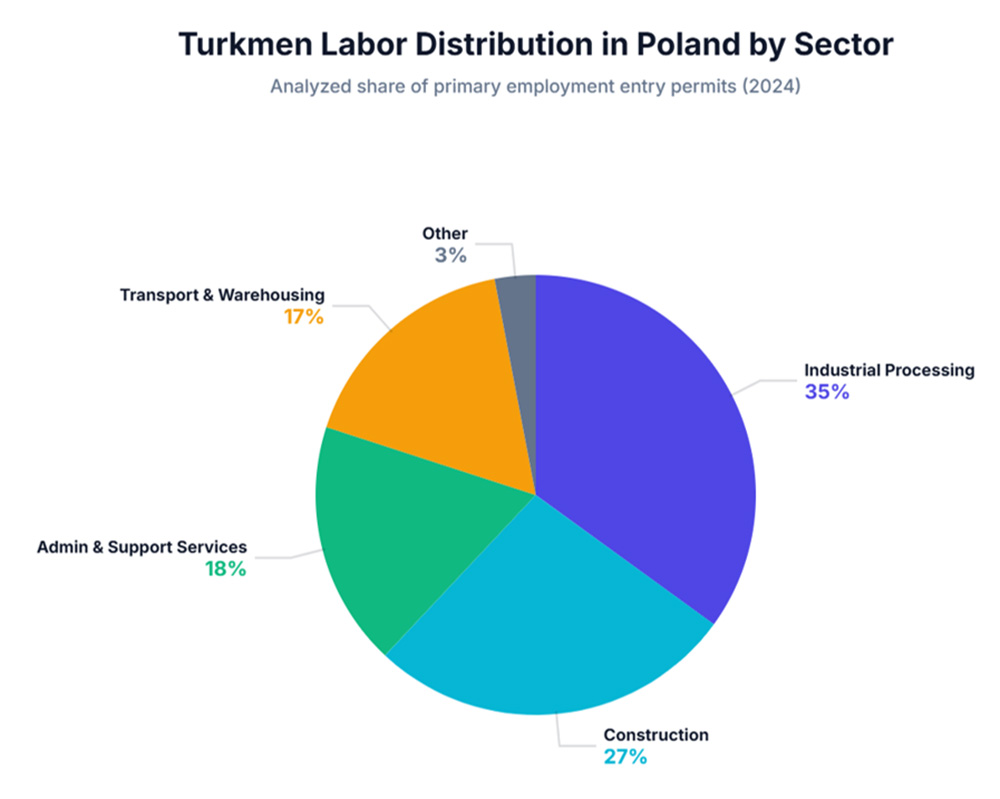
Once in Eastern Europe, Turkmen labor is predominantly concentrated in intense, physically demanding fields, as illustrated in figure below.
However, rapid migration expansion has outpaced structural support, exposing workers to unique protection risks and exploitation. While the report does not provide a specific case study on Turkmen migrants, it notes that Central Asians in general face risks of recruitment deception, wage theft, and employer-tied permits that can lead to loss of legal status if a worker raises a complaint or is fired.
Moreover, legal precariousness is on the rise. In 2024, the Polish Border Guard issued 170 return orders (due to expired visas, lapsed residency permits, or irregular entry) to Turkmen citizens, primarily men. Lithuania also saw its return decisions climb to 14, up from virtually zero in prior years. Local sources estimate that several thousand Central Asian migrants now reside in the region under irregular legal status due to expired permits or visa deceptions, highlighting an urgent need for enhanced institutional safeguards and clearer legal protections in their new host nations.
Furthermore, in 2024, 50 Turkmenistan citizens applied for international protection in Poland. Of these, 3 were granted full protection, 3 received subsidiary protection, 24 received negative decisions, and 3 cases were discontinued. No asylum applications were filed by Turkmen citizens in Lithuania that year.
A Practical Way Forward
To manage these shifting corridors effectively, the Turkmen government should pursue practical, protective measures for its citizens abroad. Establishing dedicated labor attachés or extending consular support in major destination hubs like Warsaw would provide Turkmen workers with a reliable, state-sanctioned resource to verify employment contracts, report exploitation, and resolve legal status issues. Additionally, partnering with international bodies like the IOM to offer pre-departure orientation programs would ensure that migrating citizens are fully informed of EU labor regulations and visa procedures, significantly reducing their vulnerability to recruitment fraud and irregular stays.