Education plays a crucial role in building human capital in Turkmenistan and pursuing the country’s long-term economic development. This article examines educational attainment and access in Turkmenistan using data from the 2022 population census. It analyses how education outcomes vary across regions, gender, and urban–rural residence, focusing on youth transitions beyond secondary school and overall post-secondary attainment.
The findings point to a highly centralized and selective system. Nationally, only about one in five people has completed any form of post-secondary education. Higher and postgraduate education are overwhelmingly concentrated in Ashgabat, which absorbs the 80% of youth who continue education at age 18, while most secondary graduates outside the capital leave formal education immediately. As a result, access to advanced education remains uneven across regions.
Gender differences also shape pathways. Women are more likely to enroll in shorter vocational programs, while men more often enter longer academic routes, contributing to unequal access to skills, income, and leadership opportunities.
Geographical concentration of universities in Ashgabat creates a stark division between the capital and the rest of the country. Of 23 higher education institutions nationwide, 19 are located in Ashgabat, one in Arkadag city, and only three in the velayats, structurally concentrating opportunity in the capital.
The analysis draws on the education chapter of the 2022 population and housing census. Because the data were published in PDF format and key educational categories were not clearly defined, the dataset required conversion and cleaning before analysis. The Progres team conducted a thematic review focusing on post-secondary attainment, youth continuation rates, the structure of post-secondary education, gender differences, and regional disparities.
REGIONAL PATTERNS OF EDUCATIONAL ATTAINMENT AMONG ADULTS
To examine educational attainment across Turkmenistan’s regions, this analysis draws on census data covering the population aged 10 years and older by highest completed level of education. To better approximate adult educational outcomes, individuals still enrolled in primary and basic secondary education are excluded from this analysis.
Nationally, the picture is strikingly narrow. Nearly four-fifths (79.3%) of the population have general (complete) secondary education as their highest level of attainment. Only 20.1% have completed any form of post-secondary education, including higher, secondary professional, or professional and technical education. Postgraduate education is extremely rare, accounting for just 0.02% of the population, while 0.36% report having no education at all.
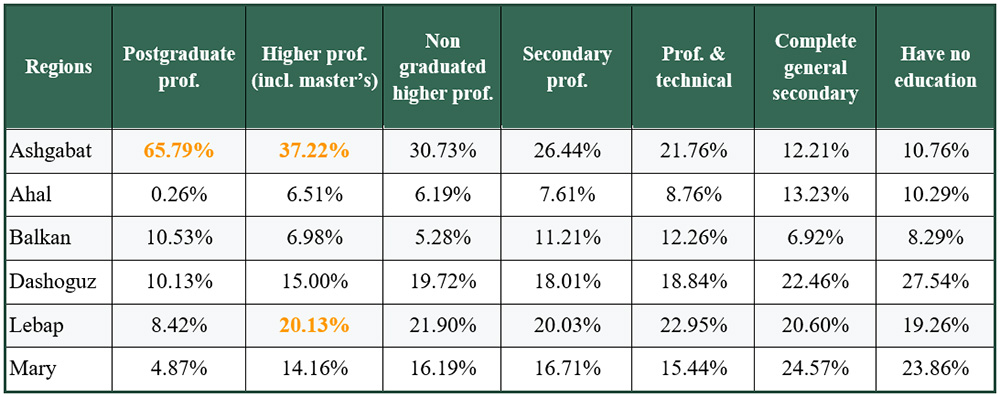
Educational attainment is highly centralized geographically. Ashgabat dominates the upper end of the education spectrum, accounting for nearly two-thirds of all postgraduate degree holders and more than one-third of individuals with higher professional education, despite representing only 15.3% of the population aged 10 and older. For example, of the roughly 760 people nationwide with postgraduate education, about 500 reside in Ashgabat.
Table 1. Regional distribution of the population aged 10 years and older by highest completed level of education (% share of national total)
Source: Developed by the author using raw census 2022 data.
Outside the capital, the velayats account for the bulk of the population with secondary professional, professional and technical, and complete secondary education, as well as the highest shares of individuals with no formal schooling. In effect, the regions function as reservoirs of secondary-educated and mid-skilled labour, while the capital concentrates advanced academic credentials. Lebap is an exception, accounting for 20.1% of higher professional graduates, likely reflecting the presence of the Seyitnazar Seydi Turkmen State Pedagogical Institute, which trains much of the country’s teaching workforce.
YOUTH TRANSITION TO POST-SECONDARY EDUCATION
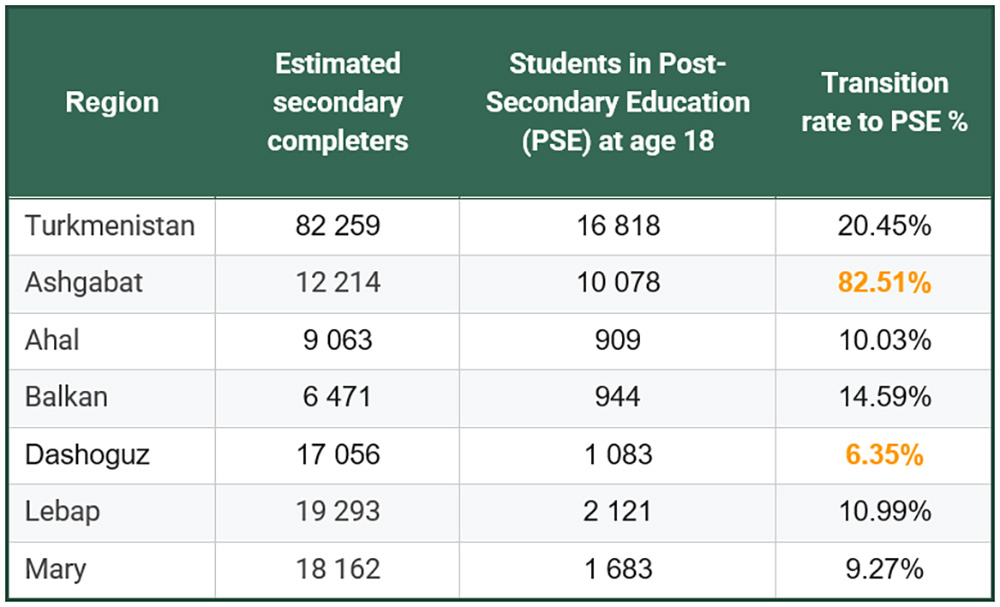
Educational centralization becomes even more pronounced when examining youth transitions. Nationally, only 20.4% of young people who complete secondary education continue into any form of post-secondary education at age 18. In practical terms, four out of five secondary graduates exit formal education immediately, indicating a highly selective post-secondary system with limited capacity.
Table 2. Transition from secondary to post-secondary education at age 18, by region
Source: Developed by the author using raw census 2022 data.
Ashgabat is a clear outlier. The capital’s transition rate reaches 82.5%, more than four times the national average, absorbing a disproportionate share of post-secondary entrants and the vast majority of university students. In contrast, transition rates in velayats range from just 6.4% in Dashoguz to 15.1% in Lebap.
This gap reflects institutional geography rather than differences in demand or ability. Of 23 higher education institutions nationwide, 19 are located in Ashgabat, one in Arkadag city, and only three in velayats. Access to post-secondary education is therefore structurally centralized, limiting regional human-capital development and reinforcing migration of youth toward the capital.
STRUCTURE OF POST-SECONDARY ENROLLMENT
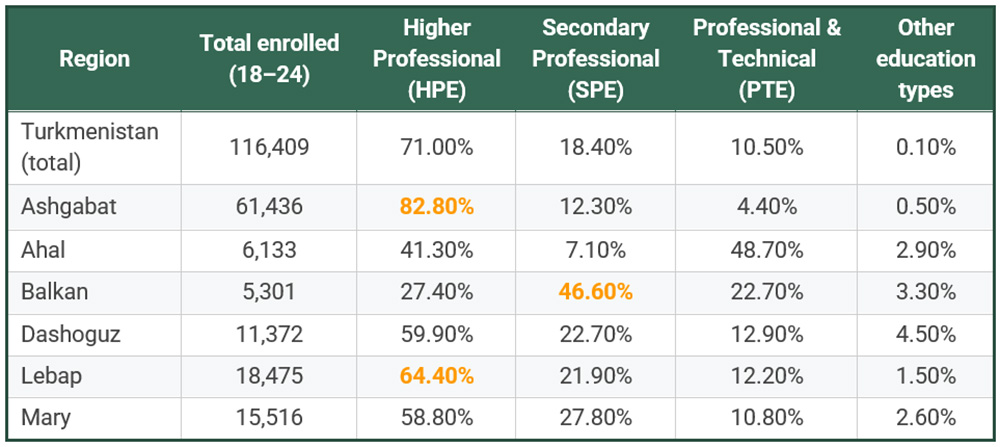
Among those who remain in education, the system is predominantly university-oriented but unevenly so. Nationally, 71% of enrolled youth aged 18–24 are in Higher Professional Education (HPE). However, Ashgabat again stands apart, with 82.8% of enrolled youth in HPE while vocational tracks play only a marginal role.
Donate to support Turkmen analysts, researchers and writers to produce factual, constructive and progressive content in their efforts to educate the public of Turkmenistan.
SUPPORT OUR WORKTable 3. Distribution of enrolled students aged 18–24 by type of post-secondary education and region
Source: Developed by the author using raw census 2022 data.
Regional systems differ sharply. Lebap most closely resembles the capital, with 64.4% of enrolled youth in HPE. Dashoguz and Mary occupy an intermediate position, while Ahal and Balkan are structurally non-academic systems: Ahal is dominated by professional and technical education, while Balkan relies heavily on secondary professional education. Post-secondary education in Turkmenistan is therefore not a single national system, but a set of regionally distinct models.
GENDER DIFFERENCES IN POST-SECONDARY EDUCATION
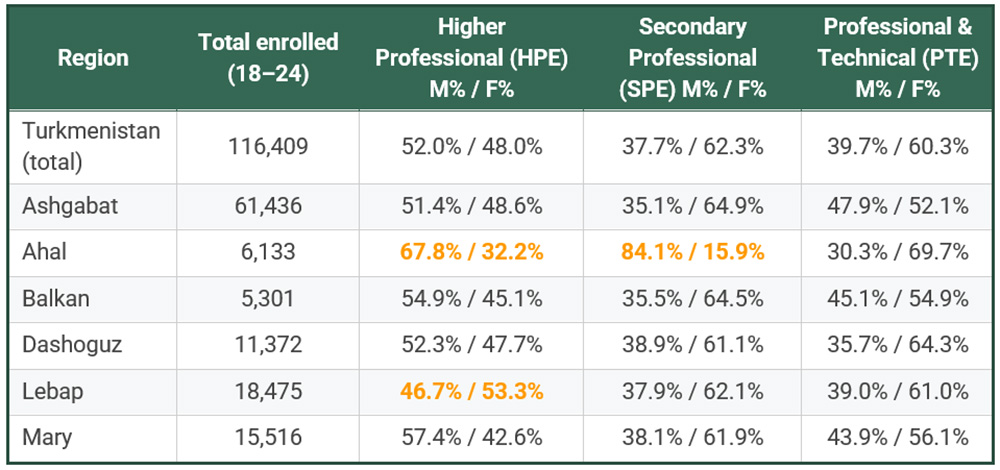
At the national level, higher education enrollment appears close to gender parity (52% men, 48% women), but this masks substantial regional and institutional variation. In Ahal and Mary, men dominate higher education enrollments, while Lebap is the only region where women form a majority. This pattern likely reflects the presence of the pedagogical institute in Lebap and the feminization of the teaching profession, where women comprise 83% of primary teachers and nearly 62% of secondary teachers.
Across all regions, vocational and secondary professional tracks are consistently female-dominated, with women accounting for roughly 60–65% of enrollments. This means women choose shorter, skill and job-focused programs, while men more often study in longer academic programs. One possible explanation is social expectations: women may be encouraged to complete education that leads quickly to employment, while men may be encouraged to pursue longer studies aimed at building a career as the primary bread winner.
Table 4. Gender composition of enrolled students aged 18–24 by education type and region
Source: Developed by the author using raw census 2022 data.
Educational choices often reflect prevailing social expectations about suitable professions for women and men. As a result, education tends to reproduce existing labour-market patterns rather than change them. Many women enroll in service and care fields, and this is later reflected in employment, where women make up the majority of workers in sectors such as teaching (72.5%) and healthcare (73.9%). These patterns contribute to a self-reinforcing cycle in which study choices shape employment outcomes, and existing workforce patterns influence the next generation’s educational decisions
URBAN – RURAL DIVIDE IN EDUCATIONAL ATTAINMENT
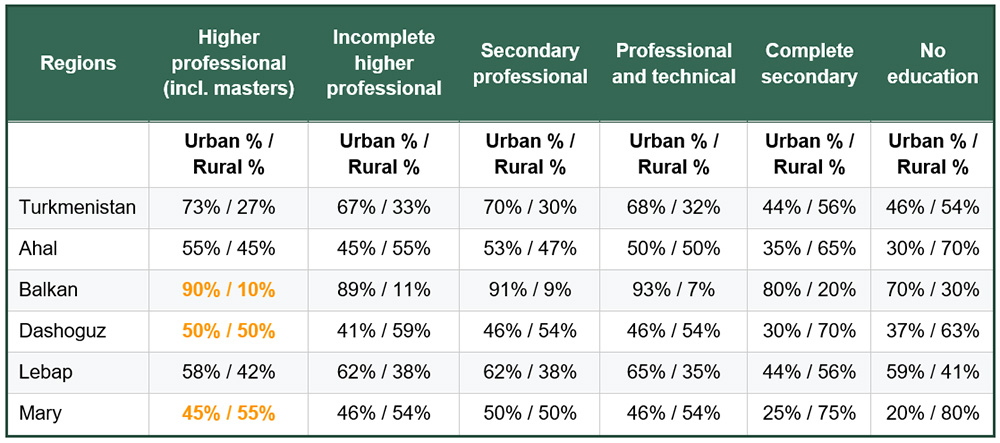
Post-secondary education in Turkmenistan is also structurally urban. Nationally, only 27% of individuals with higher professional education reside in rural areas, while those whose highest attainment is complete secondary education (56%) or no education (54%) are predominantly rural.
Table 5. Urban–rural distribution of the population aged 10 years and older by completed level of education and region
Source: Developed by the author using raw census 2022 data.
Regional patterns mirror settlement structures. In Balkan, where over 82% of the population is urban, educational attainment is urban-dominated at all levels. In contrast, Dashoguz and Mary exhibit strong rural concentrations even among higher-educated populations. Overall however, these patterns indicate that educational opportunity beyond secondary school remains tightly linked to urban residence.
Overall, the census data reveals an education system characterized by centralization, selectivity and segmentation. Concentrating higher education in Ashgabat leads to extreme, systemic inequality, causing the capital to become a highly skilled “brain hub” while the rest of the country stagnates, creating a severe, permanent divide between the haves and have-nots. This centralization drives rural stagnation in Turkmenistan, as provincial and rural communities are left with no educational choices, while the capital faces intense overcrowding and competition. This leads to serious consequences including:
1. Societal and Demographic Consequences
- Extreme Inequality: A stark, permanent divide emerges between the urban elite and rural populations, as education becomes a luxury rather than a right.
- Forced Migration: Youth seeking better education and employment opportunities move to the capital, leading to overcrowding in the city and brain drain in provinces and rural areas.
- Loss of Regional Culture and Stability: Rural communities lose their social, cultural, and educational centers, breaking down local community bonds.
2. Economic and Structural Impacts
- Widening Regional Income Gaps: Rural areas lose the ability to foster skilled workers, reducing local income per capita compared to the high-income capital.
- Economic Stagnation outside the Capital: Without local educational institutions to train the workforce, rural industries remain underdeveloped.
3. Educational and Developmental Disparities
- Loss of Opportunity: Rural students face limited access to advanced, specialized courses, leaving them with fewer academic credits and lower-quality education compared to their urban counterparts.
- Systemic Marginalization: The educational system fails to serve the entire population, focusing only on the urban and privileged elite creating marginalization of rural and socioeconomically disadvantaged populations.
- Lower Overall Human Capital: Even if the capital excels, the total national human capital stock – a key driver of GDP – diminishes because a large portion of the population lacks access to education.