
The World Bank Group report Mend the Gap, Unleashing Potential: Addressing Barriers to Women’s Economic Opportunities in Europe and Central Asia examines persistent gender inequalities across the region. It argues that closing employment gaps could raise GDP per capita by up to 14%. It provides a roadmap for unlocking women’s economic potential through reforms in labor markets, financial inclusion, care systems, and legal frameworks.
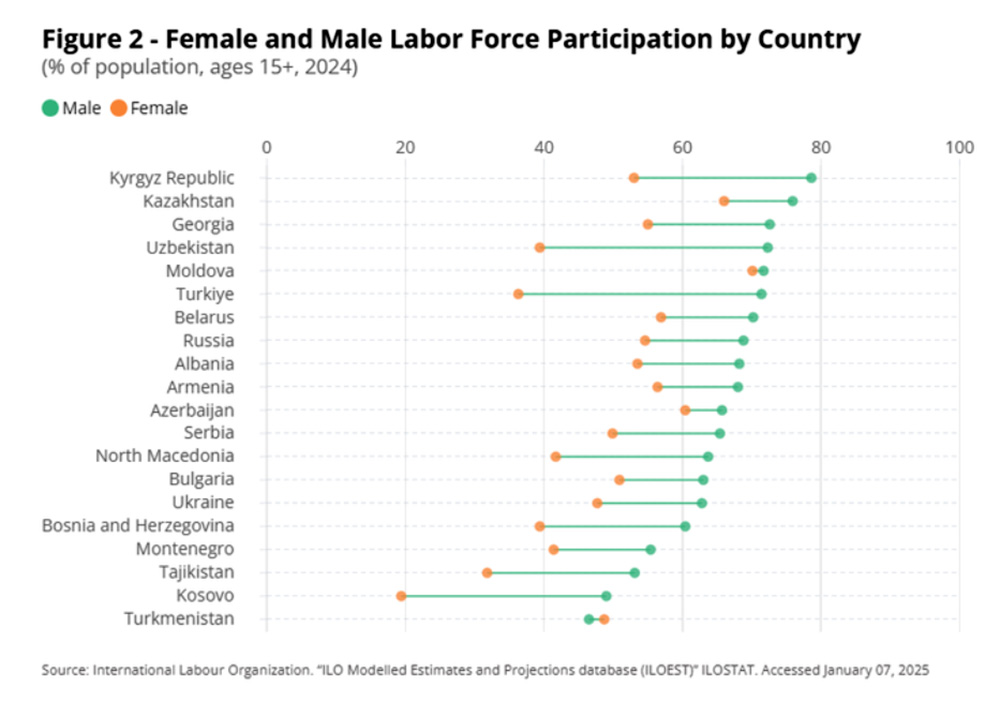
Turkmenistan has the lowest labor force participation rates in the region (≈49% for women, 53% for men). However, the country is missing entirely from most other indicators, including:
- Youth NEET (Not in Education, Employment, or Training) rates;
- Female entrepreneurship and leadership statistics;
- Financial inclusion (account ownership, digital payments);
- Credit constraints for women-led firms;
- Gender-based violence prevalence and support systems;
- World Bank gender-focused project data.
This absence highlights a critical structural issue: the lack of sex-disaggregated and publicly available data, making Turkmenistan effectively invisible in regional gender analysis.
Source: The World Bank Report
What Regional Peers Reveal and Imply for Turkmenistan
Donate to support Turkmen analysts, researchers and writers to produce factual, constructive and progressive content in their efforts to educate the public of Turkmenistan.
SUPPORT OUR WORKIn contrast, neighboring Central Asian countries provide a clearer, though concerning, picture of gender gaps:
- Labor & Youth Participation: In Tajikistan and Kyrgyz Republic, over 40% of young women are not NEET, indicating deep structural barriers early in life.
- Entrepreneurship & Leadership: Female ownership is only 22% in Tajikistan, with just 6.6% of firms led by women, while Kazakhstan performs better at 24% female-led firms.
- Financial Inclusion: In Tajikistan and Uzbekistan, 40% and 41% of women, respectively, use digital payments compared to approximately 60% of men.
- Care Burden & Social Norms: Over 60% of adults in Tajikistan and the Kyrgyz Republic believe women should handle most unpaid care work, directly limiting labor participation.
- Violence Against Women: Lifetime intimate partner violence reaches 27% in the Kyrgyz Republic and 26% in Tajikistan, with high stigma and underreporting. Furthermore, 64% of women in Tajikistan believe wife-beating is justified.
- Legal and Institutional Gaps: Critical protections for women are missing. Kazakhstan, Tajikistan, and Uzbekistan do not have specific legislation on sexual harassment in employment, and none of the Central Asian states listed mandate equal remuneration for work of equal value.
- Implementation Gap: While the laws exist across the region, enforcement is weak. Uzbekistan scores 100 on equal pay legislation but 0 on implementation frameworks, illustrating a broader regional issue – rights exist on paper but not in practice.
What Does This Say About Turkmenistan
Given its even lower labor participation rates, it is highly likely that similar or more severe constraints exist in Turkmenistan but cannot be confirmed or addressed due to missing data. Turkmenistan’s exclusion from key indicators is not just a technical issue, it prevents evidence-based policymaking, limits international support, and masks potential inequalities. The data from its regional peers suggests that Turkmenistan likely faces substantial challenges regarding unpaid care work, financial exclusion, and a lack of protective legal frameworks.