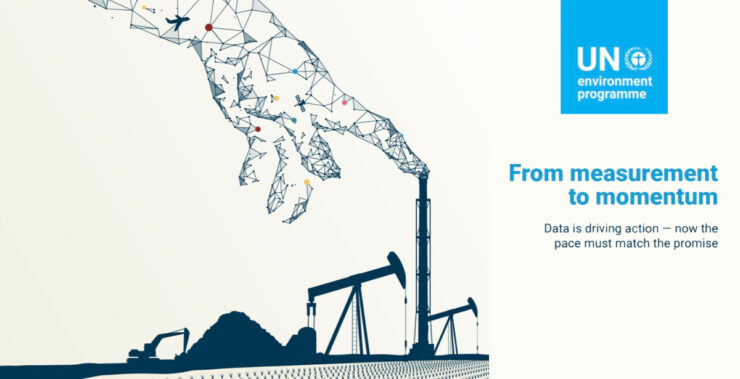
According to the new report by the United Nations Environment Programme (UNEP), titled “An Eye on Methane 2025: From measurement to momentum”, the global action to tackle methane emissions is increasing. Turkmenistan emerges as one of the countries taking necessary steps forward and “increasingly responding despite challenges in the availability of detection equipment and outdated infrastructure”.
Methane is a powerful greenhouse gas, responsible for around a third of the global warming experienced today. Reducing methane emissions, especially from leaks, is one of the fastest and most effective ways to slow climate change.
UNEP notes that despite limited detection equipment and aging infrastructure, countries such as Kazakhstan and Turkmenistan are increasingly responsive to satellite alerts, showing a positive sign of growing regional engagement.
The report highlights several examples of progress in Turkmenistan. Three major emission events were detected in the Abadanchylyk field and the relevant parties promptly notified. The leaks were traced to pipelines that connect gas wells to collection points.
One source was detected several times in July 2024-June 2025, and after the latest notification in June 2025, Turkmengaz found the leak, identified wear and tear as the cause, and completed maintenance and repair work in Northern Balguýy. Additional two leaks were detected in June 2025 in the 10 ýyl Abadanchylyk area, and were also repaired by Turkmengaz.
Turkmengaz reported that since the introduction of methane emission monitoring, it has reduced average daily methane emissions from 22.9 tonnes to 11.6 tonnes during January-September, 2025.
Donate to support Turkmen analysts, researchers and writers to produce factual, constructive and progressive content in their efforts to educate the public of Turkmenistan.
SUPPORT OUR WORKThrough its International Methane Emissions Observatory (IMEO), UNEP operates one of the most advanced global systems for monitoring methane, supporting the Global Methane Pledge. Turkmenistan has also joined the Global Methane Pledge in December, 2023. Using satellite data, IMEO’s Methane Alert and Response System (MARS) detects large emissions and notifies governments and companies so they can act quickly. The data on Turkmenistan is not available.
In the past year, UNEP sent more than 3500 methane alerts to 33 countries. Most of the alerts are unanswered, but response rate has been growing from just 1% to 12% in the past year. Turkmenistan is among 25 countries that have nominated focal points to receive MARS alerts, enabling faster follow-up when methane leaks are detected. It is not clear if Turkmenistan has a MARS contact person.
Regional gaps and opportunities for improvement
Despite some success, the report also highlights some challenges. Central Asia still lags behind other regions in systematic methane reporting. UNEP’s Oil and Gas Methane Partnership (OGMP 2.0) already includes 153 companies in 90 countries, covering 42% of global gas and oil production. However, the coverage in Central Asia is the lowest of all regions. For example, 83% of gas and oil production in the region remains outside UNEP’s OGMP 2.0 scope.
While some companies in Kazakhstan and Azerbaijan have joined the initiative, no Turkmen company is yet a member.
A first-of-its-kind UN program for Turkmenistan
IMEO, together with UNOPS and the UNECE, is developing a UN Joint Programme for Methane Emission Reduction in Turkmenistan. Once approved, the program would be the first of its kind, focusing on methane emission reduction. It aims to rapidly mitigate major methane sources identified by MARS and to strengthen Turkmenistan’s capacity to measure, monitor, and manage emissions more effectively. The details of the program and progress reports are not available to the public.