
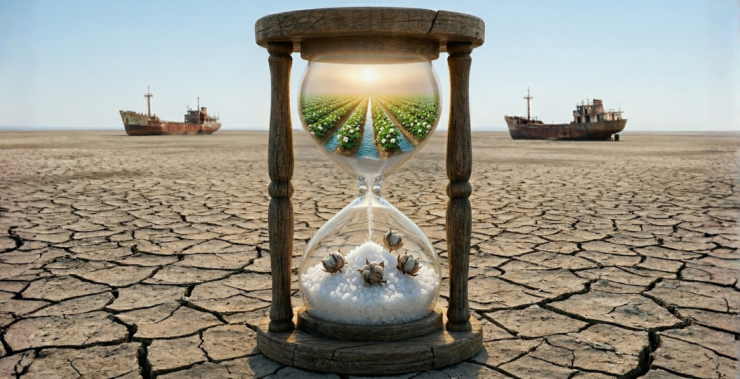
Cotton holds a valuable place in the economy of Turkmenistan. As a water-intensive crop sustained by the legacy of Soviet-era central planning, cotton fields are now facing existential risks driven by climate change. The rising temperatures and water shortage are not only an agricultural issue but a threat to the economic stability and regional water security.
Cotton represents Turkmenistan’s second most important export commodity after natural gas and oil and contributes crucially to rural employment. In 2017, textile exports, largely cotton-based products, constituted 6.2% of all national exports. Furthermore, the agricultural sector, which relies heavily on cotton, makes up approximately 12% of the country’s gross domestic product (GDP).
Other countries in the region, such as Uzbekistan, are also navigating the challenges of cotton production. Uzbekistan has shifted its economic strategy to prioritize value-added processing, with a focus on domestic textile production.
Aral Sea
Central Asia’s farming problems started with the Soviet focus on growing cotton. This used too much water from rivers which eventually dried up the Aral Sea. The government prioritized cotton over the environment, causing a natural disaster. The area is now plagued by salt and toxic minerals in the air and soil. This history of environmental damage makes the current climate crisis even worse, with dryness, unstable rivers, poor land and infrastructure and increasing salt and dust storms.
Climate Change
Central Asia is expected to warm at a rate faster than the global average, with temperatures projected to rise by 1.5-2.4°C. This warming trend is already evident in Turkmenistan, where temperatures have increased by over 1°C in the past 20 years, as seen in the figure below.
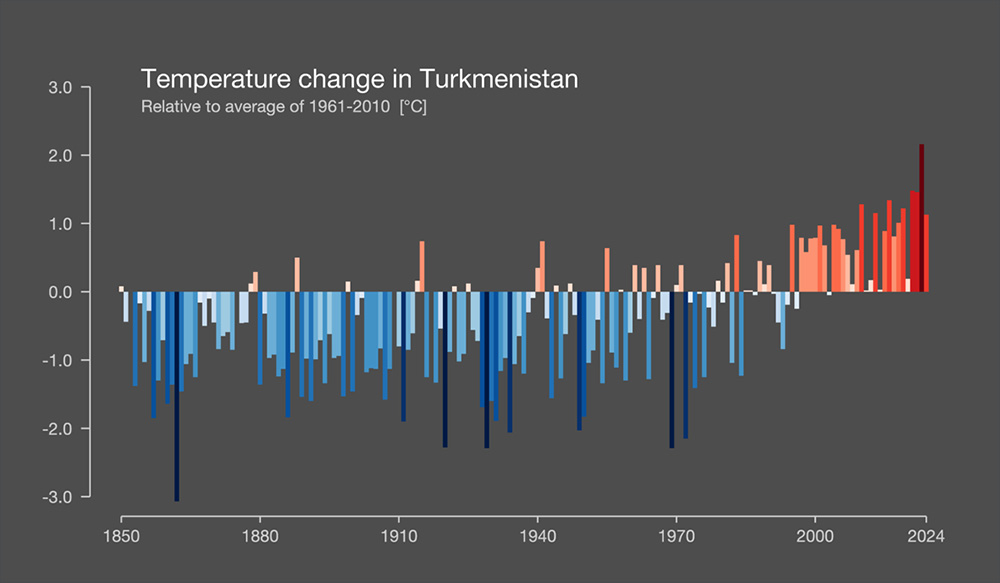
Temperature change in Turkmenistan relative to average temperatures of 1961-2010.
Source: https://showyourstripes.info
A consequence of this warming is an increase in the length of the growing season. While a longer growing season may seem beneficial, it can be offset by increased heat stress and drought. Higher temperatures can damage crops, particularly cotton, and even halt their growth. Crucially, higher temperatures dramatically increase evapotranspiration rates, meaning crops require more water. This can put immense pressure on already strained irrigation systems and exacerbates the risk of soil degradation.
Water Scarcity
The primary water risk stems from the reliance of Turkmenistan on rivers sustained by glacier and snow meltwater originating in the upstream mountainous regions (Kyrgyzstan and Tajikistan). These glaciers are shrinking rapidly, risking severe water shortage in the coming decades.
Significant drought conditions are predicted for more than 60% of Central Asia. This destabilization of water supply is likely to aggravate geopolitical tensions over scarce transboundary water supplies. Over 97% of Turkmenistan’s water resources originate from outside its borders making it heavily dependent on these shared resources. The country faces amplified risk if new water-sharing agreements are not negotiated.
Soil Degradation
Compounding the issues of heat and water scarcity is soil salinization. This crisis is linked to the historical large-scale, inefficient irrigation combined with high evaporation rates in arid and semi-arid climates. Salinization reduces agricultural yields and is a major factor limiting cotton production, despite cotton possessing some salinity tolerance.
The scale of the problem is substantial: more than 60% of irrigated land in Turkmenistan already suffers from salinity. If salinization continues unchecked, agricultural land risks becoming unsuitable for farming. Addressing this issue requires adopting costly practices such as using additional leaching water to remove soil salinity from the root zone, which further increases overall water demand.
Turkmenistan: Climate Vulnerability and the Governance Barrier to Adaptation
Turkmenistan’s centralized agriculture policy hinders diversification into less water-intensive or high-value crops. While global models suggest cotton might be buffered by the CO2 fertilization effect, Turkmenistan’s reliance on one specific water source makes yields highly vulnerable to drought, heat, soil degradation, and infrastructure integrity issues, as shown by localized variances in key cotton regions.
The state controls virtually all farmland, dictates crops, sets prices, and imposes mandatory cotton quotas on farmers. This structure creates an inefficiency cycle: farmers prioritize meeting quotas over adopting water-efficient techniques. Mandating water-intensive cotton cultivation in an arid environment leads to massive water waste. Due to a lack of market incentives and poor central management, critical Soviet-era water infrastructure (dams, canals, etc.) is neglected and deteriorating. This exacerbates water loss and accelerates soil salinization. Ironically, a centralized system could facilitate swift action, but only if there is a willingness to change.
Donate to support Turkmen analysts, researchers and writers to produce factual, constructive and progressive content in their efforts to educate the public of Turkmenistan.
SUPPORT OUR WORKTurkmenistan’s cotton harvesting relies on systemic state imposed forced labor, coercing public sector employees (teachers, doctors, etc.) to pick cotton under threat of job loss or to pay for replacement workers. This human rights abuse has caused international isolation, triggering punitive measures, including the US Withhold Release Order against Turkmen cotton and the global Cotton Pledge signed by over 100 major brands.
This reliance on coerced labor creates a self-imposed “governance barrier” to climate resilience. The negative reputation and institutional lack of transparency severely restrict Turkmenistan’s access to international climate finance and sustainable supply chains demanding ethical sourcing. Although the FAO supports projects for climate-resilient cotton, the regime’s closed nature limits large-scale international support. Therefore, eliminating forced labor is necessary not only for human rights but also for unlocking the resources needed for climate adaptation.
Uzbekistan: Structural Reforms and Climate Adaptation
Uzbekistan serves as a contrast to Turkmenistan, demonstrating that reforms can significantly enhance a nation’s capacity for climate resilience, even while facing environmental stress. Figure below shows that the area used for cotton cultivation in Uzbekistan has declined over time, hinting at the growing farming productivity.
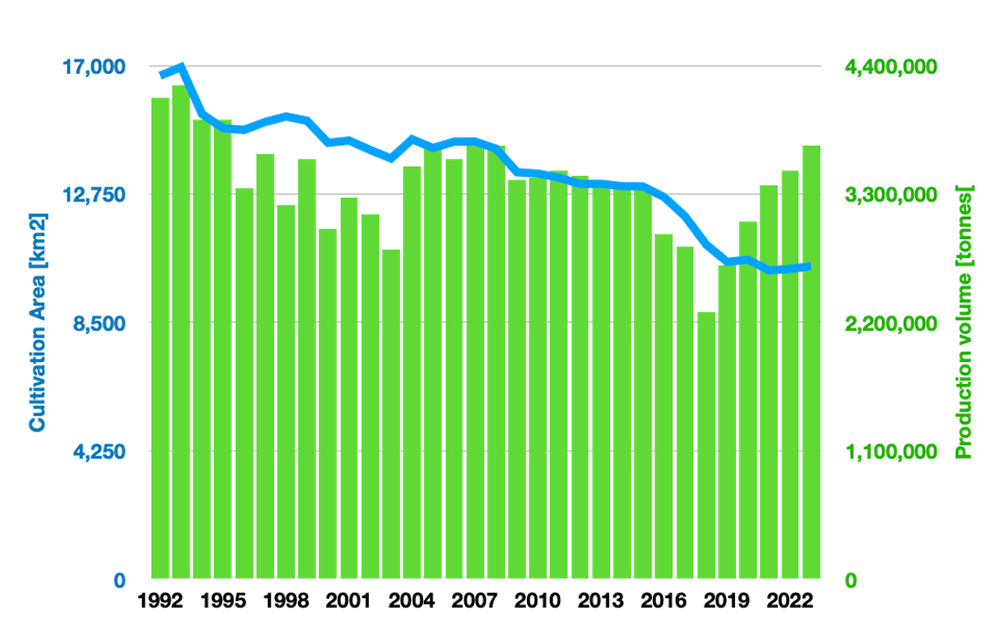
Cotton production and cultivation area in Uzbekistan
Source: Food and Agriculture Organization
Uzbekistan can offer a partial point of reference for Turkmenistan, although its reforms remain incomplete and challenges persist. Since 2017, Uzbekistan has replaced the state-imposed cotton quota system with a “textile cluster” model that integrates farming, processing, and manufacturing, and by 2021 the country ended the systemic use of state-imposed forced labour in cotton harvesting. However, human and labour rights risks continue due to restricted civic space, limitations on freedom of association and expression, and ongoing government influence over the sector. By 2023, all raw cotton was processed domestically, reflecting a shift toward value-added production. At the same time, the sector faces growing climate pressures: rising temperatures and water stress, particularly in western regions, are expected to reduce yields and could push Uzbekistan toward becoming a net cotton importer. This prospect is creating stronger market incentives for private clusters to invest in productivity and water-efficient practices.
Uzbekistan is modernizing its agriculture to secure its raw material supply. The focus is on improving water management through advanced farming technologies. Modeling indicates that modernizing Central Asia’s irrigation infrastructure could increase crop yields by 20% by 2030. Specifically in Uzbekistan, modern furrow irrigation has been shown to increase irrigation water use efficiency by 35-103% compared to traditional methods, leading to yield gains of 10-19%. Precision agriculture systems, which utilize satellite remote sensing, have also achieved a 20% increase in water use efficiency. Furthermore, genetic improvement is a core part of the adaptation strategy, concentrating on developing climate-resilient cotton varieties that are water-saving, high-yielding, and fast-ripening to manage resource scarcity and spring planting stresses.
Climate change increases agricultural pest pressure, like the cotton bollworm, by creating warmer, favorable conditions that boost insect populations and reduce yields. Strengthening pest management is essential. Pest management uses natural pest control (e.g., parasitic wasps) to protect crops, reduce chemical use, and mitigate climate change by lowering emissions from synthetic fertilizer/pesticide production.
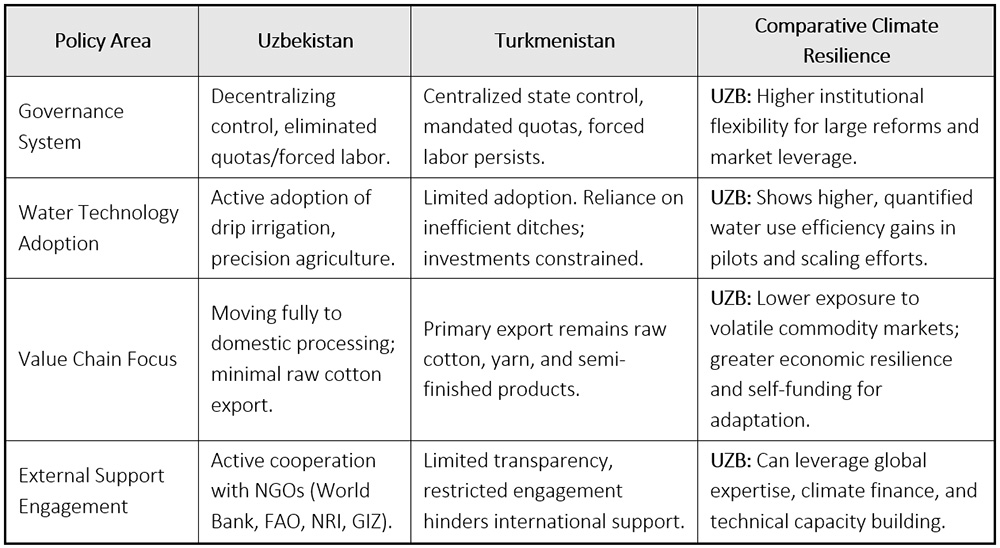
The institutional flexibility and commitment to modernization in Uzbekistan stand in sharp contrast to Turkmenistan, as shown in the comparative analysis below.
Table 1: Comparative Analysis of Adaptation Trajectories: Uzbekistan vs. Turkmenistan
Source: Developed by the author
Policy Recommendations
To secure Turkmen cotton’s future, a two-part strategy is needed: technical adaptation and governance reform.
Technical adaptation requires urgently modernizing irrigation with pipe, drip, and sprinkler systems, which could increase yields by up to 50%. This must be paired with accelerating research for heat- and water-tolerant cotton, and investing in drainage and salinization monitoring to manage soil.
These technical fixes are not sustainable without political change. The most critical governance reform is the abolition of the state cotton quota and centralized control. Introducing market signals and free trade would incentivize water efficiency, diversification, and proper maintenance of new technology. Essential external reforms include strengthening diplomatic agreements for transparent Amu Darya water sharing and eliminating forced labor, which is vital for unlocking international climate finance and partnerships.
The long-term strategy for resilience is agricultural diversification away from cotton into less water-intensive crops, and value addition by consolidating farming, processing, and textile manufacturing (like the Uzbek model). This reduces market volatility, retains economic value, and provides the capital for continuous reinvestment in modernization and research.