
At a recent event hosted by the Davis Center for Russian and Eurasian Studies at Harvard University, scholars examined how Central Asia’s armed forces have evolved more than three decades after independence. The discussion drew on a comparative research project by Michael Hilliard of the Oxus Society for Central Asian Affairs and Andrew Gundal, analyzing military structures, budgets, doctrines, and external partnerships across the five Central Asian countries. Chapters on Uzbekistan and Tajikistan, are already published and freely available, while the chapter on Turkmenistan is forthcoming. Among the five cases, Turkmenistan emerges as the most unusual and opaque.
Turkmenistan was described during the panel as the oddest of the five Central Asian states: one of the most isolationist countries in the world, combining extreme political repression with rigid state control. Its policy of “permanent neutrality” was introduced under President Saparmurat Niyazov, initially with the ambition that Turkmenistan might serve as a neutral venue for regional conflict resolution. In the 1990s, Ashgabat briefly hosted negotiations related to the Tajikistan and Afghanistan civil wars.
Beyond these early moments, however, neutrality did not evolve into sustained diplomatic mediation. Instead, it became the ideological foundation for a broader strategy of self-imposed isolation. Under both Niyazov and Gurbanguly Berdimuhamedov, neutrality was used to justify limiting international engagement, avoiding regional organizations, and restricting foreign political and security ties. Critics argue that this approach has constrained economic development and excluded Turkmenistan from meaningful regional security frameworks. Meanwhile, the leadership in Ashgabat likely sees neutrality as a shield that has preserved its political independence and insulated the country from regional instability.
From a military perspective, neutrality has meant no foreign military bases, no permanent foreign personnel, and no binding multilateral defense commitments. Cooperation with Russia declined sharply after the Russian–Turkmen troop cooperation agreement was discontinued in 1999, reinforcing Turkmenistan’s inward-facing defense posture.
Infrastructure, Geography, and Structural Vulnerabilities
One of the most striking findings highlighted in the presentation concerns Turkmenistan’s infrastructure and logistics, which remain heavily shaped by Soviet-era planning.
Picture 1. The Rail System in Turkmenistan
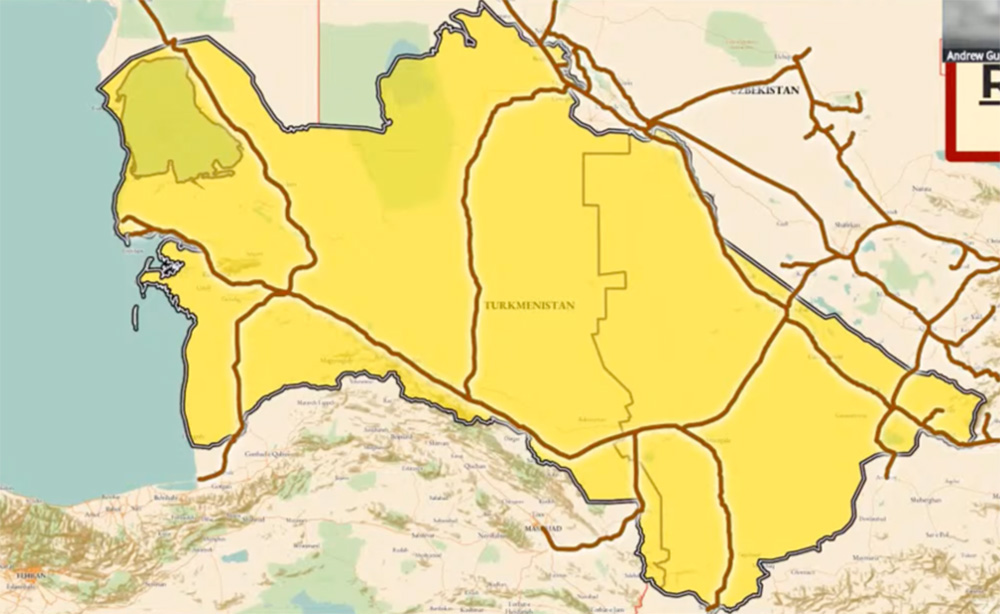
The country’s rail system still relies largely on Soviet-built infrastructure, rolling stock, and signaling technology. While some procurement has taken place from Russia and China, much of the system remains outdated and inefficient. Although Turkmenistan has rail connections to neighboring states, only about a quarter of freight volume crosses borders, with the majority of trade still conducted by road.
The M37 highway, which runs east–west across the country, is the backbone of national transport and military mobility. Originally designed during the Soviet period with a defensive focus on Iran, its strategic emphasis shifted after independence toward border security with Afghanistan. Yet infrastructure development along the Afghan border has lagged far behind what exists near Iran. Most military bases are clustered along the M37, while eastern regions remain underdeveloped and weakly connected.
Picture 2. The M37 Highway in Turkmenistan that Crosses the Entire Country
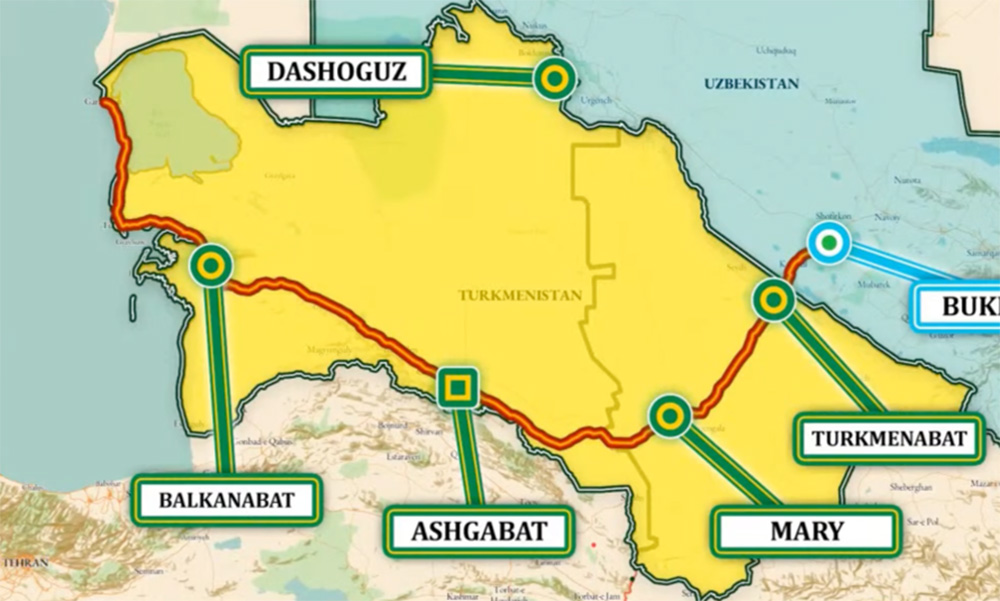
The result is a linear infrastructure system with minimal redundancy. Analysts involved in the project emphasized that if a single major node or city were disrupted, large parts of the country could be effectively cut off. In most states, such a vulnerability would be treated as a national security priority. In Turkmenistan, it remains largely unaddressed.
Economic Concentration and Strategic Risk
Turkmenistan’s economic structure mirrors these infrastructural weaknesses. Approximately 92.2 percent of exports come from natural gas, with China as the dominant destination. All gas exports flow through three parallel pipelines, with plans for a fourth, also directed toward China.
This lack of diversification creates acute strategic risk. Any disruption to pipeline infrastructure, deterioration in relations with Beijing, or shift in global gas markets could rapidly undermine state revenues. China’s dominant position also gives it significant leverage over pricing, leaving Turkmenistan economically exposed despite its vast energy reserves.
Picture 3. Turkmenistan’s Exports in 2018 – 2024
Donate to support Turkmen analysts, researchers and writers to produce factual, constructive and progressive content in their efforts to educate the public of Turkmenistan.
SUPPORT OUR WORK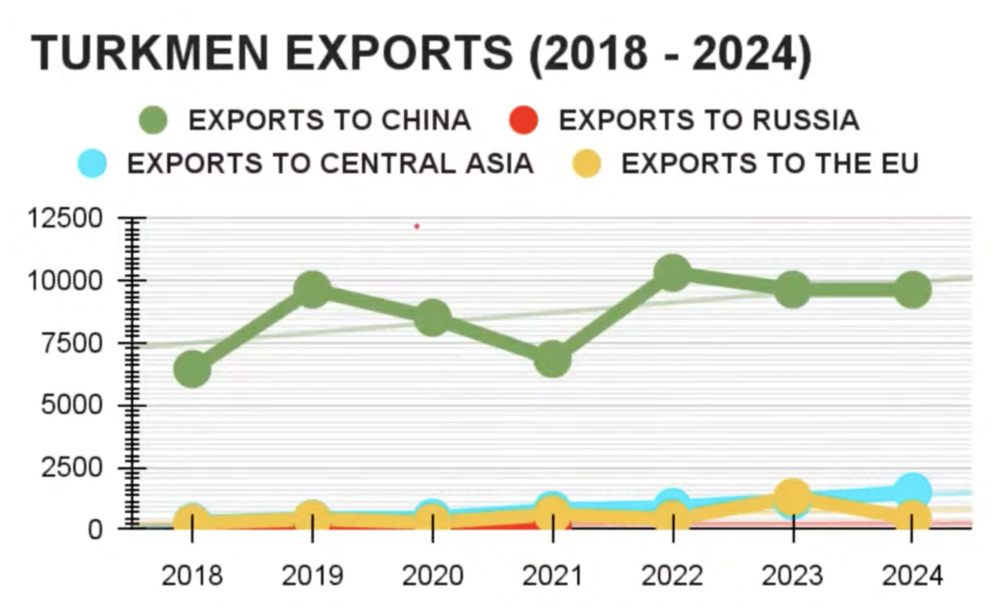
A Fragmented Military by Design
Despite the economic and infrastructural centralization of the state, Turkmenistan’s military command structure is deliberately fragmented. Power is divided among multiple institutions and departments to prevent any single force from becoming strong enough to challenge the ruling elite. The ruling regime likely prefers competition among units rather than efficiency or joint capability.
Picture 4. The Command Structure of Turkmenistan’s Military
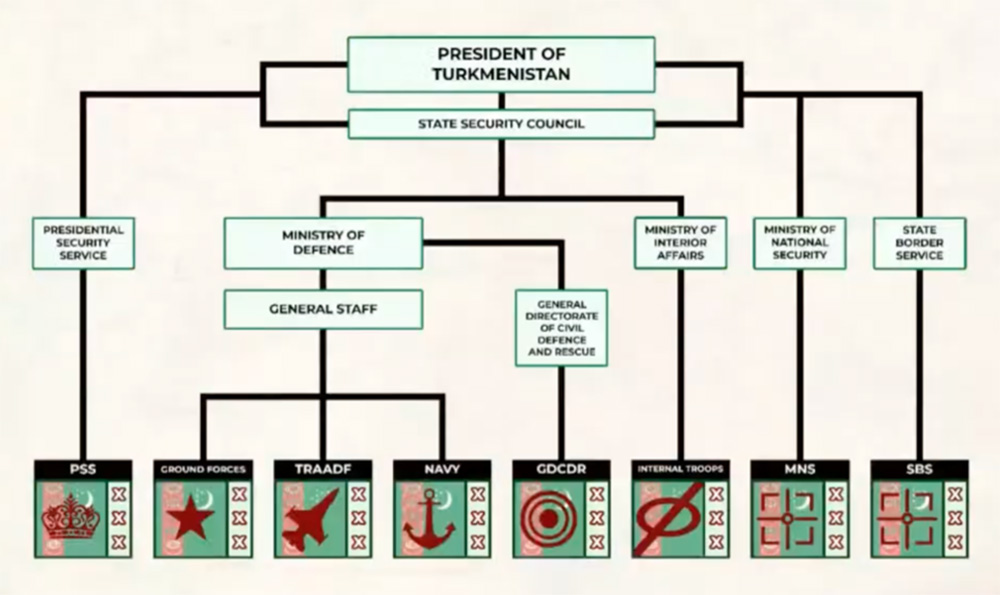
The National Guard, unusually, is integrated into the ground forces rather than operating as a separate internal security institution. This further blurs the line between conventional military roles and regime protection.
Threat Perceptions and Force Priorities
According to the research, Turkmenistan’s military planning revolves around three perceived threat areas: Afghanistan, domestic unrest, and the Caspian Sea.
Along the Afghan border, Turkmenistan has established numerous outposts and positions, reflecting long-standing concerns over instability and the potential presence of groups such as ISKP in northern Afghanistan. Yet upkeep is poor. Many border posts lack reliable internet, adequate infrastructure, or sufficient personnel. In some cases, mannequins reportedly stand in for soldiers, underscoring chronic manpower and resource shortages. Despite these vulnerabilities, defense spending is often directed toward highly visible military parades rather than operational readiness. For example, border forces in Turkmenistan account for only 8% of the total forces, the second smallest share in Central Asia after Uzbekistan (6.64%).
- Kyrgyzstan – 23.53%
- Tajikistan – 13.81%
- Kazakhstan – 12.41%
- Turkmenistan – 8%
- Uzbekistan – 6.64%
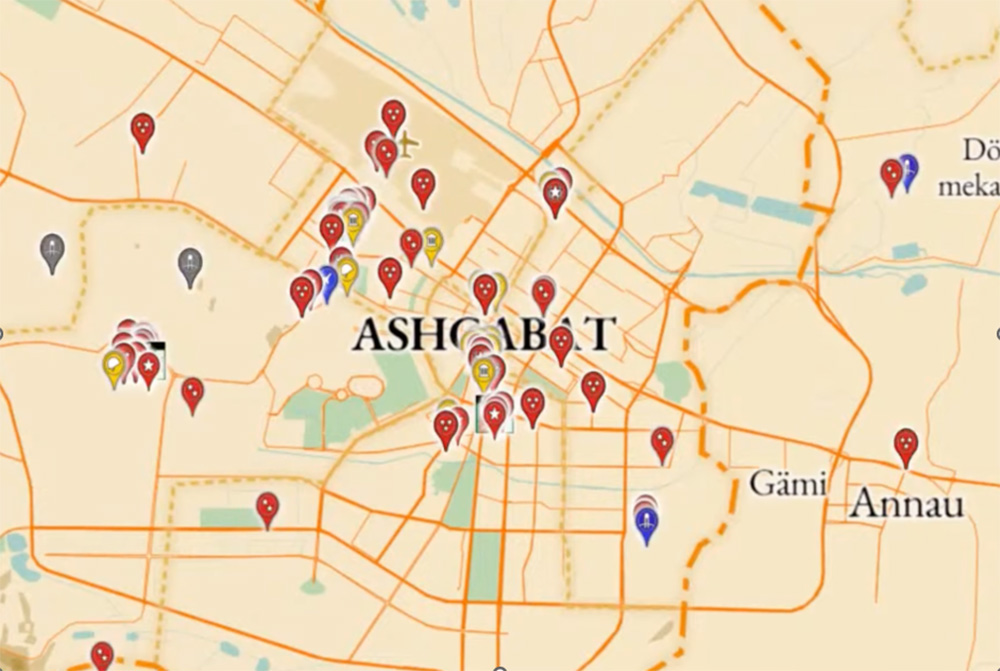
By contrast, the state invests heavily in forces tasked with preventing domestic insurrection. Ashgabat is ringed by well-equipped bases and internal security units designed to respond rapidly to any sign of unrest. While border forces struggle with limited stockpiles and capacity, internal troops are comparatively well armed and prepared, reflecting the regime’s overriding priority: internal stability.
Picture 5. The Military Bases and Forces Stationed Around Ashgabat
The navy is a notable exception to the otherwise underfunded and outdated force structure. Built largely from scratch since 2010, Turkmenistan’s Caspian naval forces have modernized quickly, supported by joint ventures with Turkish defense manufacturers. Analysts noted that the scale of investment is striking given the country’s broader military weaknesses. Possible explanations include the protection of offshore oil infrastructure, securing Caspian trade routes, or using the navy as a showcase of modernization.
Training, Regional Engagement, and Future Trajectories
Turkmenistan conducts very limited cross-border military training. When such training occurs, it is typically restricted to the same trusted units, often elements of the 152nd unit or loyal Interior Ministry forces. These select troops receive exposure to modern tactics and weapons handling, while the rest of the military remains isolated, limiting overall institutional learning.
A small number of special forces and security personnel continue to train with Russia. Recent meetings of the five Central Asian defense ministers in Samarkand may signal a modest shift toward greater regional engagement, but for now Turkmenistan remains the least integrated militarily among its neighbors.
Overall, the research presented by Hilliard and Gundal portrays Turkmenistan as a state where neutrality has evolved into isolation, economic concentration into vulnerability, and military planning into a system optimized more for regime survival than external defense. While the broader project highlights diverse trajectories across Central Asia, Turkmenistan’s case stands apart for its contradictions: centralized wealth alongside fragmented command, modern naval assets alongside neglected border forces, and heavy securitization of the capital amid infrastructural fragility elsewhere.