The physical infrastructure alone is insufficient to unlock the transit potential of Turkmenistan.
The report published by the Eurasian Development Bank (EDB) on the Eurasian Transport Network (ETN), which is a system of existing and planned North-South and East-West transport corridors and routes that promote Eurasia’s intra- and transcontinental connectivity in trade, situates Turkmenistan as a strategically significant but underutilised due to infrastructure barriers within emerging Eurasian transport connectivity.
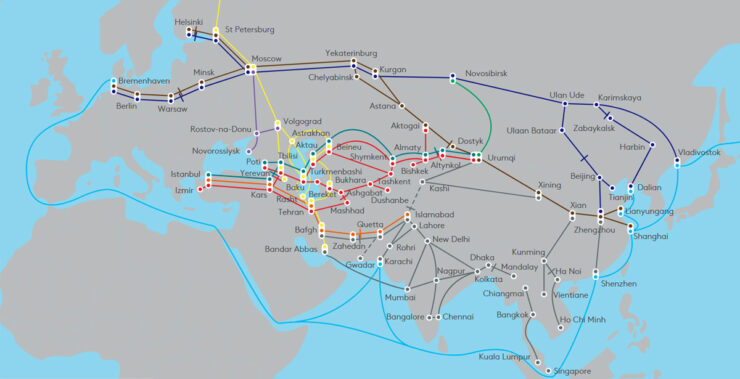
The report highlights that the Eurasian Transport Network will be a game-changer for all Central Asian countries, transforming them from landlocked to land-linked and creating a busy transport hub in Central Asia. The countries will benefit from reduced transport costs, faster delivery of goods, and a 5% increase in mutual trade. To facilitate these aims, EDB has developed and implemented diverse infrastructure projects such a: the Northern Eurasian Corridor is the main land route linking Europe and Asia through Russia; the Central Eurasian Corridor is the shortest route between China, the Eurasian Economic Union (EAEU), and Western Europe; the the Transport Corridor-Caucasus-Asia (TRACECA) corridor, including the Trans-Caspian International Transport Route (Middle Corridor), links Central Asia with the South Caucasus, Türkiye, and Europe; the International North–South Transport Corridor (INSTC) connects Russia and Central Asia with the Persian Gulf and South Asia and lastly the Southern Eurasian Corridor links Türkiye, Iran, and Pakistan through road transport, but remains incomplete and underdeveloped. A detailed overview of completed and prospective initiatives and projects can be observed below.
However, to further increase the capacity and growth in international transport of the Eurasian transport, creation of new meridional corridors such as the Trans-Afghan Transport Corridor between Uzbekistan, Afghanistan, the China–Kyrgyzstan–Uzbekistan transport corridor, the Meridian Highway, the Tajikistan–Afghanistan–Turkmenistan (TAT) transport corridor, new Russia–China transport corridors in Eastern Siberia and the Russia–Mongolia–China (XUAR) corridors in Western Siberia will be critical for future connectivity.
Turkmenistan
Turkmenistan, as a landlocked Central Asian country with direct access to the Caspian Sea, holds transit potential linking East–West and North–South transport axes. Since 2023, Turkmenistan has been a participant in the Transport Corridor-Caucasus-Asia (TRACECA) corridor, which spans rail and road networks and connects to other Eurasian transport corridors. This corridor contributed immensely to Turkmenistan’s trade growth in 2022, with foreign trade rising by 151% compared to 2021.
Within the International North–South Transport Corridor (INSTC), the TurkmenistanCaspian port in the city of Turkmenbashi connects several rail and road border crossings with Iran, serving as a transit link for trade between Russia, Central Asia, and Iran and onward to the Persian Gulf on the eastern route. This route is mainly rail-based and used to transport all types of goods, while cargo is delivered by road. Total freight traffic on the east route reached 1.1 million tons in 2023, a63% increase since 2021. In this corridor, the largest share of freight transport in 2023 was wood products (28%), followed by grain (20%) and chemicals (5%) from Russia to Turkmenistan, Iran, and Afghanistan.
Railway connections to Turkmenistan, both operational and under construction.
Donate to support Turkmen analysts, researchers and writers to produce factual, constructive and progressive content in their efforts to educate the public of Turkmenistan.
SUPPORT OUR WORK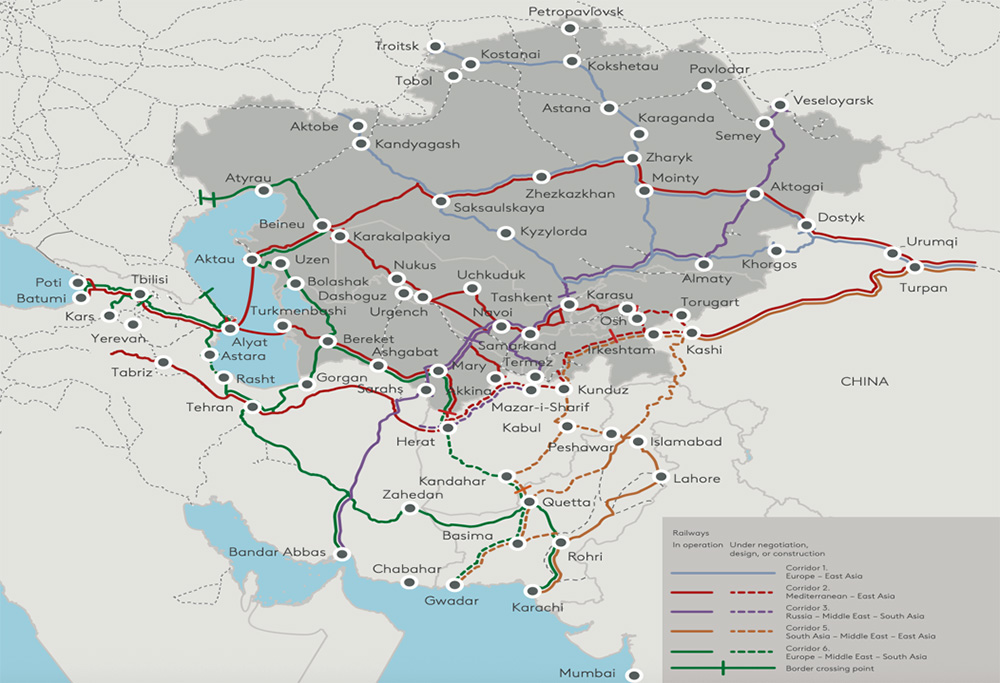
Source: The Eurasian Development Bank, 2024.
The report further emphasizes that the Tajikistan–Afghanistan–Turkmenistan (TAT) railway, a planned North–South corridor linking Dushanbe, northern Afghanistan, and Ashgabat, was signed in 2013 and is intended to strengthen connectivity between Central Asia and South Asia. To date, construction of 150 km of the Atamyrat–Imamnazar (Turkmenistan)-Akina (Afghanistan) section of the TAT Project has been completed. In comparison, no work has been reported in the 450 km-long section in Afghanistan or in the 50 km section in Tajikistan.
Despite the trade, economic, and social advantages of the ETN, the report is clear that physical infrastructure alone is insufficient to unlock the transit potential of Central Asian countries, including Turkmenistan. In addition, due to funding constraints in national budgets, the TRACECA and INSTC projects have relied on loans and grants from international development banks, and the focus remains on construction, with sustainability overlooked. Therefore, the report notes that countries in the region should prioritise harmonising transport regulations and simplifying border-crossing procedures, as well as promoting the digital transformation of transport and transit in parallel to the development of the transport infrastructure.
The report identifies several critical infrastructure bottlenecks that limit Turkmenistan’s transit potential within the Eurasian Transport Network and provides the following recommendations.
TRACECA: Construction of second tracks and electrification of the Turkmenabat–Ashgabat–Turkmenbashi line are required, as it is the single-track diesel-powered rail line with throughput capacity in terms of container traffic limited to 31,000 TEU, despite the fact that the container terminals of the new commercial seaport of Turkmenbashi are capable of handling 250,000 TEU.
INSTC: There is a need to introduce modern technologies for handling goods and rearranging containers at the Sarakhs and Akyaila border stations (Turkmenistan) that slow freight flow, as well as to implement the Ashgabat–Mary (Turkmenistan) Railroad Electrification Project, which can contribute to further development of transport and logistics routes along the INSTC and better integrate Turkmenistan into Eurasian transit corridors.