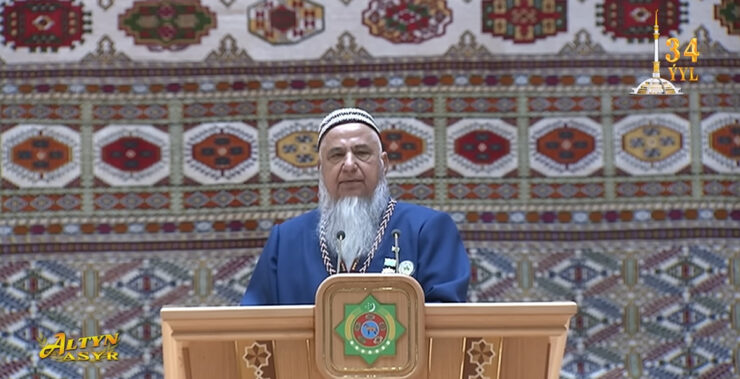
At a meeting of People’s Council on September 19, 2025, Yazmyrat Atamyradov, a member of the People’s Council of Turkmenistan (Halk Maslahaty), proposed to terminate the long-standing policy of annually increasing public sector wages, pensions, and social assistance payments by 10%. He justified the proposal by claiming that “the living conditions of the people have reached a high level” and that “our people live a peaceful, prosperous, and happy life” and adding that “there are no other countries in the world that provide such benefits for people”. He suggested that saved funds should be directed to “further develop the country”. Nevertheless, the stress of announcing this proposal made his mouth go dry at the word “pension”. It is not surprising given that in Turkmenistan, older people receive the lowest pension in Central Asia.
This proposal signals the end of the major annual ritual. The decision is typically announced in July, but authorities failed to announce the measure this summer. As of December 18, 2025, no official reaction or explanation has been provided by the government, creating ambiguity and a space for speculations among the public. Meanwhile, the recently approved 2026 budget law still lists “wages, pensions, state benefits and scholarships” as protected (article 6).
Progres team has analyzed – what is annual indexation or adjustment, why governments implement it and what happens if it ceases to exist.
What is Indexation and Why does it Matter?
Indexation of salaries and pensions is a common global practice where governments adjust incomes to reflect inflation. The core purpose is to preserve purchasing power and prevent the erosion of living standards caused by rising prices. International bodies stress the necessity of indexation. The ILO warns that rising inflation without wage adjustments leads to a significant decline in real wages, threatening poverty, inequality, and social unrest. The OECD views pension indexation as a crucial protection against inflation and poverty among the elderly, essential for upholding purchasing power and a stable standard of living.
The Consumer Price Index (CPI), which tracks the average cost of common goods and services, is the standard tool used to determine these adjustments. While Turkmenistan collects CPI data, its reliability is questionable. For example, the World Bank has not published the economic output, income, or growth data for Turkmenistan since 2020 “due to a lack of reliable data of adequate quality”. Similarly, the IMF developed a case study using Turkmenistan to demonstrate and highlight that the national accounts statistics are subject to serious shortcomings in Turkmenistan, which are often manifested as overestimated growth rates.
Despite this data ambiguity, the CPI for Turkmenistan from 2000–2024 averaged 7.3%. However, during years like 2018 (13.2%), 2021 (19.5%), and 2022 (11.2%), price increases exceeded the fixed 10% raise, indicating a loss of consumer purchasing power. For 2025, the ADB and IMF predicted 4% inflation. Meanwhile, the independent Palaw Index (PI) recorded an average 14.5% rise in prices between January and November 2025. This suggests that food prices are growing faster than wages, eroding purchasing power of consumers in Turkmenistan. This situation is further exacerbated given that over 50% of Turkmen household income goes toward food (UN). In the absence of a reform agenda, removing the annual 10% increase, is therefore expected to further impoverish the population and drive migration.
Figure 1. Consumer Price Index for Turkmenistan, 2000–2024
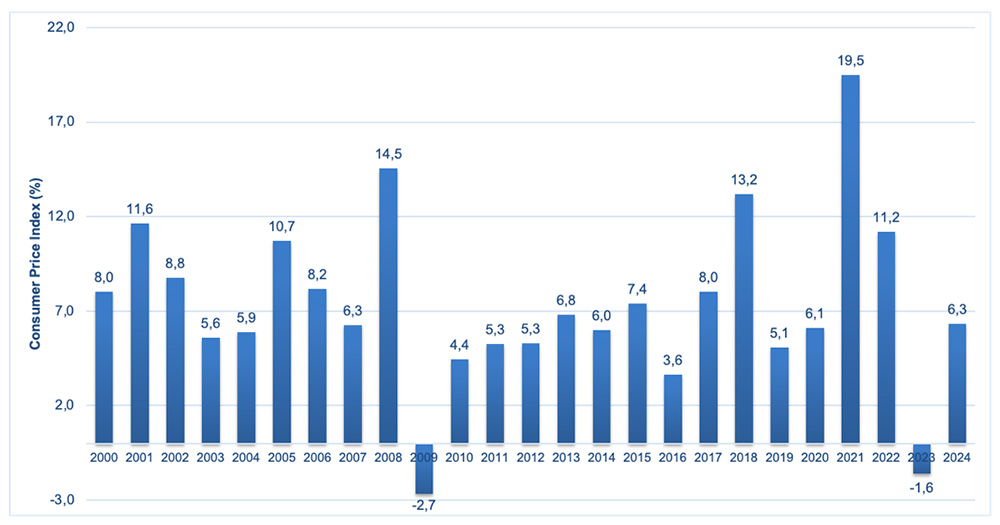
Source: Asian Development Bank
The Dual Exchange Rate
The purchasing power of Turkmens is further eroded by the dual exchange rate. The official rate has been fixed at 3.5 manat to 1 USD since 2015, while the black-market rate had drastic swings in the last couple of years reaching as high as 37.8 manat in April 2021 (10 times more expensive). This has a devastating impact on living standards and opportunities in the country. Therefore, in addition to accurately tracking the annual CPI changes, the government should also take into account the dual exchange rate and its devastating impact on the purchasing power and living standards of its people.
Regional Contrast
Furthermore, to debunk the statement made by Yazmyrat Atamyradov, a member of the People’s Council (Halk Maslahaty), Turkmenistan has the second lowest median daily income in Central Asia. Turkmenistan is not the only country providing an annual increase in salaries and pensions. Indexation is practiced globally, and other Central Asian governments not only continue the practice but often aim for higher adjustments:
- Tajikistan increased salary, pension and benefit payments by 10% (Sept 2025).
- Kyrgyzstan increased pensions after indexation (Sept 2025).
- Kazakhstan will increase pensions and social benefits by 10.5% (Jan 2026).
- Uzbekistan is implementing a strategy to make annual indexation exceed the inflation rate.
The Breakdown of Turkmenistan’s Soviet – Era Social Contract
Donate to support Turkmen analysts, researchers and writers to produce factual, constructive and progressive content in their efforts to educate the public of Turkmenistan.
SUPPORT OUR WORKTurkmenistan’s economy remains centrally planned and it has failed to transition to a market economy (EBRD). The wage structure is a relic of Soviet practices, designed to incentivize labor in the public sector through a combination of money wages, bonuses, and “social wages” like subsidized healthcare and education.
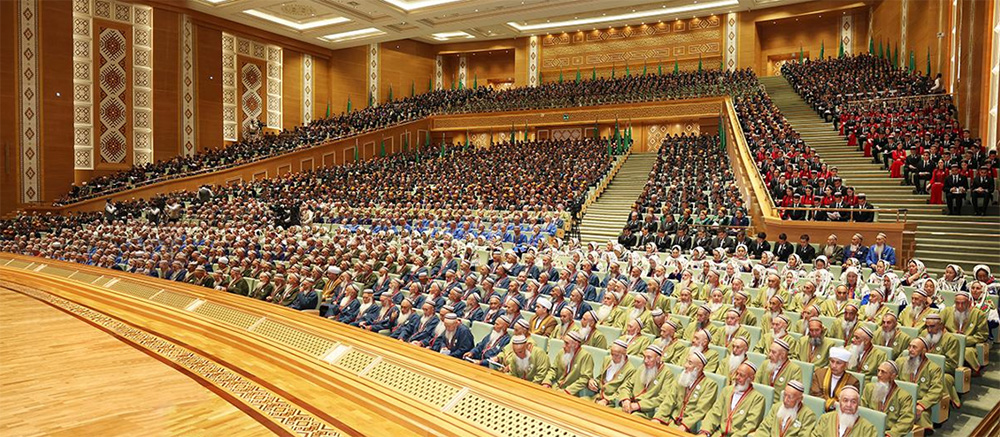
Source: People’s Council, September 19, 2025.
Today, this system is broken: the “carrot” (bonuses, subsidized services) is largely gone, but the “stick” (penalties for failing quotas) persists across all sectors, including healthcare and education. Wage equality has vanished, resulting in no meaningful pay difference between manual laborers and white-collar workers like teachers and doctors.
An average working Turkmen has been offered virtually nothing. All state-provided services, including free healthcare, education, and subsidized housing or food are gone. Education and healthcare are free on paper but not in practice due to high levels of corruption. The minimum wage (1,410 manat or ∼$70) and pension (550 manat or ∼$28) are already set below the poverty line. Turkmenistan neither measures nor reports the national poverty line although the United Nations’ committees have recommended this on numerous occasions and reports. Many citizens supplement their income through remittances and informal work. As shared by Turkmenportal, one of the ways to increase people’s purchasing power is by increasing the minimum wage. Interestingly, this news appeared two days before the meeting on September 17, 2025.
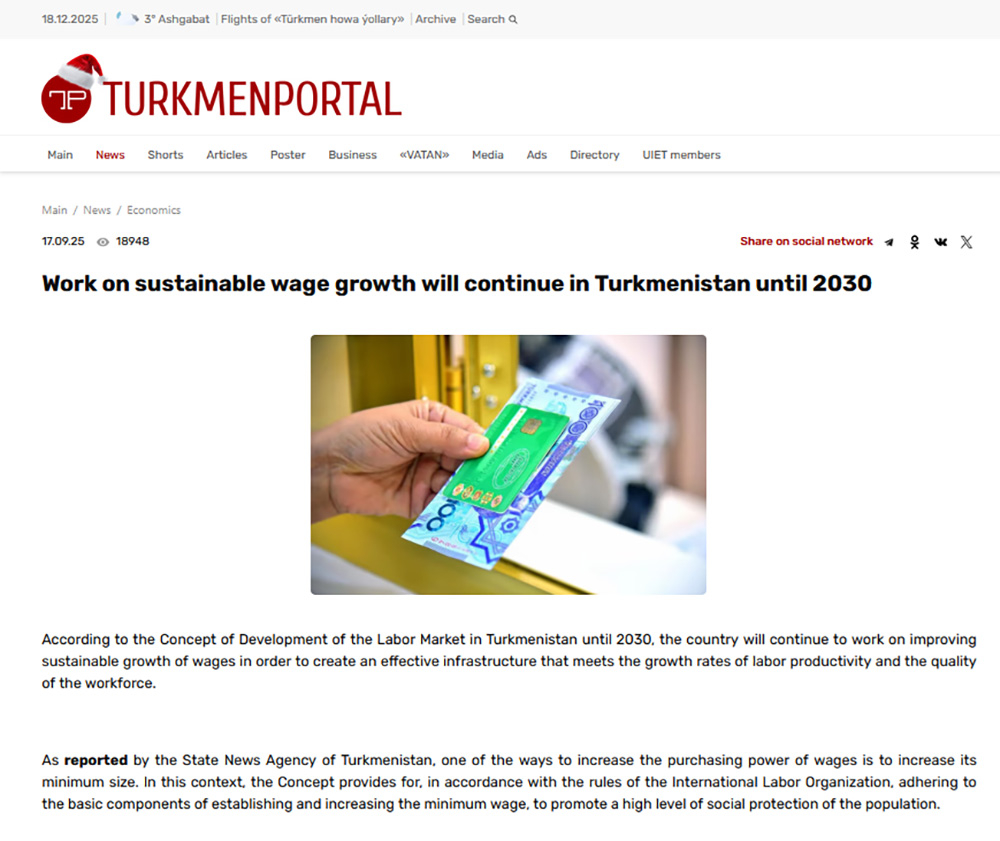
Source: Turkmenportal, September 17, 2025.
In addition, Turkmenistan’s economic model is characterized by high income inequality, limited opportunities, intellectual and financial isolation, and a struggling private sector despite its resource wealth in natural gas and oil. Pervasive state-control limits economic diversification, employment opportunities, and has resulted in corruption and government mismanagement, affecting the overall quality of life for its citizens.
Independent sources report that at various public institutions employees are coerced to make illegal contributions to “maintain public infrastructure and pay for public works”. Many working-age Turkmens leave for low-skilled jobs abroad, making remittances an unacknowledged but vital lifeline for almost every family. There are conversations and debates on social media where Turkmens ponder if sending money home enables the autocracy and never-ending economic and social restrictions.
What can the Government Offer its People in 2026?
As of December 18, 2025, the government has provided no explanation or announcement regarding the halted raise – a silence typical of an autocratic regime. This lack of reform is guaranteed to further impoverish Turkmens.
The absence of opportunities will accelerate migration and force more citizens into the informal economy and black market, where the only avenue for “creativity” remains corruption. International recommendations for publishing economic data and communicating policy logic continue to fall on autocratic, and deeply reactionary ears.
The government of Turkmenistan should seriously consider the potential negative consequences of halting the annual payment increase. If the automatic 10% annual increase is not sustainable, then the government should implement indexation linked to the annual CPI of the preceding year. However, that would require transparent and consistent CPI data from the State Statistics Committee – the one that is accurate and reliable.
Ultimately, the halting of indexation forces a critical question: If the state offers nothing – no basic social services, no economic opportunity, and now, no defense against inflation – will the existing social contract endure, and if not, what will replace it?