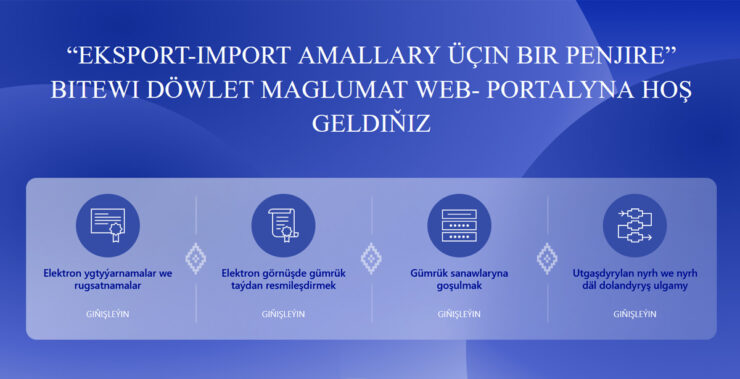
The UNDP Independent Evaluation Office assessed Turkmenistan’s Single Window for Export-Import Operations, a digital trade platform launched in 2021 to modernize customs processes through the Automated System for Customs Data. With a total budget of $3.76 million, financed by the government and implemented by the State Customs Service, the project integrated 16 ministries and 22 agencies into one platform and shifted trade procedures from paper-based workflows to electronic processing aligned with WTO standards.
By July 2024, around 5,000 foreign economic participants had registered and more than 20,000 electronic applications were processed. Core modules reached 100% functionality, including online contract registration and electronic phytosanitary and veterinary certificates, contributing to reduced administrative burden and faster processing.
Despite these achievements, the platform has not reached full digital maturity due to significant legal, technical, institutional, and inclusion gaps.
Key Shortcomings and Challenges
Donate to support Turkmen analysts, researchers and writers to produce factual, constructive and progressive content in their efforts to educate the public of Turkmenistan.
SUPPORT OUR WORK- Lack of Electronic Signature and Payment Integration: The system’s core is operational, but electronic signatures and payments remain inactive due to legislation that does not fully recognize digital trade actions. Addressing this requires high-level policy dialogue and legal reform beyond the project’s technical scope.
- Persistent Parallel Manual Processes: Because signatures and payments are not functional, traders and officials still maintain paper procedures, duplicating work and limiting efficiency gains.
- Incomplete Institutional Integration: Some smaller regulatory bodies remain outside the platform. Limited digital infrastructure, secure networks, and ICT budgets prevent full interoperability and keep the trade ecosystem fragmented.
- Inconsistent Technical Capacity and Legacy Systems: Agencies differ significantly in digital readiness. Many rely on outdated standalone systems not designed for integration. Coordinating 16 ministries and 22 agencies complicates decision-making and slows uniform adoption.
- Gaps in Private Sector Engagement: The project was largely government-driven with limited business involvement in design. Additional outreach is needed so SMEs and traders can fully use the system.
- Insufficient Focus on Social Inclusion: Gender equality and disability inclusion were not mainstreamed. No targeted measures or training were designed for women entrepreneurs or traders with disabilities, as the first phase prioritized technical deployment over inclusive design.
- Delayed Regional Connectivity: Although protocols exist with Azerbaijan and Uzbekistan, integration with Kazakhstan and Iran remains incomplete. Cross-border data exchange requires lengthy negotiations on regulation, data sharing, and security.
Meanwhile, the evaluation itself faced limitations due to Turkmenistan’s culture of privacy and guarded confidentiality, which makes individuals and institutions hesitant to provide information through formal, anonymous, or semi-anonymous digital surveys. Internet access barriers compounded this, as common platforms such as SurveyMonkey were inaccessible, restricting quantitative data collection.
The report identified reliable internet connectivity as a fundamental precondition for the Single Window’s success. Agencies must exchange information continuously to reduce processing times and improve transparency. Without stable connectivity, workflows revert to siloed manual processes. Similarly, cross-border data exchange with partners such as Azerbaijan and Uzbekistan requires stable international connectivity. Hence, the platform’s effectiveness depends not only on software and institutional coordination but on consistent, accessible internet as the infrastructure enabling digital trade.