The United Nations Environment Programme (UNDP) recently released the Adaptation Gap Report 2025, a comprehensive assessment of global progress in climate change adaptation and the growing financial requirements to meet these challenges. The report is important for all countries, but especially for regions such as Central Asia, a region with increasing water scarcity and temperature extremes. However, Turkmenistan still lacks a National Adaptation Plan (NAP) and is yet to submit its Biennial Transparency Reports (BTRs).
Regional Progress and Financial Requirements
The report places an emphasis on the Biennial Transparency Reports (BTRs), which became a mandatory requirement for parties to the Paris Agreement starting from December 2024. These reports are to be submitted every two years and are essential for tracking national progress on climate commitments. While a total of 105 countries have submitted their BTRs, including Azerbaijan, Kazakhstan, Tajikistan, and Uzbekistan, Turkmenistan has not yet fulfilled its reporting obligation.
A similar trend is observed in the development of National Adaptation Plans (NAPs). These documents serve as a framework for countries to outline medium and long-term strategies to address climate risks. Currently, 172 out of 197 countries to the UNFCCC have established such plans or policies. However, Turkmenistan remains among the minority of nations that have not yet finalized and published an official NAP.
Donate to support Turkmen analysts, researchers and writers to produce factual, constructive and progressive content in their efforts to educate the public of Turkmenistan.
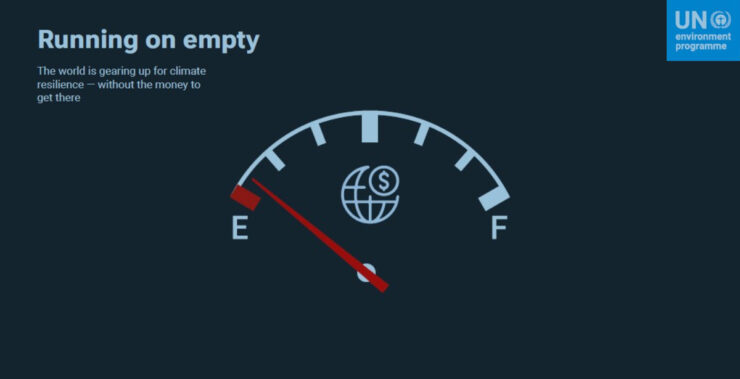
SUPPORT OUR WORKAdditionally, the 2025 report highlights that the cost of adapting to climate change is increasing globally. For the region of Europe and Central Asia, that includes all Central Asian states, several countries in the Caucasus, and Balkan counties, the annual adaptation finance need is estimated at US$51 billion. Approximately 50% of the required funding needs to be directed toward the agriculture and food sectors in this region, followed by water supply management, disaster response, and others.
The National Adaptation Planning Process in Turkmenistan
To address this policy gap, Turkmenistan has been collaborating with the UNDP on a project titled “Developing a National Adaptation Planning Process in Turkmenistan”. Funded by the Green Climate Fund, the project aims to strengthen institutional frameworks and evidence-based decision-making. A review of the project’s documentation reveals several inconsistencies regarding its timeline, budget, and results:
- Data availability: Despite the project’s reported completion, the most recent outputs available on the UNDP Turkmenistan website date back to 2021-2022. However, there is a final project progress report available which lists the outputs and refers to various documents, including the Roadmap of the Adaptation Components of the 2022 NDCs, Institutional Guidance document, the NAP Roadmap, and the draft Adaptation component for NDC 3.0. The provided links were not accessible. Only two research reports/outputs of this project are publicly available: the report on climate change risks for water and agriculture in Ashgabat and Dashoguz regions, earlier covered by the Progres team, and another report on local adaptation practices in water and agriculture in Turkmenistan.
- Timeline discrepancies: The official UNDP website lists the project status as “completed” with a duration spanning from May 2021 to July 2025. However, the final project progress report indicates the project conclusion as April 2024. This lack of clarity regarding the project’s end date complicates the assessment of the final deliverables.
- Budget discrepancies: Financial reporting for the project varies significantly across different sources. While the original Green Climate Fund proposal estimated the budget at US$2.3 million on the UNDP website, another UNDP website records a budget of US$1.8 million. Furthermore, the final progress report cites an available budget of US$1.6 million, with US$1.5 million used by the project’s end date.